
Station to Station (1976) – The Story Behind the Album Cover
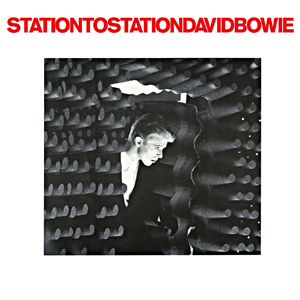
Image: David Bowie World collection / editorial use
Released in January 1976, Station to Station stands at a fascinating crossroads in David Bowie’s career. The album marked the final appearance of the Thin White Duke, the end of Bowie’s intense Los Angeles period and the beginning of the artistic journey that would eventually lead him to Berlin.
Its cover is deceptively simple. Rather than commissioning a glamorous new photo session, Bowie chose a still image from Nicolas Roeg’s film The Man Who Fell To Earth. The result became one of the most mysterious and symbolic album sleeves of the 1970s.
- Album: Station to Station
- Released: 23 January 1976
- Cover image: Film still from The Man Who Fell To Earth
- Film director: Nicolas Roeg
- Character shown: Thomas Jerome Newton
- Visual era: Thin White Duke
- Label: RCA Records
- Photographic source: Production still from the film
The Birth of the Thin White Duke
Although the Thin White Duke is never explicitly named on the album cover, Station to Station is the record most closely associated with Bowie’s final great 1970s character.
Tall, elegant, emotionally distant and dressed in black waistcoats and white shirts, the Duke became Bowie’s stage persona throughout 1975 and 1976.
The stark black-and-white cover perfectly reflected that image. Unlike the colourful glamour of Aladdin Sane or the theatrical chaos of Diamond Dogs, the sleeve projected cold sophistication and mystery.
The Man Who Fell To Earth Connection

Image: David Bowie World collection / editorial use
The cover image was not created specifically for the album. Instead, Bowie selected a still from Nicolas Roeg’s science-fiction film The Man Who Fell To Earth, in which he played the alien Thomas Jerome Newton.
The role became deeply connected to Bowie’s public image at the time. Audiences often struggled to separate Bowie, Newton and the Thin White Duke from one another.
That overlap between reality, performance and fiction helped make the album cover especially powerful.
The Teleportation Chamber Scene
The image used on the sleeve shows Thomas Jerome Newton entering a futuristic device often described as a teleportation chamber.
The still captures a moment of transition, movement and transformation — themes that fit remarkably well with the music contained on the album.
Looking back, the image almost feels prophetic. Bowie himself was about to leave Los Angeles behind and begin a new phase of artistic reinvention in Europe.
Why Bowie Chose a Film Still
Most major artists would have commissioned an entirely new photo shoot. Bowie chose something different.
By using a frame from the film, he blurred the boundaries between cinema, music and performance art. The sleeve became an extension of the strange world created in The Man Who Fell To Earth.
The decision also reinforced the feeling that Bowie himself was becoming increasingly difficult to define. Was he David Bowie, Thomas Jerome Newton or the Thin White Duke? The cover deliberately offers no clear answer.
A Cover About Transformation
Transformation had always been one of Bowie’s central artistic themes.
On earlier albums he transformed through costumes and make-up. On Station to Station, transformation became psychological.
The cover image suggests movement between worlds, identities and realities. It is one of Bowie’s most symbolic sleeve designs despite its apparent simplicity.
The Dark Printing Mystery
One curious aspect of the original album concerns the printing of the cover itself.
Many early pressings appeared much darker than intended, making details within the image difficult to see.
Later reissues reproduced the original film still more clearly, revealing significantly more detail than many listeners had ever noticed on the original 1976 release.
The Original Back Cover
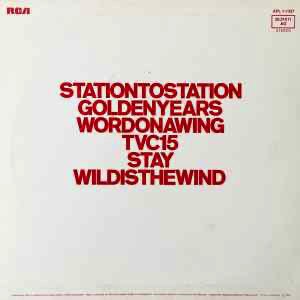
Image: David Bowie World collection / editorial use
The back cover continued the minimalist visual approach of the front sleeve.
Rather than distracting from the central image, the design focused primarily on typography, credits and track information. The restraint suited the atmosphere of the album perfectly.
Like the music itself, the packaging feels controlled, elegant and almost clinical in its presentation.
The End of an Era
Today, Station to Station is often viewed as the closing chapter of Bowie’s American period.
The soul influences of Young Americans were still present, but new European ideas were beginning to emerge. Krautrock, electronic experimentation and artistic minimalism were already appearing beneath the surface.
The cover reflects that moment perfectly: one foot in Hollywood, the other pointing toward Berlin.
One of Bowie’s Most Mysterious Covers
Unlike many famous Bowie sleeves, Station to Station does not rely on colourful design, elaborate costumes or dramatic make-up.
Its power comes from ambiguity.
The image invites interpretation without ever fully explaining itself. That quality has helped make it one of the most admired album covers in Bowie’s catalogue.
Legacy
The Station to Station sleeve remains one of the defining visual documents of Bowie’s mid-1970s transformation.
It captures the artist at a moment when cinema, music and personal mythology merged into a single image. The photograph shows a fictional alien entering a machine, yet it also symbolises Bowie himself moving toward another reinvention.
Few album covers have expressed transition so effectively. It is the perfect visual companion to one of Bowie’s greatest records.
Article origin
This page was created using historically verified information surrounding the creation of the Station to Station album cover, production material from The Man Who Fell To Earth, documented Bowie interviews, RCA artwork history and research into the Thin White Duke era.
Additional historical context was drawn from film-production records, contemporary reviews, Bowie archive material and documented studies of the visual relationship between Thomas Jerome Newton and the Thin White Duke persona.