
Aladdin Sane (1973) – The Story Behind the Album Cover
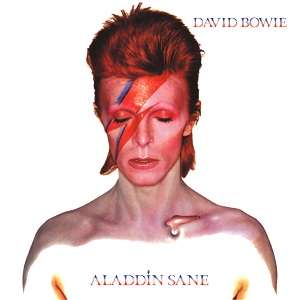
Image: David Bowie World collection / editorial use
Aladdin Sane features one of the most famous album covers ever created. The image of David Bowie with a red and blue lightning bolt painted across his face became far more than an album sleeve — it became one of the defining visual symbols of popular music.
Photographed by Brian Duffy in 1973, the cover captured Bowie at the height of his glam-rock fame while also revealing a darker and more fractured identity beneath the Ziggy Stardust image.
- Album: Aladdin Sane
- Released: 13 April 1973
- Photographer: Brian Duffy
- Make-up artist: Pierre La Roche
- Cover concept: Split identity / fractured fame
- Famous feature: The lightning bolt
- Studio: Duffy’s London studio
The image that became Bowie
Few album covers have become as culturally recognisable as the sleeve for Aladdin Sane. Even people unfamiliar with David Bowie’s music often immediately recognise the lightning bolt image.
Ironically, the photograph was never intended to become a permanent logo or symbol. It was originally created specifically for the Aladdin Sane album and represented a particular moment in Bowie’s artistic evolution.
Over time, however, the image escaped the album itself and became inseparable from Bowie’s public identity.
From Ziggy Stardust to Aladdin Sane
The album followed the enormous success of The Rise and Fall of Ziggy Stardust and the Spiders from Mars. By 1973, Bowie had become internationally famous, but the pressure of touring, media attention and constant reinvention was beginning to affect him personally and creatively.
The title Aladdin Sane itself has often been interpreted as a play on the words “A Lad Insane”.
The cover reflected that unstable atmosphere. Bowie no longer appears as the playful Ziggy Stardust figure standing in a city street. Instead, he looks isolated, fragile and psychologically divided.
Brian Duffy and the photoshoot
The famous photograph was taken by British photographer Brian Duffy, one of the leading fashion and portrait photographers of the era.
Duffy and Bowie worked together several times during the 1970s, but the Aladdin Sane session became their most legendary collaboration.
The shoot took place in January 1973 at Duffy’s London studio. Bowie posed shirtless against a stark white background, creating an image stripped of distractions and entirely focused on expression, colour and emotion.
The lightning bolt
The red and blue lightning bolt was designed by make-up artist Pierre La Roche. Contrary to popular belief, the design was not copied from Japanese kabuki theatre or superhero comics alone, although those influences have often been suggested.
The bolt primarily functioned as a visual representation of fracture, energy and instability.
Running diagonally across Bowie’s closed eyes and face, the image suggests both glamour and damage at the same time. Bowie appears beautiful, exhausted, alien and vulnerable simultaneously.
The famous closed eyes
One of the most striking details of the sleeve is that Bowie’s eyes are closed.
Unlike most rock-star portraits, the image avoids direct connection with the viewer. Bowie appears withdrawn into himself, almost disconnected from reality.
That decision gave the cover a strangely intimate quality. Rather than looking outward toward the audience, Bowie appears trapped somewhere inside his own imagination.
The teardrop on the collarbone
Another important detail is the large silver droplet resting on Bowie’s collarbone.
The droplet was inspired partly by avant-garde beauty photography and partly by the idea of emotional collapse beneath fame and theatricality.
Although small compared to the lightning bolt, the droplet helps soften the aggression of the image and adds an almost melancholic atmosphere to the portrait.
A cover almost abandoned
During the session, hundreds of photographs were taken, but the final image was not immediately treated as obviously iconic.
Some alternative shots showed Bowie looking directly at the camera, while others experimented with slightly different lighting and make-up positioning.
The now legendary cover image eventually stood out because of its simplicity and emotional ambiguity.
The expensive colour printing problem
At the time, the Aladdin Sane sleeve became unusually expensive to print because of the delicate airbrushed colours and high photographic quality required for the final artwork.
RCA Records reportedly worried about the production costs, but Bowie insisted on maintaining the visual quality of the image.
That decision helped preserve the vivid intensity of the lightning bolt and skin tones that made the cover so striking.
More than just glam rock
Although the image became associated with glam rock, the Aladdin Sane cover goes far beyond glitter and fashion.
The photograph captures tension between performance and identity. Bowie appears simultaneously controlled and unstable, theatrical and emotionally exposed.
That complexity is one reason the image has survived long after many other glam-era visuals faded into nostalgia.
A global cultural symbol
Over the decades, the Aladdin Sane lightning bolt became one of the most reproduced images in popular culture.
The design has appeared on posters, murals, fashion collections, magazine covers and tribute artwork across the world. It eventually evolved into a universal symbol of Bowie himself.
Yet the original context is often forgotten: the image was created during a period when Bowie himself felt increasingly exhausted by fame, touring and the pressure of constantly becoming someone new.
Legacy
Today, the Aladdin Sane cover is widely regarded as one of the greatest album sleeves ever created.
Its combination of photography, make-up, colour and emotional ambiguity transformed a simple studio portrait into a permanent piece of visual culture.
The image did not merely advertise an album. It helped redefine what a rock artist could look like.
Article origin
This page was inspired by historical interviews, Brian Duffy archive material, Bowie biographies and documented information surrounding the creation of the Aladdin Sane album cover and its lasting cultural impact.