Pin Ups (1973) – The Story Behind the Album Cover
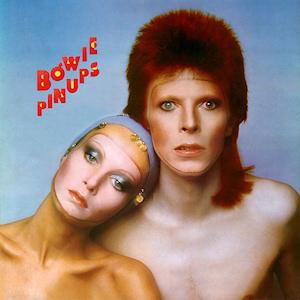
Image: David Bowie World collection / editorial use
Pin Ups has one of the most elegant and unusual album covers in David Bowie’s 1970s catalogue. Instead of presenting Bowie alone, the sleeve places him beside Twiggy, the defining face of Swinging London, in a stylised portrait originally intended for Vogue.
The result was a perfect visual match for an album built around Bowie’s favourite songs from the 1960s. The cover looked back to the decade that had shaped him, while still feeling strange, theatrical and unmistakably Bowie.
- Album: Pin Ups
- Released: 19 October 1973
- Cover models: David Bowie and Twiggy
- Front cover photograph: Justin de Villeneuve
- Make-up masks: Pierre Laroche
- Back cover photography/design: Mick Rock
- Front cover lettering: Ray Campbell
- Photo shoot: Paris, 18 July 1973
- Original purpose: Vogue fashion shoot
A cover that was not meant to be an album cover
The famous Pin Ups sleeve was not originally created for a David Bowie record. The photograph was planned as a fashion image for Vogue, pairing Bowie with Twiggy, one of the most recognisable models of the 1960s.
That origin is important. The image does not look like a conventional rock album sleeve. It looks closer to a fashion portrait: polished, controlled, artificial and beautifully strange.
Why Twiggy made perfect sense
Twiggy was not chosen at random. She was one of the defining faces of 1960s British pop culture, and Pin Ups was Bowie’s tribute to the music that had shaped him as a teenager.
Bowie had already namechecked her in Drive-In Saturday with the phrase “Twig the Wonder Kid”. Placing her on the cover of an album filled with 1960s songs created a direct visual link to the era Bowie was revisiting.
In that sense, Twiggy was not just a model on the sleeve. She represented the period itself.
Justin de Villeneuve behind the camera
The photograph was taken by Justin de Villeneuve, Twiggy’s manager and former partner. Although he was not primarily known as a conventional studio photographer in the same way as Brian Duffy or Mick Rock, he understood Twiggy’s image extremely well.
The session took place in Paris while Bowie was in France during the Pin Ups period. What began as a Vogue shoot quickly became something Bowie wanted for himself.
After seeing the result, Bowie decided the image was too strong to let go. Instead of appearing in Vogue, the photograph became the front cover of Pin Ups.
The masks by Pierre Laroche
One of the most important elements of the cover is the mask-like make-up created by Pierre Laroche, who had already worked on Bowie’s Aladdin Sane image.
Bowie and Twiggy had very different skin tones during the shoot. Twiggy was deeply tanned, while Bowie appeared extremely pale. The painted masks helped unify their faces and turned the contrast into the main visual idea.
The result is not naturalistic. It is theatrical, symmetrical and slightly unsettling. Bowie and Twiggy appear almost like two porcelain figures, both human and artificial at the same time.
The first-frame magic
According to Justin de Villeneuve, the final image worked almost immediately. The connection between Bowie and Twiggy, the make-up, the lighting and the pose came together with remarkable speed.
That sense of instant success helped the cover retain its freshness. It does not feel overworked. It feels precise, but still alive.
Vogue lost the image
The story became more dramatic because the shoot had been arranged for Vogue. Bowie’s decision to use the image for his album meant the magazine lost what could have been a remarkable fashion cover.
The decision made perfect sense for Bowie. A Vogue cover would have disappeared after one issue. An album sleeve could travel around the world and stay attached to his work forever.
Why the cover fits Pin Ups
Pin Ups is an album of cover versions: Bowie revisiting songs by artists who had influenced him in the 1960s.
The sleeve mirrors that idea visually. It presents Bowie beside a 1960s icon, but not in a nostalgic or simple way. The image is glamorous, artificial and slightly unreal, as if the 1960s have been filtered through Bowie’s 1973 imagination.
That is why the cover works so well. It is not just a portrait of Bowie and Twiggy. It is a portrait of memory, influence and pop transformation.
The back cover and Mick Rock
The back cover of the original album used photographs by Mick Rock, who was one of Bowie’s key visual collaborators during the Ziggy Stardust period.
This gave the full sleeve package a wider Bowie-world connection: Justin de Villeneuve and Twiggy on the front, Mick Rock’s Bowie imagery on the back, and Ray Campbell’s lettering helping to complete the design.
Confusion around Twiggy
Because later pressings did not always reproduce the original credit insert, some listeners failed to realise that the woman on the cover was Twiggy.
Over the years, some people even mistakenly assumed it was Angie Bowie. The original credits make clear that the front cover shows Twiggy, described in Bowie’s own playful wording as “Twig the Wonderkid”.
A fashion image turned into Bowie history
The Pin Ups cover is unusual because it began in the world of fashion but became part of rock history.
It does not show Bowie as Ziggy Stardust, Aladdin Sane or a new dramatic character. Instead, it presents him as a pop-cultural mirror: reflecting the 1960s while already moving beyond them.
Legacy
Today, the Pin Ups cover remains one of Bowie’s most beautiful and enigmatic sleeve images.
It is less aggressive than Diamond Dogs, less famous than Aladdin Sane and less mythic than Ziggy Stardust, but it has a unique elegance of its own.
The image captures a perfect meeting point between fashion, memory, celebrity and Bowie’s instinct for visual reinvention.
Article origin
This page was inspired by historical material about the Pin Ups photo shoot, Justin de Villeneuve’s recollections, Bowie archive information and documented credits from the original album artwork.