
David Bowie – Beckenham Free Festival (1969)
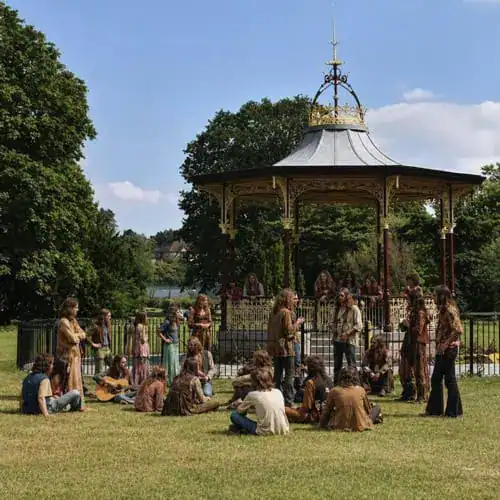
Photo: Diedrich / Wikimedia Commons / CC BY-SA 4.0 (editorial use)
On 16 August 1969, David Bowie played a central role in the Beckenham Free Festival, also known as the Growth Summer Festival, held at Croydon Road Recreation Ground in Beckenham.
The event grew out of the Beckenham Arts Lab / Growth scene at The Three Tuns and became one of the most important early milestones in Bowie’s development as organiser, performer and cultural catalyst.
The festival later inspired Memory of a Free Festival, one of the most revealing songs of Bowie’s early career.
- Event: Beckenham Free Festival / Growth Summer Festival
- Date: 16 August 1969
- Location: Croydon Road Recreation Ground, Beckenham
- Bowie’s role: Organiser, compère and performer
- Arts Lab connection: Fundraising event for the Beckenham Arts Lab / Growth
- Legacy: Inspired Memory of a Free Festival
The origins of the festival
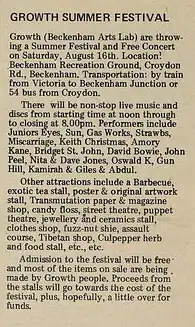
The Beckenham Free Festival grew directly out of the Beckenham Arts Lab, also known through its earlier Growth identity. Growth was the Sunday creative gathering linked to The Three Tuns pub in Beckenham, where music, poetry, mime, theatre and countercultural ideas mixed freely.
Bowie worked closely with people including Mary Finnigan to build this local creative scene. The festival was intended partly as a fundraising event to help secure a more permanent base for the Arts Lab.
The aim was to create a free, open-air gathering that reflected the ideals of the late 1960s: community, creativity, non-commercial culture and freedom of expression.
The event ran from midday until around 8pm and centred on the Edwardian bandstand in Croydon Road Recreation Ground.
Original announcement and flyer

Bowie’s role: organiser, compère and performer
David Bowie was deeply involved in the event. He helped organise it, acted as compère, introduced performers and performed his own set.
His performance was mostly solo, with occasional support from musicians including Tony Visconti. His set included material associated with the Space Oddity period, such as Space Oddity, Janine, Wild Eyed Boy from Freecloud and An Occasional Dream.
The festival shows Bowie before superstardom, already working not only as a singer-songwriter but as a cultural organiser and scene-builder.
Performers and festival atmosphere
The line-up mixed local acts, folk performers, experimental artists and more established names. Performers associated with the event included Bridget St John, The Strawbs, Keith Christmas, Comus, Amory Kane and others, reflecting the diverse and emerging nature of the Beckenham Arts Lab scene.
Composer Lionel Bart also appeared. Although John Peel was mentioned on some promotional material, he did not attend.
The festival also included stalls, food, artwork, handmade goods, jewellery, theatre, children’s activities and other informal attractions. It was not simply a concert, but a small countercultural fair.
Attendance and local impact
The festival is often described as attracting around 3,000 people, while some recollections give even higher estimates. The safest way to understand it is as a surprisingly large local success for an event organised outside the normal commercial concert circuit.
The peaceful atmosphere was important. Local officials reportedly responded positively to the event, and the festival strengthened the visibility of the Arts Lab / Growth movement in Beckenham.
Personal circumstances: a darker reality
Behind the idealistic atmosphere, Bowie was going through a painful personal period. His father, Haywood “John” Jones, had died on 5 August 1969, and the funeral had taken place only days before the festival.
Several witnesses later remembered Bowie as withdrawn, tense or difficult on the day, even though his performance itself remained professional.
This contrast between public celebration and private grief gives the festival story much of its emotional complexity.
Memory of a Free Festival
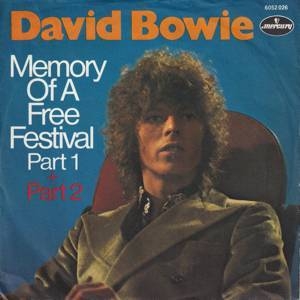
Bowie later transformed the event into Memory of a Free Festival, the closing track of his 1969 album David Bowie, later widely known as Space Oddity.
The song does not simply document the day. It reshapes the festival into a dreamlike memory of communal hope, summer light and fragile optimism.
Bowie later acknowledged that his own experience of the day was more conflicted than the song suggests. That tension makes the track more powerful: it is both memory and reinvention.
The recording legacy
The album version of Memory of a Free Festival was recorded shortly after the event in September 1969. Bowie later re-recorded the song in 1970, splitting it into two parts for single release.
The 1970 version introduced a heavier band arrangement and featured musicians including Mick Ronson, Tony Visconti, John Cambridge and Ralph Mace, pointing toward Bowie’s next musical phase.
The Bowie Bandstand
The Edwardian bandstand at Croydon Road Recreation Ground later became known locally as the Bowie Bandstand. Its association with the 1969 Growth Summer Festival has made it one of the most meaningful early Bowie landmarks in Beckenham.
Unlike major studios or famous London venues, the bandstand’s importance lies in its modest scale. It represents Bowie before fame, bringing together local art, music and community in a public space.
A small-scale counterpart to Woodstock
The festival took place during the same weekend as Woodstock in the United States. The comparison should not be overstated: Beckenham was a small local event, not a mass international festival.
Yet the timing is symbolic. Both events belonged to the same late-1960s atmosphere of free gatherings, counterculture, music and utopian possibility.
YouTube – context and legacy
Memory of a Free Festival – inspired by the Beckenham Free Festival
The song remains the festival’s most enduring artistic legacy. It turned a local Beckenham gathering into one of the defining myths of Bowie’s early career.
Its famous communal ending helped preserve the ideal of the festival even though the real day was more complicated.
Historical significance
Although modest compared with later Bowie landmarks, the Beckenham Free Festival is historically important because it shows Bowie as more than a performer. He was already building environments, shaping communities and transforming real experience into art.
The festival links the Beckenham Arts Lab, Growth, Space Oddity, local counterculture and the beginning of Bowie’s long fascination with myth-making.