
Diamond Dogs (1974) – The Story Behind the Album Cover
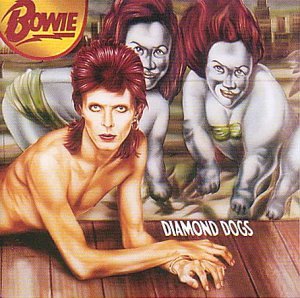
Image: David Bowie World collection / editorial use
Diamond Dogs features one of the most controversial and visually disturbing album covers in David Bowie’s career. Released in 1974, the sleeve transformed Bowie into a grotesque half-man, half-dog hybrid inspired by dystopian fiction, theatrical decadence and Bowie’s growing fascination with mutation and identity.
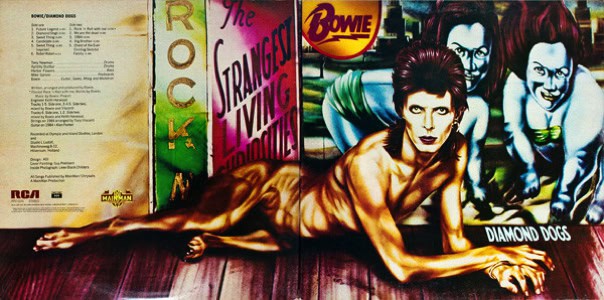
The original uncensored artwork by Belgian artist Guy Peellaert was considered too shocking for public release and was quickly altered after the album reached stores. As a result, the first uncensored pressings became some of the rarest and most sought-after Bowie records ever produced.
- Album: Diamond Dogs
- Released: 24 May 1974
- Cover artist: Guy Peellaert
- Photography: Terry O’Neill
- Theme: Dystopia / mutation / Hunger City
- Main inspiration: George Orwell’s Nineteen Eighty-Four
- Famous controversy: The uncensored “butcher cover”
The moment Bowie became the Diamond Dog
By 1974, David Bowie was moving away from the glitter and theatrical glamour of Ziggy Stardust. The world of Diamond Dogs was darker, dirtier and more dangerous.
Inspired partly by George Orwell’s Nineteen Eighty-Four, Bowie imagined a ruined future city called Hunger City, populated by violent street gangs, decaying buildings and mutated survivors.
The album cover visually introduced that world before listeners even placed the needle on the record.
Guy Peellaert’s disturbing artwork
The sleeve artwork was created by Belgian artist Guy Peellaert, known for his highly stylised, surreal imagery. Bowie admired Peellaert’s work and reportedly rushed to work with him after learning that Mick Jagger had also approached the artist for Rolling Stones artwork.
Peellaert painted Bowie as a hybrid creature: human above the waist, dog below it. The image was bizarre, theatrical and deliberately unsettling.
Unlike many rock album covers of the period, the artwork did not attempt to make Bowie appear glamorous or approachable. Instead, Bowie appears transformed into a strange creature from his own dystopian imagination.
The uncensored “butcher cover”
The original gatefold version of the artwork revealed the full anatomy of the dog body, including visible genitalia. RCA Records quickly decided that the image was too controversial for mass distribution.
Most copies were therefore airbrushed almost immediately after release, removing the explicit details from the lower half of the painting.
Because the corrected version replaced the original so quickly, uncensored copies became extremely rare. Collectors later nicknamed the original pressing the “butcher cover”.
Today, original uncensored copies are among the most valuable Bowie vinyl releases ever produced.
 <
<
A cover designed to shock
The Diamond Dogs sleeve was never intended to feel comfortable. Bowie wanted the artwork to reflect physical transformation, decay and instability.
The image matched the atmosphere of songs such as Future Legend, Sweet Thing and Big Brother, which describe a collapsing society filled with paranoia, violence and desperation.
Rather than presenting Bowie as a clean pop idol, the cover pushed him toward something theatrical, mutated and almost post-human.

Terry O’Neill and the Diamond Dogs imagery
Photographer Terry O’Neill also played an important role in shaping the visual identity of the Diamond Dogs era. O’Neill photographed Bowie repeatedly throughout the 1970s and described him as one of his great creative muses.
During one Diamond Dogs-era session, Bowie arrived with a large dog and already had a clear vision for the photographs. He wanted something animalistic, tense and visually dangerous.
At one point during the shoot, the dog became agitated by the studio lighting and suddenly lunged toward the strobe equipment. While assistants reportedly ran from the set, Bowie remained calm and motionless beside the animal.
The resulting photographs perfectly captured the atmosphere Bowie was searching for: elegance beside chaos, beauty beside aggression.
From glam rock to dystopian theatre
The Diamond Dogs cover also marked a major visual shift in Bowie’s career.
The Ziggy Stardust imagery had still contained traces of glamour, pop fantasy and science-fiction romance. Diamond Dogs abandoned much of that brightness.
The artwork introduced a harsher world filled with urban decay, fear, mutation and theatrical excess. Bowie himself later admitted that the Diamond Dogs period pushed him into increasingly extreme artistic and personal territory.
The Orwell connection
Much of Diamond Dogs was shaped by Bowie’s fascination with George Orwell’s novel Nineteen Eighty-Four. Bowie originally hoped to create a musical adaptation of the book, but Orwell’s estate denied him the rights.
Instead, Bowie rebuilt many of the ideas into his own dystopian universe.
That influence can be seen directly on the cover. Bowie is no longer simply a performer or character. He appears almost like a survivor from a broken future society.
One of Bowie’s boldest sleeves
Few Bowie covers divided audiences like Diamond Dogs. Some critics found it grotesque or excessive, while others immediately recognised it as groundbreaking.
Over time, the artwork became one of the defining visual statements of 1970s rock music — not because it was beautiful in a traditional sense, but because it was fearless.
The sleeve pushed beyond ordinary rock-star imagery and turned Bowie into something unstable, theatrical and impossible to ignore.
Legacy
Today, the Diamond Dogs cover remains one of the most discussed and collected album sleeves in Bowie’s catalogue.
The uncensored version became legendary among collectors, while the censored edition became the image most fans grew up recognising.
Together, both versions helped reinforce Bowie’s reputation as an artist willing to challenge expectations visually as much as musically.
The Diamond Dogs cover was not designed simply to decorate an album. It was designed to disturb, provoke and transport listeners directly into Bowie’s dystopian world.
Article origin
This page was inspired by historical articles, Terry O’Neill archive material, Bowie interviews and documented information surrounding the creation of the Diamond Dogs artwork and the controversial original Guy Peellaert sleeve painting.