
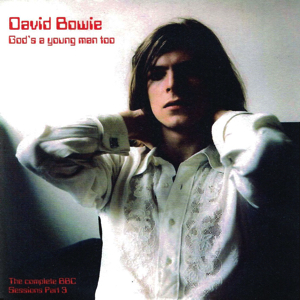
David Bowie – Glastonbury Festival (1971)
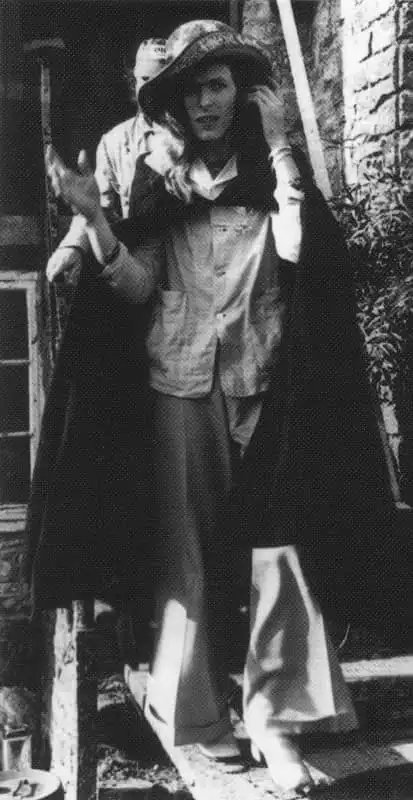
On June 23, 1971, David Bowie performed at the Glastonbury Fayre, one of the most iconic early editions of what would later become the Glastonbury Festival. His appearance took place at sunrise (5am in the morning), creating one of the most atmospheric and legendary moments of his early career.
Performing solo with acoustic guitar, Bowie delivered a reflective and intimate set that contrasted sharply with the larger, more chaotic festival environment. The performance captured him at a pivotal moment — transitioning from cult artist to the brink of international breakthrough.
The imagery of Bowie singing as the sun rose over Worthy Farm would later become one of the defining visual memories of early 1970s counterculture.
- Name: David Bowie (David Robert Jones)
- Date of birth: 8 January 1947
- Date of death: 10 January 2016
- Role: Performer (solo acoustic set)
- Period: Pre-Ziggy Stardust era (1971)
The Glastonbury Fayre context
The 1971 Glastonbury Fayre was a free festival held at Worthy Farm in Somerset, organised by Andrew Kerr and Arabella Churchill. Unlike later commercial editions, the event embraced a strong countercultural ethos, blending music with theatre, poetry, spirituality and communal living.
Thousands of attendees gathered in a relaxed, open environment that reflected the ideals of the late 1960s and early 1970s: peace, creativity and freedom of expression. The festival featured a diverse line-up including artists such as Hawkwind, Fairport Convention and Gong.
Within this setting, Bowie’s appearance stood out not because of spectacle, but because of its intimacy and timing.
Bowie before Glastonbury
David Bowie’s rise to success was far from immediate. By the time he finally reached the charts with Space Oddity in 1969, he had already spent years searching for his musical identity — performing in multiple bands, releasing several singles, and even issuing a debut album that attracted little attention.
In 1970, Bowie introduced a darker, heavier sound with The Man Who Sold the World, but the album initially failed to make a commercial impact. Despite his growing artistic confidence, he was still largely seen by the public as the artist behind “Major Tom,” and his long-term future in the music industry remained uncertain.
It was against this backdrop that Bowie agreed to appear at the second Glastonbury festival in June 1971, at a time when both the artist and the event itself were still developing their identities.
Known as the Glastonbury Fayre, the festival took place at Worthy Farm in Pilton, Somerset, and was scheduled to coincide with the summer solstice. Organised by Andrew Kerr and Arabella Churchill, the event was free of charge, reflecting a conscious rejection of the increasing commercialisation of music festivals in Britain.
The 1971 edition also introduced what would become one of Glastonbury’s defining features: the first Pyramid Stage, constructed using metal scaffolding and plastic sheeting. The festival itself was filmed and later released as the documentary Glastonbury Fayre (1972), directed by Nicolas Roeg, who would later collaborate with Bowie on The Man Who Fell to Earth.
Bowie was originally scheduled to perform in the evening alongside major acts such as Gong, Traffic and Pink Floyd. However, delays and logistical changes led to a reshuffling of the programme, and a planned late-night slot was abandoned due to concerns from local residents.
As a result, Bowie took to the stage in the early hours of the morning, performing at approximately 5 a.m. as the sun began to rise. Accompanied by guitarist Mick Ronson, this intimate sunrise set would become one of the most memorable and symbolic performances of his early career.
A sunrise performance
David Bowie’s set took place at dawn on the final day of the festival. As the sun began to rise over the Somerset countryside, he appeared on stage with an acoustic guitar, performing to an audience that had either stayed awake through the night or gathered specifically for the moment.
The atmosphere was quiet, almost spiritual. Unlike the louder, more chaotic performances earlier in the festival, Bowie’s set created a sense of stillness and reflection.
This performance was later captured in the documentary film Glastonbury Fayre (1972), preserving one of the earliest visual records of Bowie in a live festival setting.
Setlist and musical direction
Bowie’s performance featured material that reflected his evolving artistic identity in 1971. Songs from this period showed a move away from psychedelic folk toward more structured songwriting and theatrical presentation.
- Oh! You Pretty Things
- Kooks
- Changes
- Amsterdam
- The Superman
- Memory of a Free Festival
- Song for Bob Dylan
These songs would soon appear on the album Hunky Dory (1971), widely regarded as one of Bowie’s most important works.
Visual imagery and legacy
The image of Bowie performing at sunrise became iconic. Dressed simply and performing alone, he appeared as a transitional figure — still rooted in the folk-influenced late 1960s, yet clearly moving toward the theatrical identity that would define his Ziggy Stardust era.
The natural lighting, the stillness of the audience, and the open landscape combined to create a moment that felt both intimate and symbolic.
From Beckenham to Glastonbury
Compared to the Beckenham Free Festival of 1969, Bowie’s appearance at Glastonbury represented a clear evolution. While Beckenham had been local and experimental, Glastonbury placed him within a larger national countercultural movement.
The contrast highlights Bowie’s rapid artistic growth in just two years — from organiser of a small community event to a performer on one of the UK’s most important festival stages.
Historical significance
Although not as widely discussed as his later performances, Bowie’s Glastonbury 1971 set holds a unique place in his history:
- It documents his transition into the 1970s artistic phase
- It captures one of his most intimate live performances
- It forms an early connection between Bowie and major festival culture
The footage remains one of the few surviving visual records of Bowie’s pre-Ziggy live performances, making it especially valuable for understanding his development as an artist.
YouTube – Glastonbury 1971
David Bowie performing at Glastonbury Fayre, 1971 (sunrise performance)