
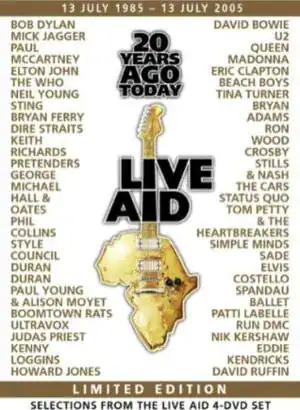
Live Aid – All-Star Ensemble and Bowie’s 1985 Performance
Photo: Unknown photographer / Wikimedia Commons / Unknown — Unknown Wikimedia file page
Live Aid was a global benefit concert held on 13 July 1985, bringing together an unprecedented all-star ensemble of musicians. David Bowie’s appearance became one of the defining moments of the event.
Rather than functioning as a single collaboration, Live Aid represented a collective convergence — a temporary alignment of artists united by urgency, visibility and shared purpose.
- Date: 13 July 1985
- Event type: Global benefit concert
- Locations: London & Philadelphia
- Bowie connection: Solo performance within all-star event
Bowie before Live Aid
David Bowie’s rise to global superstardom had been gradual but transformative. From his early struggles in the 1960s to his breakthrough with Space Oddity, he continuously reinvented himself throughout the following decade.
By the early 1980s, Bowie had reached a new commercial peak with Let’s Dance (1983), becoming one of the most recognisable artists in the world. His ability to move between artistic experimentation and mainstream success positioned him uniquely within the Live Aid line-up.
A global musical moment
Live Aid marked an unprecedented moment in popular music history, linking simultaneous concerts across continents via live broadcast to an audience of over one billion people.
The event transformed music into a shared global experience, collapsing geographical distance through technology, spectacle and collective awareness.
David Bowie at Live Aid
David Bowie’s performance at Wembley Stadium was carefully constructed, balancing accessibility with emotional weight. Rather than relying on spectacle, he delivered a focused and controlled set.
His stage presence was measured and confident, allowing the music — and the message of the event — to take centre stage.
Setlist
- TVC 15
- Rebel Rebel
- Modern Love
- Heroes
“Heroes” and emotional impact
The performance of “Heroes” became one of the defining moments of Live Aid. Following footage highlighting the Ethiopian famine, Bowie’s delivery resonated deeply with both the audience in Wembley Stadium and millions watching worldwide.
The emotional intensity of this moment elevated the performance beyond entertainment, turning it into a powerful shared experience.
All-star context
Live Aid’s defining feature was its collective nature. Individual performances existed within a broader ensemble of artists, each contributing to a unified cultural statement.
Bowie’s appearance functioned not as a traditional collaboration, but as part of a global moment in which music and humanitarian awareness became inseparable.
Broadcast, image and memory
Televised worldwide, Live Aid reshaped how music was consumed and remembered. Performances became inseparable from their visual documentation.
Bowie’s imagery from the event remains embedded in collective memory, reinforcing his role as both performer and visual communicator.


-
TVC 15
-
Rebel Rebel
-
Modern Love
Place within Bowie’s universe
Within David Bowie’s extended creative universe, Live Aid represents a moment where individual artistry intersected with collective action on a global scale.
It stands as a reminder that Bowie’s influence extended far beyond albums and tours, reaching into moments that shaped cultural and humanitarian history.