
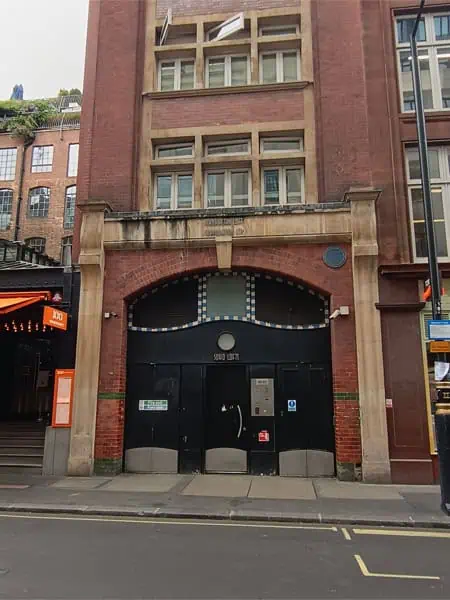
David Bowie – Marquee Club (London)
Photo: Unknown photographer / Wikimedia Commons / CC BY-SA 4.0 (editorial use)
The Marquee Club in London was one of the most important live venues in the British music scene during the 1960s, and it played a significant role in David Bowie’s early career. Performing here placed Bowie within a network of emerging artists, helping him gain visibility and experience in front of live audiences.
At a time when Bowie was still searching for a clear musical identity, the Marquee Club offered a professional stage where experimentation met expectation. It marked a crucial step from small local gatherings to the competitive London club circuit.
- Location: Wardour Street, London
- Period: Late 1960s
- Type: Live music venue
- Bowie connection: Early live performances and exposure
The London music scene
During the late 1960s, London was at the centre of a rapidly evolving music culture. Clubs like the Marquee became essential platforms for new talent, offering artists the opportunity to perform in front of industry professionals and dedicated audiences.
For Bowie, entering this environment meant stepping into a competitive but inspiring scene, where originality and stage presence were key to standing out.
Bowie on stage
David Bowie’s performances at the Marquee Club reflected an artist in transition. Moving beyond his earlier mod and pop influences, he began incorporating theatrical elements into his shows, influenced in part by his work with Lindsay Kemp.
These performances allowed Bowie to test new material and refine his stage persona, gradually developing the confidence and presence that would later define his career.
Testing new directions
The Marquee Club functioned as a proving ground. Bowie experimented with different musical styles, from folk-inspired songs to more dramatic and conceptual pieces. This willingness to evolve became one of his defining characteristics.
Each performance contributed to a growing understanding of what worked on stage and what resonated with audiences.
Part of a wider network
Performing at the Marquee placed Bowie within a broader community of musicians. The venue hosted many future stars, making it a key hub for artistic exchange and competition.
This environment pushed Bowie to develop not only musically, but also visually and theatrically.
From clubs to larger stages
The experience gained at venues like the Marquee Club prepared Bowie for larger stages in the early 1970s. It marked a transition from experimentation to a more defined artistic direction.
By the time he moved into the Ziggy Stardust era, the lessons learned in these smaller venues had become integral to his performance style.
The 1980 Floor Show (1973)
One of the most important events in the history of the Marquee Club took place in October 1973, when David Bowie recorded the legendary 1980 Floor Show for the American television programme The Midnight Special.
Filmed over several days at the Marquee Club, this special was far more than a live concert. It was a carefully staged television production combining music, theatre, choreography and visual storytelling, capturing Bowie at a crucial moment between the end of the Ziggy Stardust era and the emergence of new ideas that would lead toward Diamond Dogs.
The show featured performances of songs such as 1984/Dodo, Sorrow, The Jean Genie and Time, along with guest appearances by Marianne Faithfull, The Troggs and Carmen.
Although broadcast only in the United States in November 1973, the 1980 Floor Show became one of the most legendary and sought-after recordings in Bowie’s visual archive. Its connection to the Marquee Club makes the venue not only important for Bowie’s early live career, but also for one of his most ambitious and theatrical television productions.
Video
Important places in the early life of David Bowie
Historical significance
The Marquee Club remains one of the defining venues of London’s music history. For David Bowie, it represents a key stage in his evolution from an emerging artist to a confident performer.
It was here that Bowie began to understand the power of live performance, laying the groundwork for the iconic shows that would follow in the 1970s.
Place within Bowie’s development
Within Bowie’s early career, the Marquee Club stands as a bridge between local experimentation and professional recognition. It connected his Beckenham period to the wider London music scene.
This venue helped transform Bowie from a developing artist into a performer capable of commanding larger audiences, setting the stage for his breakthrough years.
Related
← Back to Bowie Collaborations
The Marquee Beginnings – 1965–1966
🏛️ Marquee Club, Wardour Street
🎸 Event: Live: Debut with The Lower Third
🎤 Artist: Davy Jones & The Lower Third
🗒️ Notes: Bowie’s first appearance at the legendary venue. Still performing as Davy Jones, he begins to establish himself in the Soho mod scene, playing a mix of R&B covers and early original compositions.
🏛️ Marquee Club, Wardour Street
🎸 Event: Live: The Bowie Showboat Residency
🎤 Artist: David Bowie & The Buzz
🗒️ Notes: Bowie secures a weekly Sunday afternoon residency. These “Showboat” gigs are essential for developing his stagecraft and professional persona, attracting a dedicated following of London mods and art-school students.
Experimental Pop Phase – 1967–1969
🏛️ Marquee Club, Wardour Street
🎸 Event: Live: Early Solo Performance
🎤 Artist: David Bowie
🗒️ Notes: Transitioning into his theatrical pop phase, Bowie performs material from his debut self-titled album. The Marquee serves as a vital platform during this period of rapid stylistic change between his mod roots and folk-rock future.
The Grand Marquee Finale – 1973
🏛️ Marquee Club, Wardour Street
🎸 Event: Television: The 1980 Floor Show
🎤 Artist: David Bowie (Final Ziggy Appearance)
🗒️ Notes: Bowie returns to the Marquee for a three-day filming session for the NBC ‘Midnight Special.’ This historic event marks the final time Bowie performs in the Ziggy Stardust costume, featuring guest appearances by Marianne Faithfull and The Troggs.
Strategic Significance of the Marquee Club
🏛️ Marquee Club, Wardour Street
🎸 Event: Live: Career Pivot Point and Media Catalyst
🎤 Artist: David Bowie
🗒️ Notes: The Marquee Club acted as a consistent thread throughout Bowie’s early development. From his mod apprenticeship to the final televised bow of Ziggy Stardust, the venue provided the professional credibility required to transition from a Soho cult figure to an international superstar.