
8 of David Bowie’s Most Iconic Interviews
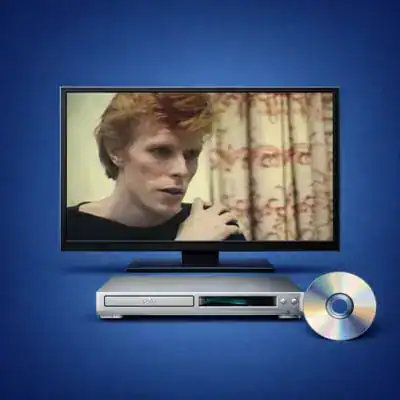
Beyond music, cinema and performance art, David Bowie was one of rock’s greatest interview subjects — witty, provocative, philosophical and often decades ahead of his time.
Whether discussing identity, race, art, addiction, technology or the future, Bowie frequently turned interviews into performances of their own — revealing as much through conversation as through song.
- Coverage: 1964–1999
- Interviews featured: 8 iconic moments
- Topics: Music, identity, media, technology
- Includes: MTV, Cavett, Burroughs, Paxman
No matter what you think of him, David Bowie is undoubtedly a pivotal pop culture icon of the 20th century. Both his time as a musician and an actor has cemented his place in history for millennia to come but there was another reason he has been so keenly taken into the hearts of his audience as his personal candour made him one of the most sincere and authentic rock stars around. While it’s only right that the Starman’s work triumph over everything else, we think he could also make the hall of fame for one other art — the art of being interviewed.
In the sanitised media world of the 21st century, the really revealing, and perhaps most caustic, interviews are gone and forgotten. It’s been a long time since we caught a truly open and authentic interview from some of today’s biggest stars. But, for a brief moment, as video surged among the masses, pop stars had no filter and were keen to use their time being interviewed to make a point. Perhaps one of the best to do it, and do it with a smile and a natural charm that would outshine most salesmen, Bowie’s list of interviews are simply brilliant.
Of course, it would be too far to suggest that his interview answers have equal billing with his music, his acting or even his painting career—but it is equally difficult to not align them in some way to his huge rise in popularity. Aside from his art, these are the moments where we get to see the real David behind Bowie, the real feelings and thoughts that troubled or titillated him.
Whether it was for MTV as a seasoned pro, delivering the kind of insights and barbs that investigative journalists would be proud of, or his very first time in front of the camera, Bowie possessed a cool and calm authenticity which became contagious.
That’s not to say that all of the interviews the singer ever conducted went well. Far from it. Quite a considerable amount of them, especially as Bowie aged and his disdain for answering the same old questions grew, had a decipherable and sharp edge to proceedings. The real magic trick is how Bowie managed to navigate, or sometimes lead, these sticky moments into something glorious and, most notably, quintessentially Bowie.
Below we’re bringing you eight of David Bowie’s most iconic interviews.
David Bowie’s iconic interviews:
1964 — David Bowie’s debut
David Bowie was a lot of things throughout his life. One of the most influential musicians of the 20th century, an outspoken pioneer of all forms of artistic expression and, arguably most importantly, he was the founder of the ‘Society for the Prevention of Cruelty to Long-haired Men’.
“The rebellion of the longhairs is getting underway,” BBC presenter Cliff Michelmore spoke to the camera during a feature for national television show Tonight in 1964. A young Bowie, sat among his fellow teenage students, had formed a collective unit to kick against the criticism they had received for growing out their hair. “Well I think we’re all fairly tolerant,” says the 17-year-old Davey Jones when asked by the interviewer who is being cruel to the teenagers. “But for the last two years we’ve had comments like ‘Darling!’ and ‘Can I carry your handbag?’ thrown at us, and I think it just has to stop now,” Bowie continued.
Presenter Michelmore, taking on the say-as-you-see form of hard-hitting journalism, asks young Bowie if aggressive insults he and his peers received were surprising before adding: “After all, you’ve got really rather long hair, haven’t you?”
“We have, yes,” Bowie replied. “It’s not too bad, really, I like it. I think we all like long hair and we don’t see why other people should persecute us because of this.”
1970 — Sharing the best advice with Jackie

Bowie was only 23 when he spoke to Jackie magazine on May 10th, 1970. The singer had not yet triumphed with Ziggy Stardust and was far from the icon he is today. Instead, he was the next pop star trying to grab some column inches and add a few more fans to his growing fan club.
Bowie being Bowie, however, meant that although he was asked the usual pop star questions, like ‘who has influenced you the most?’ or ‘does he write his own material?’, to which he promptly replied: “I’ve always written my own songs.” What was his most embarrassing moment? “When I was singing with a group called The Buzz four or five years ago. I forgot the words to three songs in a row. That was dreadful.” He was also able to add a searing bout of intellectualism to each of his answers.
So when he was asked the fairly simple question of “what’s the best advice you’ve ever received?” His answer was naturally cultivated and cultured and opened up a view of Bowie as the mystical music man he would become. The reply revealed the very soul of Bowie, he answered: “To try to make each moment of one’s life one of the happiest, and if it’s not, try to find out why.”
If the answer sounds dripping with mysticism and spirituality it’s because it came directly from a Buddhist monk. “I was told that by a Tibetan friend of mine, Chimi Youngdon Rimpoche [sic Chime Youngdon Rinpoche],” clarifies Bowie to his interviewer, unwilling to take any credit.
1972 — Introducing Ziggy Stardust
In one of Bowie’s little known interviews, he let slip the mask of pop production and accidentally gave a preview of his new creation, Ziggy Stardust, to an unwitting American radio host. “Could you explain a little more in-depth about the album that’s coming out—Ziggy?” the interviewer asks, likely thinking he would be given a fob-off response. But artists weren’t as media-trained back then and Bowie is happy to provide a preview of the star in waiting. “I’ll try very hard. It’s a little difficult,” began the singer, “but it originally started as a concept album, but it kind of got broken up, because I found other songs I wanted to put in the album which wouldn’t have fitted into the story of Ziggy, so at the moment it’s a little fractured and a little fragmented.
“So anyway, what you have there on that album when it does finally come out,” he continues, laying out the blueprint for one of his most treasured creations, “is a story which doesn’t really take place, it’s just a few little scenes from the life of a band called Ziggy Stardust and the Spiders From Mars, who could feasibly be the last band on Earth—it could be within the last five years of Earth.” Bowie is still bubbling with the creativity of the project and finds it somewhat difficult to piece it all together “I’m not at all sure. Because I wrote it in such a way that I just dropped the numbers into the album in any order that they cropped up. It depends in which state you listen to it in.”
Thinking about the meaning behind the album and the songs on it, Bowie is again a little unwilling to commit to a certain understanding: “The times that I’ve listened to it, I’ve had a number of meanings out of the album, but I always do. Once I’ve written an album, my interpretations of the numbers in that album are totally different afterwards than the time when I wrote them and I find that I learn a lot from my own albums about me.”
1974 — Drugged up on The Dick Cavett Show
The 1970s saw Bowie hit his professional peak and perhaps one of his lowest personal moments as he struggled with crippling drug addiction. There’s one interview which sadly captured these two facets of Bowie’s juxtaposing life with supreme clarity.
David Bowie’s cocaine addiction had begun to swirl out of control by the time he arrived at The Dick Cavett Show in December 1974. The Thin White Duke never looked thinner or possessed more white and it made for one of the most infamous interviews in pop history.
Bowie had previously ‘cracked’ America a few years prior with Ziggy Stardust and had continued to gather up fans as he portrayed the filthy side of glam rock on stage, captivating the hearts and minds of America’s outsider generation. But while on stage he was Ziggy, the alien rock star from outer space, off stage his drug-taking had continued to increase and had begun to render him useless.
Though Bowie put Ziggy to bed and essentially killed off the persona for good, the flame-haired role had continued to swarm over Bowie’s real life. It meant when he was beginning to get on the promotion tour for his upcoming new album Young Americans he was in the throes of a sticky situation and personal dilemma.
Part of what makes the below video somewhat watchable is the knowledge that Bowie did eventually get a grip on his drug habits and curtailed them effectively and without much public fuss. Taking himself to Berlin to get clean and create some of his most notable works. However, watching the show back in 1974, as a fan of the Starman, one might have been worried about the singer’s health and his future.
1974 — Bowie meets Burroughs
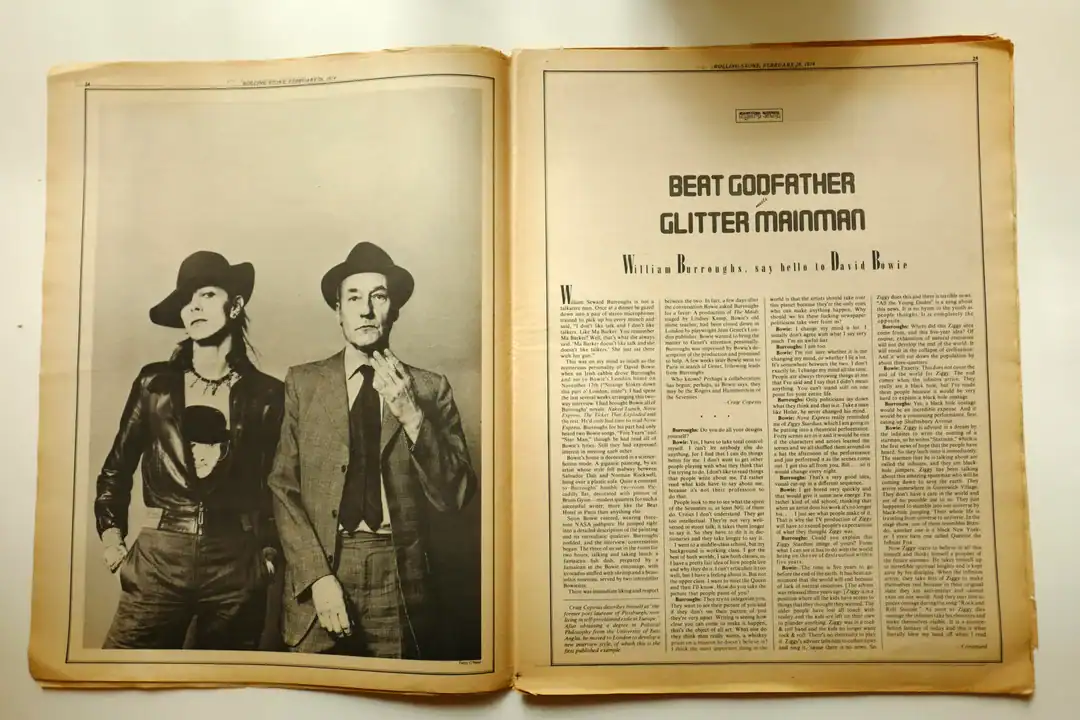
William S. Burroughs, the acclaimed Beat writer and novelist, famed for such titles as Naked Lunch and Junky, was rightly revered by many in the 1990s as one of the forefathers of grunge. His visceral style had helped inspire Kurt Cobain to achieve his own balance of beautiful beastliness. But, as ever, Bowie was there first.
In this conversation, which you can read in full here, Bowie introduces Burroughs to his new concept — Ziggy Stardust. During the conversation, they talk about Bowie’s unstoppable creativity energy, as the Starman confesses, “I get bored very quickly and that would give it some new energy. I’m rather kind of old school, thinking that when an artist does his work it’s no longer his… I just see what people make of it. That is why the TV production of Ziggy will have to exceed people’s expectations of what they thought Ziggy was.”
Throughout the conversation, the two artists share their thoughts and feelings about the very nature of art as well as the intricacies of Ziggy’s story. It is a swirling and mind-altering piece of journalism and is worthy of revisiting. It also sees Bowie pay homage to the writer for developing his ‘cut-up’ method which Bowie used for years to help cultivate lyrics.
1983 — Calling out MTV
Bowie was promoting Let’s Dance in 1983 when he challenged MTV over its lack of Black artists in regular rotation.
Calmly but relentlessly, he pressed interviewer Mark Goodman on racial exclusion in American media. What began as routine promotion became one of the most admired confrontations in music journalism.
The exchange remains a defining example of Bowie’s intelligence, moral clarity and refusal to separate art from politics.
1987 — Ronnie Wood and Bill Wyman backstage
During the Glass Spider era, Bowie sat down backstage with Ronnie Wood and Bill Wyman in one of his warmest filmed conversations.
Beneath the rock-star humour lies something revealing: artists discussing painting, touring, friendship and aging.
It shows Bowie stripped of persona — charming, funny and genuinely relaxed.
1999 — When Bowie predicted the internet
In his famous BBC interview with Jeremy Paxman, Bowie described the internet as both exhilarating and terrifying.
He foresaw the collapse of boundaries between artist and audience and recognised digital culture as a revolutionary force long before social media.
Few interviews feel so prophetic decades later.
Why these interviews still matter
Together these conversations reveal Bowie not simply as musician or actor, but as thinker, provocateur and cultural observer.
They show the same imagination found in the records — only spoken rather than sung.
From a teenager defending long hair in 1964 to predicting the internet in 1999, Bowie remained intellectually restless and unmistakably himself.