
David Bowie and Japan – The Visual Revolution

Photo: To be added / Editorial use
Few countries influenced David Bowie as deeply and creatively as Japan. During the early 1970s, Bowie discovered Japanese theatre, kabuki performance, fashion and visual aesthetics — influences that would permanently reshape his appearance, stage presentation and artistic identity.
By the time Bowie first toured Japan in 1973, Ziggy Stardust already existed, but the visual language of the character was still evolving. Japan gave Bowie new ideas about movement, costume, makeup and theatrical transformation.
Through his encounters with legendary kabuki actor Bando Tamasaburo V and fashion designer Kansai Yamamoto, Bowie entered a completely different artistic world that combined tradition, performance, ritual and futurism.
- Main year: 1973
- Country: Japan
- Main cities: Tokyo & Osaka
- Main influence: Kabuki theatre
- Important collaborators: Kansai Yamamoto & Bando Tamasaburo V
- Era: Ziggy Stardust / Aladdin Sane
- Main themes: Theatre, makeup, fashion & performance art
- Historical significance: Japan transformed Bowie’s visual identity
Bowie Discovers Japan
When David Bowie arrived in Japan during 1973, he encountered a culture that deeply fascinated him both artistically and philosophically. Japanese theatre, design and performance traditions immediately connected with Bowie’s growing interest in identity, transformation and visual storytelling.
Unlike many Western rock performers of the era, Bowie did not simply view Japan as an exotic tour destination. He approached Japanese culture with genuine curiosity and artistic respect, studying kabuki theatre, costume design, gesture, makeup and stage presentation with intense concentration.
Japan offered Bowie something he had long been searching for: a complete fusion between music, theatre, fashion and performance.
Bando Tamasaburo V
One of the most important figures Bowie encountered in Japan was legendary kabuki actor Bando Tamasaburo V, one of the greatest onnagata performers of the modern era — a male actor specializing in female roles within traditional kabuki theatre.
According to Tamasaburo’s later recollections, Bowie visited his dressing room during the 1973 Japanese tour and carefully observed the kabuki makeup process. Bowie became fascinated by the dramatic red shading around the eyes and the stylized transformation that occurred before performance.
Shortly afterwards, Bowie’s own stage makeup evolved visibly. During subsequent tours, Bowie adopted softer red eye-shadow techniques and more theatrical facial styling that echoed elements of kabuki performance aesthetics.
“Japan helped Bowie understand performance not only as music, but as total transformation.”
Kansai Yamamoto And The Ziggy Revolution
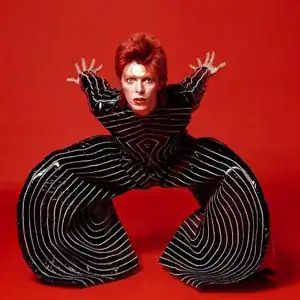
Image: David Bowie World collection / editorial use
Bowie’s collaboration with Japanese fashion designer Kansai Yamamoto became one of the most visually revolutionary partnerships in rock history.
Kansai’s designs exploded with colour, geometry, theatricality and exaggerated forms inspired partly by kabuki and Japanese visual traditions. Bowie immediately understood that these costumes could push Ziggy Stardust beyond ordinary rock performance and into something closer to avant-garde theatre.
The famous asymmetrical bodysuits, flowing capes and futuristic stage outfits worn during the Ziggy Stardust and Aladdin Sane tours became inseparable from Bowie’s image during the early 1970s.
Together, Bowie and Kansai created one of the most iconic visual identities in modern music culture.
The Dinner Conversation
During Bowie’s 1973 Japanese visit, Bowie, Bando Tamasaburo and Kansai Yamamoto reportedly shared dinner together at Hanya-en, a prestigious Japanese restaurant associated with writers, diplomats and international visitors.
According to Tamasaburo, the three young artists discussed theatre, performance, fashion, art and the future of culture late into the evening.
One remark Bowie made during the dinner remained deeply memorable for Tamasaburo for decades afterwards. Bowie reportedly predicted that within the future, people would increasingly experience world events only as “phenomena” rather than emotionally.
Tamasaburo later reflected that Bowie seemed unusually capable of seeing simultaneously into the past, present and future — not simply as a musician, but as an artist with extraordinary cultural awareness.
Japan And The Reinvention Of Bowie
Japan strengthened Bowie’s understanding of identity as performance. Kabuki theatre, with its stylized gestures, elaborate transformations and fluid relationship between gender and appearance, resonated deeply with Bowie’s own artistic instincts.
Elements of Japanese performance culture can be seen throughout Bowie’s stage movement, costume design, posture and visual presentation during the Ziggy Stardust and Aladdin Sane years.
Bowie did not merely borrow Japanese imagery superficially. Instead, he absorbed ideas about theatrical transformation and incorporated them into his own evolving artistic language.
The Japanese Legacy
Bowie’s relationship with Japan became one of the most important artistic exchanges of his career. The influence of kabuki theatre, Japanese fashion and visual discipline remained visible in Bowie’s work long after the Ziggy Stardust era ended.
Through Japan, Bowie discovered new possibilities for what a rock artist could become: not merely a singer, but a constantly shifting visual and theatrical creation.
The First Japanese Tour (1973)
During April 1973, David Bowie finally brought the Ziggy Stardust tour to Japan for the first time. These concerts became some of the most visually important performances of Bowie’s early career and further deepened his artistic relationship with Japanese culture.
The very first Japanese concert took place on April 8, 1973, at the Shinjuku Koseinenkin Kaikan in Tokyo. For Japanese audiences, this was their first encounter with Ziggy Stardust live on stage — a performer unlike anything most had ever seen before.
Because Bowie suffered from a strong fear of flying during this period, parts of the journey connected to the Japanese tour were reportedly made by ship across the Pacific before reaching Japan.
By this point Ziggy Stardust had already transformed Bowie into an international sensation, but Japan represented something far more personal and creatively meaningful. The country’s theatre traditions, visual aesthetics and approach to performance strongly connected with Bowie’s evolving artistic vision.
The Japanese audiences of 1973 encountered Bowie at the exact moment when Ziggy Stardust stood at its theatrical peak — combining music, fashion, mime, kabuki-inspired movement and futuristic stage imagery unlike anything seen before in rock music.
📅 1973-04-08
📍 Tokyo, 🇯🇵 Japan
🏛️ Shinjuku Koseinenkin Kaikan
🎤 Performer: David Bowie & The Spiders From Mars
🗒️ Opening night of Bowie’s first Japanese tour
📅 1973-04-10
📍 Tokyo, 🇯🇵 Japan
🏛️ Shinjuku Koseinenkin Kaikan
📅 1973-04-11
📍 Tokyo, 🇯🇵 Japan
🏛️ Shinjuku Koseinenkin Kaikan
📅 1973-04-12
📍 Nagoya, 🇯🇵 Japan
🏛️ Nagoya Kokusai Tenji Kaikan
📅 1973-04-14
📍 Hiroshima, 🇯🇵 Japan
🏛️ Hiroshima Yubinchokin Kaikan
📅 1973-04-16
📍 Kobe, 🇯🇵 Japan
🏛️ Kobe Kokusai Kaikan
📅 1973-04-17
📍 Osaka, 🇯🇵 Japan
🏛️ Osaka Koseinenkin Kaikan
📅 1973-04-18
📍 Tokyo, 🇯🇵 Japan
🏛️ Shibuya Kokaido
📅 1973-04-20
📍 Tokyo, 🇯🇵 Japan
🏛️ Shibuya Kokaido
These performances became legendary partly because Bowie appeared in many of Kansai Yamamoto’s groundbreaking stage costumes during the tour. The visual combination of Ziggy Stardust and Japanese-inspired theatrical fashion created some of the most iconic imagery of Bowie’s entire career.
Japanese audiences immediately understood Bowie’s fascination with theatre, transformation and performance art. In many ways, Japan embraced Bowie earlier and more naturally than several Western countries had done during his earliest years.
The 1973 Japanese tour helped confirm Bowie not simply as a rock star, but as a complete visual artist whose concerts combined music, fashion, mime, drama and avant-garde performance into a single experience.
“In Japan, Ziggy Stardust became something more than rock and roll — he became theatre.”
“In Japan, Bowie found a new language of transformation.”
Before Berlin. Before the Thin White Duke. There was Japan — and the visual revolution.