
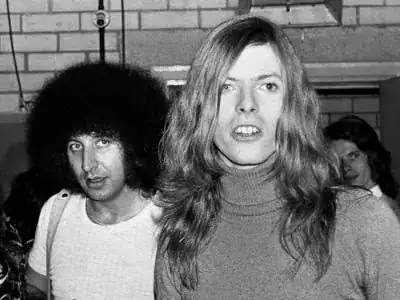
Tony Defries – Architect of David Bowie’s Ziggy Stardust Era
Tony Defries (born 3 September 1943) is the British manager and entrepreneur who helped transform David Bowie from a struggling cult artist into an international phenomenon during the Ziggy Stardust era.
As founder of MainMan, Defries approached management as theatre, strategy and controlled mythology — often treating Bowie less as a conventional recording artist than as a global cultural event.
- Born: 3 September 1943, Watford, England
- Role: Manager, impresario, rights strategist
- Bowie connection: Manager, 1971–1975
- Company: MainMan (founded 1972)
- Managed also: Iggy Pop, Lou Reed, Mick Ronson, Mott the Hoople
Before Bowie
Before meeting Bowie, Defries had already built a reputation in publishing, contracts and music rights. That business background would become one of his greatest assets.
He understood something many managers did not: ownership could matter as much as stardom.
MainMan and the creation of a star

When Bowie came into Defries’ orbit in 1971, his career was unstable and directionless despite flashes of brilliance.
Defries saw not simply a singer-songwriter, but a potential world-changing phenomenon. Together they built that phenomenon.
Through MainMan, Bowie was projected with unprecedented ambition — not merely marketed but mythologised.
The Ziggy Stardust strategy
Defries understood that Ziggy Stardust required more than records and concerts. It needed narrative, danger, iconography and mystique.
Touring, costumes, interviews, photography and controversy were all folded into a single strategy. Ziggy became not just a character but an event.
In this sense Defries helped invent a new style of artist management — part theatre producer, part strategist, part ringmaster.
MainMan as empire
MainMan was unlike conventional management companies of its era. It combined management, publishing, image control and rights ownership under one umbrella.
Its orbit extended far beyond Bowie, involving artists including Iggy Pop, Lou Reed, Mick Ronson, Dana Gillespie and Mott the Hoople.
Defries also helped facilitate collaborations now central to Bowie mythology, including Bowie and Mick Ronson’s work with Lou Reed on Transformer.
Contracts and controversy
Defries negotiated major advances and powerful deals, but his methods were famously aggressive and often controversial.
Some arrangements accelerated Bowie’s rise enormously. Others later became entangled in financial and contractual disputes.
The same visionary instincts that propelled Bowie forward also created tensions that would eventually tear the partnership apart.
Managing the myth
Few managers ever shaped an artist’s mythology as actively as Defries. Silence could be strategic. Interviews could be scripted through implication. Scarcity itself became promotion.
Under Defries, Bowie was often presented less as a pop figure than as an alien intelligence passing through the culture.
The break in 1975
By 1975 the relationship had fractured amid severe financial and contractual conflict. Bowie severed ties with Defries and MainMan.
The split was bitter, but it marked the beginning of Bowie asserting far greater personal control over his business and artistic life.
Defries and Bowie’s creative freedom
Paradoxically, part of Defries’ importance lies in the freedom he helped create. By restructuring earlier agreements and aggressively protecting rights, he helped place Bowie in a stronger long-term position than many of his contemporaries.
That emphasis on ownership and control would later echo in Bowie’s famously sophisticated business thinking — including, decades later, the Bowie Bonds.
Legacy
Tony Defries remains one of the most controversial figures in Bowie history, but also one of the most consequential.
Without Defries, Ziggy Stardust may still have existed — but perhaps not as the global cultural eruption we know.
He was, as one writer put it, somewhere between fairy godmother and wicked stepfather. That ambiguity may be the truest summary of all.
Why Tony Defries still matters
Today Defries is often discussed mainly through lawsuits or legend, but his real significance lies elsewhere: he helped redefine what artist management could be.
Modern ideas of branding, myth-building and rights-conscious artist control owe more to that early Bowie–Defries experiment than is often acknowledged.