
SO36 – Kreuzberg’s Legendary Club and the Spirit of Bowie’s Berlin
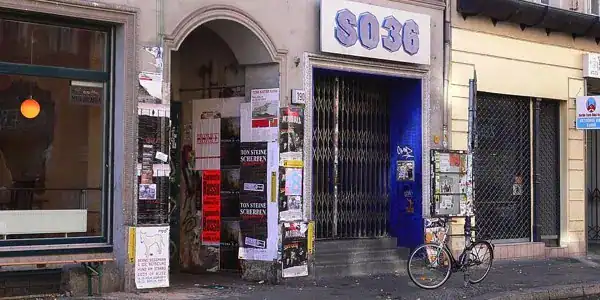
Photo: Unknown photographer / Wikimedia Commons / CC BY-SA 3.0 (editorial use)
SO36 is one of Berlin’s most iconic music venues, located on Oranienstraße in Kreuzberg, near Heinrichplatz. Its name derives from the historic postal code of the district — “SO” (Südost, southeast) and “36” identifying this specific part of the city.
During the late 1970s, when David Bowie was living in West Berlin, SO36 stood at the heart of a rapidly evolving underground scene that combined punk, experimental music and visual art.
- Location: Oranienstraße 190, Kreuzberg, Berlin
- Name origin: Historic postal code “SO36”
- Founded: Late 1970s (modern club era)
- Scene: Punk, new wave, avant-garde
- Bowie connection: Part of Berlin nightlife during his 1976–1978 period
- Cultural role: Underground hub in divided West Berlin
Kreuzberg and the SO36 district
The area known as SO36 was one of the most unconventional parts of West Berlin during the Cold War. Situated close to the Berlin Wall, Kreuzberg attracted artists, outsiders and subcultures who were drawn to its affordability, its isolation from mainstream West German society, and its creative freedom.
By the late 1970s, the district had become synonymous with counterculture, including squatter movements, punk communities and experimental art spaces. SO36, both as a location and as a concept, came to represent this raw and unfiltered environment.
The rise of SO36 as a club
SO36 emerged as a music venue at a time when Berlin’s underground culture was undergoing rapid transformation. Initially rooted in punk, the club quickly expanded into new wave, performance art and multimedia experimentation.
Under the influence of figures such as Martin Kippenberger, SO36 evolved into more than just a concert space. It became a meeting point for artists, musicians and creatives, comparable in spirit to venues like CBGB in New York.
David Bowie in Berlin nightlife
During his Berlin years (1976–1978), David Bowie immersed himself in the city’s nightlife alongside Iggy Pop. They frequented a wide range of clubs and bars, including venues such as Dschungel, Exxcess and other late-night spaces that defined the era.
SO36 formed part of this broader cultural landscape. While there is no definitive evidence that it was Bowie’s primary or favourite venue, it undeniably belonged to the same underground network that shaped his experience of Berlin.
The environment of Kreuzberg — raw, experimental and socially diverse — mirrored the direction Bowie was moving toward musically and artistically.
Influence on Bowie’s creative period
The Berlin period marked a turning point in Bowie’s career. Seeking distance from fame and excess, he embraced anonymity and experimentation. The clubs of West Berlin, including SO36, exposed him to new sounds, new ideas and a different kind of audience.
This atmosphere contributed to the development of the Berlin Trilogy — Low, “Heroes” and Lodger — where fragmentation, mood and sonic experimentation replaced traditional rock structures.
Although SO36 itself was not a recording location, it represents the cultural energy that surrounded Bowie during this period.
From punk venue to cultural institution
In the decades since Bowie’s time in Berlin, SO36 has remained an active and important venue. While its programming has expanded to include electronic music, performance art and community events, it has retained its identity as a space for alternative culture.
The club continues to host concerts, themed nights and events for diverse communities, reflecting the inclusive and experimental spirit that defined its early years.
SO36 in Bowie’s legacy
SO36 stands not as a direct collaborator in Bowie’s work, but as part of the environment that made his Berlin transformation possible.
It represents the world he stepped into: a city divided yet creatively unified, where music, art and identity were constantly being reinvented.
In that sense, SO36 remains a living symbol of the Berlin that helped reshape David Bowie — not through direct collaboration, but through atmosphere, freedom and possibility.