
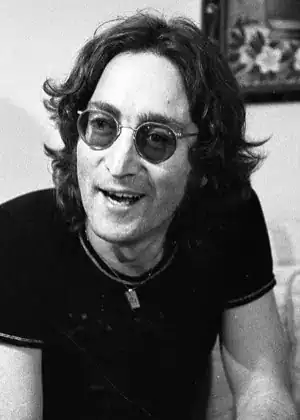
David Bowie & John Lennon – “Fame” (1975)
Photo: Unknown photographer / Wikimedia Commons / CC BY-SA 4.0 — Wikimedia file page
The collaboration between David Bowie and John Lennon on “Fame” stands as one of the most historically significant encounters in 1970s popular music.
Released in 1975, the song became Bowie’s first number-one single in the United States and captured a rare moment of direct artistic dialogue between two cultural giants.
- Song: “Fame”
- Released: 1975
- Bowie album: Young Americans
- Lennon role: Co-writer, backing vocals
- US chart: #1 (Billboard Hot 100)
- Recording location: Los Angeles
The Los Angeles context
In early 1975, Bowie was living in Los Angeles, immersed in the fragmented psychological environment that would define the Young Americans era. Lennon, recently separated from Yoko Ono, was also in the city during his so-called “lost weekend”.
Their reconnection occurred in an atmosphere of creative restlessness, personal uncertainty, and mutual skepticism toward the music industry.
From “Footstompin’” to “Fame”
The song began life as a loose studio jam titled “Footstompin’”. Lennon immediately responded to the groove, improvising vocal lines that mocked the hollow rewards of celebrity culture.
Lennon’s shouted refrain — “Fame!” — became the song’s defining hook, transforming it into a confrontational chant rather than a celebration.
John Lennon’s contribution
Lennon’s role extended far beyond guest vocals. His delivery injected sarcasm, aggression, and lived experience into the track.
Having personally endured global adoration and disillusionment, Lennon approached the subject with bitter clarity.
Bowie’s lyrical perspective
Bowie’s lyrics articulate exhaustion, detachment, and manipulation. Fame is presented not as achievement, but as erosion of identity.
Together, Bowie and Lennon frame celebrity as psychological burden.
Musical architecture
The song’s minimal harmonic structure places emphasis on rhythm and texture. Lennon’s voice functions as a rhythmic weapon rather than harmony.
The result is hypnotic, abrasive, and deliberately unsentimental.
Commercial success and irony
Ironically, a song critiquing fame became Bowie’s biggest hit to date. The contradiction only reinforced its message.
“Fame” permanently altered Bowie’s position in the American market.
Legacy
“Fame” remains the only officially released studio collaboration between Bowie and Lennon.
It stands as a rare moment where two artists openly interrogated the system that elevated them.


-
Fame 90 (Official Video)
The official music video for David Bowie's - Fame 90 directed by Gus Van Sant. Fame 90 is a remix of "Fame," originally released in 1975 on Bowie's 9th studio album 'Young Americans'. -
Heroes - Hong Kong 1977
1977. Lennon was in Hong Kong during a trip to Japan – and Bowie was in town on tour with his band. They met up in Hong Kong (where Bowie was touring along with Iggy Pop). While there, a tourist approached John and said, “Aren’t you John Lennon?” John replied, “No, but I wish I had his money!” This immediately caused the tourist to say, “Oh sorry – of course you’re not him” and walk away. Bowie witnessed this and thought it was the most brilliant way to keep fans from hounding you for autographs. Bowie started using that tactic himself when he wasn’t in the mood to sign autographs.Two months later back in New York, Bowie is in Soho when he hears a fan behind him say “Aren’t you David Bowie?” Without turning around, Bowie immediately says “No, but I wish I had his money!” To which the guy behind him says, “You lying bastard. You wish you had MY money!”It was John Lennon.Bowie told this story at a graduation commencement speech at Berklee College of Music in Boston in 1999. -
Oct 1980 "FAME"
Oct 1980 - Bowie was appearing in the stage adaptation of the Joseph Merrick Story "The Elephant Man" and popped round to The Dakota to visit John. It wasnt too long before the guitars came out and a jam session took place. This is just one song from that session. Bowie and Lennon sing and play Bowie's US No1 single "Fame". Bowie was later quoted as saying "It was a night like no other"
John Lennon in Bowie’s creative universe
Lennon occupies a unique position among Bowie’s collaborators: not only a peer, but a philosophical mirror.
Their collaboration reinforces Bowie’s tendency to create his most revealing work through dialogue rather than isolation.