
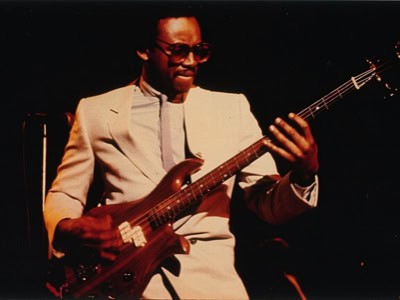
Bernard Edwards & David Bowie – The Chic Connection Behind Let’s Dance (1983)
Photo: Unknown photographer / Wikimedia Commons / CC BY-SA 3.0 (editorial use)
Bernard Edwards, best known as the bassist, songwriter, and co-founder of Chic, was indirectly connected to David Bowie’s 1983 album Let’s Dance, one of the most commercially successful releases of Bowie’s career.
While Edwards himself was not a central performer across the album, his musical influence — developed through his long-standing partnership with Nile Rodgers — formed a crucial part of the rhythmic and structural approach brought into Bowie’s work.
The Let’s Dance Sessions and Nile Rodgers’ Vision
The Let’s Dance album was conceived as a deliberate recalibration of Bowie’s relationship with the mainstream. After years of experimentation and fragmentation, Bowie sought clarity, accessibility, and strong rhythmic definition.
Producer Nile Rodgers shaped the album’s direction, applying the tight, groove-oriented philosophy he had developed together with Bernard Edwards in Chic.
The Chic Blueprint
Bernard Edwards’ influence on the project is best understood through what might be called the “Chic blueprint”: precise rhythm, minimal but effective bass movement, and a strong sense of musical architecture.
Even when Edwards himself was not directly responsible for specific bass parts, his approach to groove and arrangement was embedded in the musical language Rodgers brought into the sessions.
Without You – A Restrained Arrangement
“Without You” stands out on Let’s Dance as one of the album’s most restrained and emotionally exposed tracks.
The bass playing on the song is deliberately understated, functioning as a supportive foundation rather than a dominant element. While Edwards is sometimes associated with the album’s overall rhythmic identity, detailed performance credits for individual tracks are not always fully documented and should therefore be treated with caution.
Interplay Within the Rhythm Section
The album featured drummer Tony Thompson, another key member of Chic, whose disciplined and powerful style contributed significantly to the album’s rhythmic clarity.
Guitarist Stevie Ray Vaughan also played an important role on several tracks, though not necessarily across the entire album, adding a contrasting blues-based texture to the otherwise tightly controlled rhythm framework.
From Chic to Bowie
Bernard Edwards and Nile Rodgers had already reshaped popular music through Chic, producing influential tracks such as Le Freak and Good Times. Their work defined a new standard for groove and rhythmic precision.
When Rodgers brought this sensibility into Bowie’s music, it resulted in a cleaner, more accessible sound that differed significantly from Bowie’s late-1970s experimental output.
Behind the Scenes Influence
Edwards’ importance lies less in clearly identifiable performance credits and more in the broader musical system he helped create. His understanding of space, timing, and restraint shaped the way rhythm was approached within the Chic camp.
That philosophy carried into Let’s Dance, influencing the album’s overall structure even where Edwards himself was not directly foregrounded.
Impact on Bowie’s 1980s Sound
The success of Let’s Dance marked a major shift in Bowie’s career, bringing him unprecedented commercial success and introducing his music to a broader global audience.
The rhythmic clarity and accessibility of the album owe much to the Chic influence — and by extension, to Bernard Edwards’ musical legacy.
Cultural and Musical Legacy
Bernard Edwards remains one of the most influential bass players in modern music history. His work continues to shape funk, pop and hip-hop, particularly through the enduring impact of his basslines.
Within Bowie’s collaborative universe, Edwards represents a more indirect but still meaningful presence — part of the musical foundation that enabled one of Bowie’s most successful stylistic reinventions.