
The Royal Albert Hall of Arts and Sciences
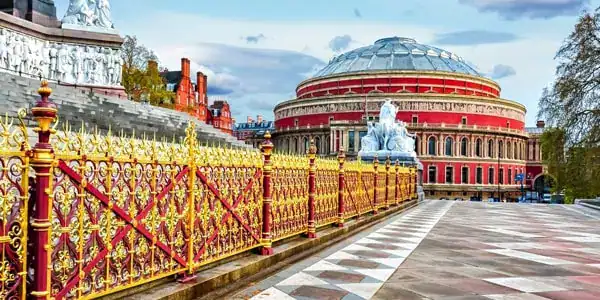
Image: David Bowie World collection / editorial use
The Royal Albert Hall of Arts and Sciences is one of London’s most famous performance venues, opened by Queen Victoria in 1871 and named in memory of Prince Albert.
In David Bowie’s story, the Royal Albert Hall is not a regular touring venue, but it holds a special late-career significance through Bowie’s surprise appearance with David Gilmour in May 2006, one of his final major live performances.
- Full name: Royal Albert Hall of Arts and Sciences
- Opened: 29 March 1871
- Location: Kensington Gore, South Kensington, London
- Named for: Prince Albert
- Bowie connection: Guest appearance with David Gilmour, 29 May 2006
- Key songs: “Arnold Layne”, “Comfortably Numb”
A landmark of London performance culture
The Royal Albert Hall was conceived as part of Prince Albert’s wider vision for the promotion of arts, science, culture and public education. After Albert’s death, Queen Victoria supported the creation of a major public hall that would stand as a living memorial to his ideals.
Officially opened on 29 March 1871, the building became one of Britain’s most recognisable cultural landmarks. Its circular auditorium, vast dome and ornate Victorian design made it unlike most other London venues, giving it a ceremonial and almost symbolic presence within the city.
From classical tradition to popular music
Although strongly associated with classical music, civic ceremonies and the BBC Proms, the Royal Albert Hall has also become an important venue for rock, pop, jazz, film, charity events and major cultural celebrations.
That range matters when placing David Bowie in relation to the hall. Bowie’s own career repeatedly crossed boundaries between high art, pop music, theatre, cinema and performance. The Royal Albert Hall, with its mixture of prestige and adaptability, reflects that same crossing of cultural categories.
London context and Bowie’s early years
Although the Royal Albert Hall was not located in David Bowie’s immediate neighbourhood, it formed part of the wider London cultural landscape that shaped his early career.
Bowie grew up in South London (Brixton and later Bromley), but as a young musician in the 1960s he frequently travelled into central London, where venues, studios, and performance spaces defined the city’s evolving music scene.
The Royal Albert Hall, as one of London’s most prestigious cultural venues, existed within that same environment — representing the kind of artistic stage that musicians of Bowie’s generation would ultimately aspire to reach.
David Bowie and the Royal Albert Hall
David Bowie did not use the Royal Albert Hall as a regular concert venue in the way he used some other London locations. His direct association with the hall is therefore limited but highly significant.
The most important Bowie-related event at the venue took place on 29 May 2006, when Bowie appeared as a surprise guest during David Gilmour’s concert at the Royal Albert Hall.
Bowie joined Gilmour to perform “Arnold Layne”, originally by Pink Floyd, and “Comfortably Numb”. The appearance is widely remembered because it came late in Bowie’s life and after he had largely withdrawn from regular live performance.
The 2006 David Gilmour appearance
Bowie’s Royal Albert Hall appearance with David Gilmour was not a full Bowie concert. It was a guest appearance, but its historical value is considerable. By 2006, Bowie had already stepped back from touring following the health problems that interrupted the A Reality Tour in 2004.
That made the Royal Albert Hall appearance feel unusually intimate and important. Bowie was not presenting a full stage persona or launching a new era; he was appearing briefly, almost quietly, in support of another artist he respected.
The performances of “Arnold Layne” and “Comfortably Numb” connected Bowie to a different strand of British rock history. Rather than centring his own catalogue, he entered the musical world of Pink Floyd and David Gilmour, showing again his ability to move naturally across artistic boundaries.
A late-career Bowie moment
The importance of the 2006 event is partly emotional. It belongs to the period after Bowie’s major touring life had effectively ended, and before his final studio return with The Next Day and Blackstar.
For that reason, the Royal Albert Hall stands as one of the rare places connected to Bowie’s final phase as a live performer. It is not a venue central to his early rise or his major tours, but it holds a special place in the closing chapter of his public performance history.
BBC Proms and Bowie’s legacy
After Bowie’s death in 2016, the Royal Albert Hall also became part of his legacy through tribute performances. The BBC Proms staged Bowie-related material at the hall, bringing his songs into a classical and orchestral concert setting.
This posthumous connection is important because it shows how Bowie’s work moved beyond the normal boundaries of rock music. His catalogue became suitable not only for clubs, theatres and arenas, but also for one of Britain’s most historically prestigious concert halls.
Why the venue matters in Bowie’s world
The Royal Albert Hall matters in Bowie’s world not because it was a regular stop on his tours, but because it represents cultural elevation, memory and late-career resonance.
Bowie’s connection to the hall is selective rather than extensive. That distinction is important. The page should not suggest that the Royal Albert Hall was a central Bowie venue throughout his career. Instead, its importance lies in a small number of meaningful moments: his 2006 guest appearance with David Gilmour and later public tributes to his work.
Legacy
The Royal Albert Hall remains one of the defining performance spaces in London. Its history stretches from Victorian cultural ambition to modern popular music, and its continued presence gives artists a stage associated with prestige, memory and artistic seriousness.
In the David Bowie story, the hall belongs to the quieter but deeply significant final chapters: a place where Bowie appeared not as a touring star, but as a guest artist, paying respect to another musical world while leaving behind one of his last major live memories.