
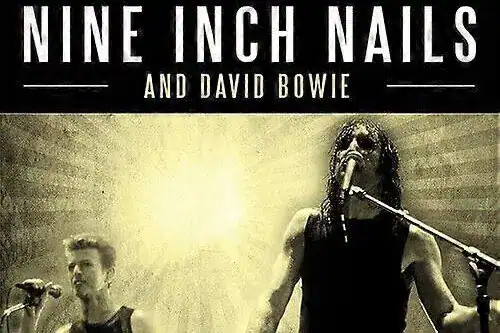
David Bowie & Nine Inch Nails – The Dissonance / Outside Tour 1995
In 1995, David Bowie entered one of the boldest reinventions of his live career through his alliance with Nine Inch Nails on the North American leg commonly known as the Dissonance Tour, tied to Bowie’s 1. Outside project. This was far more than a support slot or conventional co-headlining package — it was a collision between two generations of experimental intensity.
At the center stood Trent Reznor, whose work with The Downward Spiral had helped push industrial music into the cultural foreground. Bowie did not recruit Nine Inch Nails to borrow relevance; he aligned himself with a younger sonic language that echoed his own appetite for disruption.
From Tin Machine to Outside
The collaboration made sense in the arc of Bowie’s own evolution. After the creative reset of Tin Machine and the exploratory electronics of Black Tie White Noise, Bowie reunited with Brian Eno for 1. Outside, a fractured work of industrial textures, cut-up narrative, jazz dislocation and technological unease.
Rather than revisit former glories, Bowie positioned himself beside one of the most forward-thinking artists of the 1990s. That instinct — not nostalgia, but collision — defined the tour.
Nine Inch Nails Before the Tour
Nine Inch Nails had emerged through a singular fusion of industrial aggression, electronic programming, post-punk tension and dark melodic architecture. While Pretty Hate Machine announced a breakthrough, The Downward Spiral established Reznor as one of the defining sonic innovators of the era.
Its psychological intensity, studio experimentation and confrontational aesthetics made NIN an unusually fitting partner for Bowie’s own return to darker terrain.
Why Bowie Chose Nine Inch Nails
Bowie recognised in Reznor something familiar: alienation turned into invention. Like Bowie’s Berlin period, Reznor’s work transformed fragmentation into new musical language.
Their alliance was not based on generational symbolism but on shared artistic instincts: noise, decay, reinvention, danger.
The Shared Segue Performances
One of the most innovative aspects of the tour was the shared transition between the two acts. Rather than one band ending and another beginning in traditional fashion, Nine Inch Nails often flowed directly into Bowie’s set through collaborative segue performances.
Songs such as Subterraneans, Scary Monsters, Hallo Spaceboy, and versions involving NIN material like Reptile created a hybrid live zone where authorship blurred. This was one of the decade’s most daring concert concepts.
The Live Sound: Machine Meets Flesh
The sonic architecture of the tour was abrasive by design: mechanical rhythms, distorted guitars, processed vocals, sampling, feedback and industrial tension pushed Bowie’s material into new territory.
Older songs were sometimes reimagined almost beyond recognition, appearing as industrial shadows of themselves. Rather than preserve catalog prestige, Bowie allowed the material to mutate.
Audience Collision and Cultural Shock
The tour often produced divided audiences: industrial devotees, longtime Bowie followers, curious alternative-rock listeners. That friction was part of the event.
Rather than simply legitimize industrial music — which had already established major force — the tour helped bring that aesthetic into broader rock consciousness through Bowie’s willingness to inhabit it rather than merely reference it.
Trent Reznor and Bowie: Mutual Transformation
For Reznor, the collaboration represented validation from a foundational influence. For Bowie, Reznor acted less as disciple than catalyst: a younger artist pushing similarly radical questions.
The exchange sharpened Bowie’s relationship to electronics, rhythmic fracture and sonic aggression, elements that would continue into later work.
From Outside to Earthling
The tour helped catalyze Bowie’s renewed appetite for technological risk. Its aftershocks can be felt in Earthling, where drum-and-bass velocity, digital manipulation and fractured structures moved even further.
Rather than invent Bowie’s late-career renaissance, the tour intensified it. That distinction matters.
I’m Afraid of Americans
The Bowie–Reznor alliance deepened beyond the tour through I’m Afraid of Americans, especially the Reznor-produced remix versions and the iconic music video in which Reznor appeared as the ominous “Johnny.”
The track remains perhaps the definitive studio-era statement of their collaboration, bridging industrial paranoia and Bowie’s late-1990s urban dread.
The Closest Thing to a Bowie–NIN Single
If one recording stands as the definitive Bowie–Nine Inch Nails studio collaboration, it is I’m Afraid of Americans. With Trent Reznor’s V1 remix and his unforgettable appearance as “Johnny” in the video, the single became the closest thing Bowie and Nine Inch Nails ever made to a true co-credited collaborative single.
Bowie on Trent Reznor
In 2005 Bowie wrote a remarkable tribute to Trent Reznor for Rolling Stone’s “The Immortals,” describing The Downward Spiral in terms of both grandeur and horror and praising Reznor’s singular imagination.
The essay revealed something crucial: Bowie did not regard Reznor as follower or student, but as a major artist in his own right. That says much about their relationship.
Prepared Video Section – Bowie & Nine Inch Nails

Dissonance / 1.Outside tour 1995

Dissonance, live 1995
-
Dissonance / 1.Outside tour 1995
David Bowie & Nine Inch Nails Dissonance/ 1.Outside tour 1995. Production mix. The Man Who Sold the World Subterraneans Scary Monsters Reptile Halo Space Boy Hurt The Heart's Filthy Lesson Under Pressure For more David Bowie material which you might not find on other Bowie forums & social networking sites visit the forum in this link as a lot of my videos are posted there but 'unlisted 'here so they appear there long before they become 'public' on my channel.. 😉 Bowie Zone forum. -
Dissonance, live 1995
00:19 Wish - 04:09 Subterraneans - 07:28 Scary Monsters - 12:50 Reptile - 19:04 Hallo Spaceboy - 24:20 Hurt - 30:20 The Hearts Filthy Lesson - 35:32 The Man Who Sold The World - 39:05 Under Pressure -
Legacy of the Bowie–Nine Inch Nails Alliance
The Dissonance/Outside collaboration stands as one of the most fearless partnerships in modern rock. Bowie did not attempt to absorb youth culture — he confronted it, worked within it, and transformed through contact with it.
For Nine Inch Nails, the collaboration reinforced their artistic stature. For Bowie, it marked another reinvention through risk — a recurring principle across his career.
Afterlife of the Collaboration
The dialogue between Bowie and Reznor continued beyond the tour: through later performances, through Reznor and Atticus Ross’s “Farewell Mix” of I Can’t Give Everything Away, and through repeated tributes by Nine Inch Nails after Bowie’s death.
That continuing reverence suggests this was never a temporary alliance, but a genuine artistic kinship.