
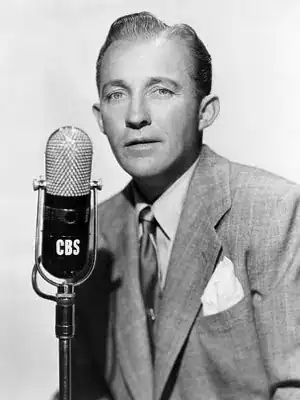
David Bowie & Bing Crosby – “Peace on Earth / Little Drummer Boy” (1977)
Photo: Unknown photographer / Wikimedia Commons / Public Domain (editorial use)
The duet between David Bowie and Bing Crosby on “Peace on Earth / Little Drummer Boy” stands as one of the most unexpected and enduring collaborations in television and popular music history.
Recorded on 11 September 1977 for Crosby’s final Christmas television special, the performance united two artists from entirely different cultural worlds: Crosby, the pre-rock-era voice of American popular song, and Bowie, then in the middle of his experimental Berlin period.
- Performance: “Peace on Earth / Little Drummer Boy”
- Artists: David Bowie and Bing Crosby
- Recorded: 11 September 1977, ATV Elstree Studios, Borehamwood, England
- Programme: Bing Crosby’s Merrie Olde Christmas
- US broadcast: 30 November 1977, CBS
- UK broadcast: 24 December 1977, ITV
- Single release: 1982, RCA
- Important note: “Peace on Earth” was written for the special as a counter-melody to “The Little Drummer Boy”
The Television Context
The performance was recorded for Bing Crosby’s Merrie Olde Christmas, a holiday television special built around traditional variety-show conventions. The programme featured Crosby, his family and several guest performers, including David Bowie, Twiggy, Ron Moody, Stanley Baxter and the Trinity Boys Choir.
Bowie’s presence in this setting was striking. In 1977 he was associated with Low, “Heroes”, European art-rock, electronic experimentation and the Berlin period. Crosby, by contrast, represented an earlier age of radio, film musicals and traditional popular song.
The contrast was precisely what made the pairing memorable. Rather than forcing Bowie into nostalgia or turning Crosby into a modern rock performer, the special allowed both artists to remain recognisably themselves.
Recording at ATV Elstree Studios
Bowie and Crosby recorded the duet on 11 September 1977 at ATV Elstree Studios in Borehamwood, England. The recording took place only weeks before Crosby’s death on 14 October 1977, making it one of his final recorded television performances.
The special later aired posthumously: first in the United States on CBS on 30 November 1977, and then in the United Kingdom on ITV on 24 December 1977.
Reworking “The Little Drummer Boy”
The original idea was for Bowie and Crosby to sing “The Little Drummer Boy” together. Bowie was reportedly uncomfortable with the song in its standard form, which led the programme’s musical team to create a new counter-melody.
That new part became “Peace on Earth”. It was written specifically for the special by Ian Fraser, Larry Grossman and Buz Kohan, allowing Bowie to sing a newly composed melodic line while Crosby delivered the traditional “Little Drummer Boy” melody.
This distinction is important: Bowie did not write “Peace on Earth”. His artistic contribution lay in the performance, interpretation and the way his voice created a modern counterpoint to Crosby’s traditional phrasing.
Musical Structure and Dialogue
The duet functions as a conversation rather than a conventional harmony performance. Crosby anchors the recording with warmth, stability and tradition, while Bowie introduces reflection, restraint and a contemporary emotional tone.
Their voices never compete. Instead, they coexist, representing two generations and two musical languages within a single arrangement.
David Bowie & Bing Crosby – Peace on Earth / Little Drummer Boy
The filmed performance remains powerful because of its simplicity. Bowie and Crosby sit in a domestic holiday setting, exchange brief scripted conversation and then perform without theatrical excess.
The understatement is part of its strength. The result feels less like a publicity stunt and more like a carefully staged encounter between two eras of popular music.
Generational Contrast
At the time of recording, Bing Crosby was seventy-four years old and already an icon of pre-rock popular culture. His career stretched back through radio, cinema and early television, and his version of “White Christmas” had become one of the defining recordings of the twentieth century.
Bowie was thirty years old and creatively restless. He had recently released Low, was preparing the release of “Heroes”, and was associated with European experimentation rather than mainstream television sentimentality.
The duet works because it does not erase that difference. It places the contrast in plain sight and allows the two performers to meet in the middle.
Visual Presentation
The staging is deliberately understated. Seated beside a fireplace, the two artists engage in casual conversation before the song begins, reinforcing a sense of personal exchange rather than spectacle.
Bowie’s subdued appearance and controlled delivery contrast sharply with his more theatrical stage identities. In this setting, his restraint becomes part of the performance.
Broadcast and Immediate Reception
Because Crosby died before the programme aired, the duet acquired an unintended sense of finality. What had been recorded as a Christmas television moment became, in retrospect, part of Crosby’s farewell to the public.
The performance was not originally released as a commercial single. It circulated through television memory before RCA issued it as a single in 1982, several years after the original broadcast.
Single Release and Later Success
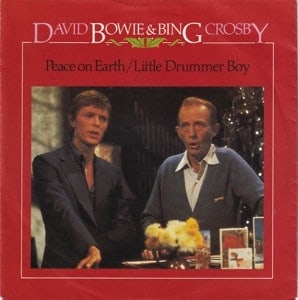
“Peace on Earth / Little Drummer Boy” was released as a single in 1982. By that time, its unusual pairing of Bowie and Crosby had already become part of seasonal pop culture memory through repeated television broadcasts.
The single reached number three on the UK Singles Chart and became one of Crosby’s final major chart successes, while also establishing itself as a recurring Christmas classic within Bowie’s catalogue.
Bowie’s Role in the Collaboration
Bowie’s contribution was not merely vocal. His presence changed the meaning of the performance. He brought a modern, reflective quality to a traditional Christmas setting and helped turn a familiar seasonal song into something more unexpected.
The duet reveals Bowie’s respect for tradition through reinterpretation rather than imitation. He did not simply enter Crosby’s world; he gently altered the emotional space around it.
Bing Crosby’s Final Television Moment
The performance is often remembered as one of Bing Crosby’s final major public appearances. Its quiet dignity and emotional balance contribute to its enduring power.
Rather than serving only as a novelty, the duet functions as a bridge between eras: one artist rooted in the golden age of American popular song, the other in the fragmented, experimental language of late twentieth-century rock.
Cultural Legacy
Today, the Bowie–Crosby duet stands as a rare example of cross-generational collaboration achieved without parody or obvious compromise.
It remains a testament to the idea that musical dialogue can transcend time, fashion and expectation.