
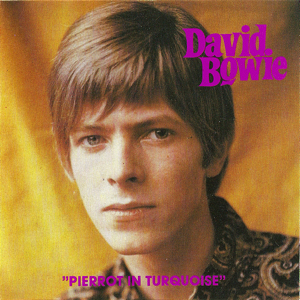
Turquoise – Bowie’s Transitional 1960s Band Before Space Oddity
Photo: Unknown photographer (source being verified)
Turquoise was a brief but important acoustic trio formed in 1968 by David Bowie, Hermione Farthingale and Tony Hill. Though short-lived, the group marked a crucial bridge between Bowie’s theatrical-mime period and the breakthrough that would soon become Space Oddity.
Rather than a failed detour, Turquoise represented Bowie in active artistic transition: mixing folk, poetry, mime, harmony singing and performance art in ways that already hinted at the multi-disciplinary imagination that would define his later career.
- Active: 1968
- Members: Bowie, Hermione Farthingale, Tony Hill
- Successor: Feathers
- Historical importance: Direct bridge toward Space Oddity
Members of Turquoise
Turquoise was structured as a three-part harmony folk trio featuring:
- David Bowie — vocals, guitar
- Tony Hill — vocals, guitar (formerly of The Misunderstood)
- Hermione Farthingale — vocals, guitar
The project continued Bowie’s growing fascination with acoustic textures, shared vocals and theatrical songwriting, while offering a gentler alternative to the mod and psychedelic groups of his earlier years.
The Roundhouse debut – September 14, 1968
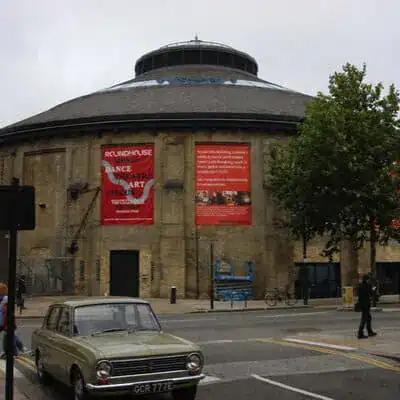
Photo: Oxyman / Wikimedia Commons / CC BY-SA 2.0 (editorial use)
Turquoise made its documented debut at London’s legendary Roundhouse on 14 September 1968.
The bill also featured The Scaffold, Pete Brown & His Battered Ornaments, Ron Geesin, Junior’s Eyes, Principal Edwards Magic Theatre, Terry Reid’s Fantasia and other figures from London’s underground — placing Bowie directly inside one of the capital’s most adventurous creative circles.
Only three live Turquoise performances are documented: 14 September, 16 September and 20 October 1968. That rarity makes the group one of the most elusive configurations in Bowie history.
Among those believed to have been in the audience was Angela Barnett, who would become Bowie’s first wife in March 1970 — a remarkable historical footnote linking this obscure performance to a major turning point in Bowie’s personal life.
The significance of the performance lies not only in the music, but in the setting itself. The Roundhouse was one of London’s great underground laboratories, where music, theatre, poetry and countercultural experimentation met — exactly the kind of environment in which Bowie’s hybrid artistic instincts could flourish.
Ching-A-Ling and the Trident session
On 24 October 1968, the Turquoise trio recorded Ching-A-Ling at Trident Studios with producer Tony Visconti — one of the few surviving recordings from Bowie’s Turquoise/early Feathers transition.
Though obscure, the recording survives as one of the clearest sonic documents of Bowie’s transitional pre-Space Oddity period.
From Turquoise to Feathers
Soon after, Tony Hill departed and was replaced by John “Hutch” Hutchinson, after which the trio became known as Feathers.
Under that name Bowie continued experimenting with acoustic music, poetry readings, mime and mixed-media performance at folk clubs and university venues. Turquoise did not end so much as evolve.
A period of reinvention
By the late 1960s Bowie had already moved through multiple bands, identities and artistic directions. Turquoise belongs to this restless period of searching, when he treated his career itself as experiment.
British folk, theatre, Jacques Brel, mime and London’s underground scene all fed into this moment. Many seeds of the later Bowie aesthetic can already be seen here.
Between mime, theatre and songwriting
This period coincided with Bowie’s deep immersion in performance art through Lindsay Kemp, whose influence reshaped Bowie’s understanding of gesture, character and symbolic performance.
Importantly, this should not be confused with Pierrot in Turquoise, the Lindsay Kemp stage production in which Bowie appeared as Cloud. That theatrical work and the band Turquoise were separate projects, though closely related in spirit.
Video: Bowie’s late-1960s theatrical and folk transition.
This rare material helps place Turquoise and the Lindsay Kemp period inside the wider artistic experimentation that led toward Space Oddity.
The sound of transition
Musically Bowie was moving toward more introspective and poetic writing, away from straight pop into stranger emotional territory.
Those developments would soon culminate in Space Oddity, where many of these experiments suddenly crystallized.
Why Turquoise matters
Even Bowie’s briefest ventures illuminate the discipline behind his later reinventions. Turquoise shows experimentation not as accident, but method.
It was one of the laboratories where Bowie was inventing himself.
Rosehill, Pierrot in Turquoise and the wider artistic context
Around this same broader period, Bowie appeared in approximately twenty-one documented performances of Pierrot in Turquoise, including Rosehill Theatre and later London productions.
Those performances deepened his sense of costume, movement and visual drama — ideas later visible from Ziggy Stardust to the Pierrot imagery of Ashes to Ashes.
Seen together, Turquoise, Feathers and the Lindsay Kemp collaborations were not failed detours, but laboratories in which Bowie’s future was being invented.
Legacy within Bowie’s evolution
Though rarely discussed, Turquoise occupies an important place in Bowie’s chronology: a bridge between youthful ambition and the singular artistic voice soon to emerge.
In retrospect, these fleeting transitional chapters reveal the method behind Bowie’s reinventions. Every experiment mattered.
🏛️ The Roundhouse
🎤 Artist: Turquoise
🗒️ Notes: Following the early experimental phase, the trio evolved into a stable line-up with David Bowie, Hermione Farthingale & John Hutchinson.
🏛️ Wigmore Hall
🎤 Artist: Turquoise
🗒️ Notes: Billed as ‘An Evening of Contemporary Music and Poetry’. David’s most ambitious attempt at high-art performance to date.
🏛️ Country Club, Haverstock Hill
🎤 Artist: Turquoise
🗒️ Notes: Final show under the name Turquoise. Following Tony Hill’s departure, the group would soon evolve into Feathers with John Hutchinson.