
Billy Corgan – Influence, Sound and Alternative Legacy
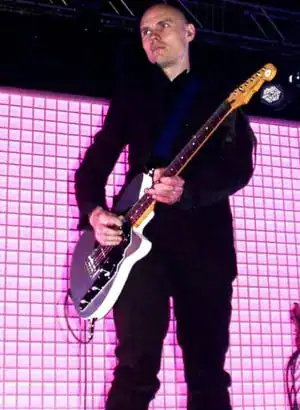
Photo: Unknown photographer / Wikimedia Commons / CC BY-SA 3.0 (editorial use)
Billy Corgan, frontman of The Smashing Pumpkins, is one of the most distinctive voices in alternative rock. Among his strongest artistic influences is David Bowie, whose work helped shape Corgan’s understanding of identity, reinvention and emotional expression in music.
Although not a studio collaborator, Corgan did share the stage with Bowie and developed a personal connection with him during the 1990s.
- Name: Billy Corgan (William Patrick Corgan Jr.)
- Born: 17 March 1967 (Chicago, USA)
- Band: The Smashing Pumpkins
- Role: Singer, songwriter, guitarist
- Bowie connection: Influence + live performance together (1997)
Alternative rock and identity
Billy Corgan emerged in the late 1980s and early 1990s as a central figure in alternative rock. With The Smashing Pumpkins, he created a sound that combined heavy guitars, melodic sensitivity and emotional introspection.
Like David Bowie, Corgan resisted simple categorisation and moved between contrasting emotional states within his music.
The Bowie influence
David Bowie’s influence on Corgan extends beyond sound into identity and artistic philosophy. Bowie demonstrated that an artist could continuously evolve, changing style and image without losing authenticity.
This idea became central to Corgan’s work, particularly in large-scale projects such as Mellon Collie and the Infinite Sadness.
Meeting Bowie and the 1990s connection
During the 1990s, Bowie and Corgan moved within overlapping musical circles and occasionally met through industry and label connections. While they were not close collaborators, they developed mutual respect.
Live performance – Madison Square Garden (1997)
The most direct collaboration between Bowie and Corgan took place in 1997, when Corgan was invited to perform at Bowie’s 50th birthday concert at Madison Square Garden.
On stage, the two performed “All The Young Dudes”, a song Bowie had originally written for Mott The Hoople. For Corgan, performing alongside Bowie was both a professional milestone and a deeply personal moment.
Sound and atmosphere
Albums such as Mellon Collie and the Infinite Sadness reflect a cinematic and layered approach to sound, echoing Bowie’s ability to create atmosphere and emotional depth within his work.
Corgan’s use of contrast — moving from quiet introspection to explosive intensity — parallels Bowie’s own exploration of dynamic range.
Reinvention and longevity
Throughout his career, Corgan has repeatedly changed direction, experimenting with different sounds and formats. This mirrors Bowie’s philosophy that reinvention is essential to artistic survival.
Tribute and legacy
After Bowie’s death in 2016, Corgan paid tribute through reflection and music. His song “Zowie” was written partly as a personal acknowledgement of Bowie’s influence.
Corgan has spoken about Bowie not only as an influence, but as a guiding artistic presence who helped define what it means to be a modern musician.
Live performance
David Bowie & Billy Corgan – All The Young Dudes (Live, 1997 at Bowie’s 50th birthday)
Place within Bowie’s legacy
Billy Corgan represents a generation of artists who absorbed Bowie’s ideas and translated them into alternative rock. His work demonstrates how Bowie’s influence extended into the 1990s and beyond.