
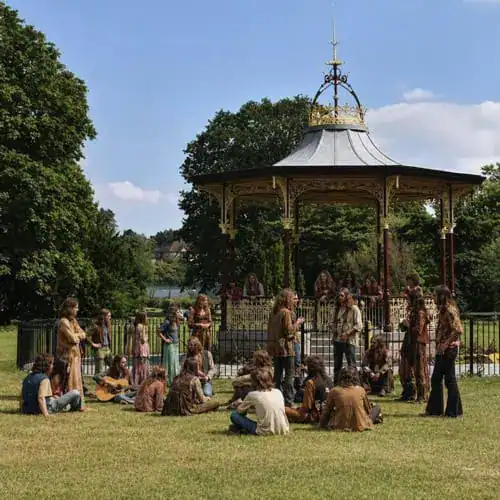
Photo: Unknown photographer / Wikimedia Commons / CC BY-SA 4.0 (editorial use)
Beckenham Place Park is one of the most important early locations in David Bowie’s career. It was here, at the park’s bandstand, that Bowie helped organise and perform at the legendary Beckenham Free Festival in 1969 — a defining moment in his transition from local artist to emerging creative force.
The park became an extension of the Beckenham Arts Lab community, transforming from a quiet suburban green space into a temporary cultural hub where music, art and experimentation came together in a uniquely open and collaborative environment.
- Location: Beckenham, London
- Main feature: Edwardian bandstand
- Bowie connection: Beckenham Free Festival (1969)
- Role: Outdoor Arts Lab expansion
The park as a creative space
In the late 1960s, Beckenham Place Park was an ordinary public park, but through Bowie’s involvement with the Beckenham Arts Lab it gained new meaning. The open space provided the perfect setting to expand the Arts Lab’s experimental spirit beyond pubs and indoor venues.
The park allowed for a different kind of interaction — less formal, more inclusive and closely aligned with the countercultural ideals of the time.
The bandstand: centre of activity
At the heart of the park stands the Edwardian bandstand, the exact location where Bowie and his collaborators staged the Beckenham Free Festival. This structure has since become known among fans as the “Bowie Bandstand”.
It was here that Bowie performed songs from his early repertoire, presenting himself not only as a musician but also as an organiser and creative leader.
Connection to the Free Festival
The Beckenham Free Festival transformed the park into a vibrant, temporary community space filled with music, poetry, stalls and artistic expression. Although relatively small in scale, it captured the essence of Bowie’s vision during this period.
The experience would later inspire the song “Memory of a Free Festival”, linking the physical location of the park directly to one of Bowie’s early compositions.
Part of the Beckenham network
Beckenham Place Park should not be seen in isolation. It was part of a wider network of locations connected to Bowie’s early development, including the Three Tuns Pub and Haddon Hall.
Together, these places formed the foundation of Bowie’s early creative identity, each contributing to a different aspect of his growth.
A place of transition
The park represents a key transition point in Bowie’s career. It marks the shift from small-scale local gatherings to larger public expression, showing his ability to bring people together through music and ideas.
This moment helped bridge the gap between experimentation and the more focused artistic direction that would soon follow.
Video
Memory of a Free Festival – inspired by Beckenham Place Park, 1969
Historical significance
Today, Beckenham Place Park remains an important historical site within the story of David Bowie. While the landscape itself has evolved, the bandstand continues to symbolise a moment of creativity, community and artistic ambition.
It stands as a reminder of a time when Bowie was still building his identity — experimenting, organising and connecting with audiences in a direct and personal way.
Place within Bowie’s early years
Within the broader timeline of Bowie’s career, Beckenham Place Park represents one of the clearest examples of his early vision in action. It shows how location, community and creativity came together to shape the artist he would become.
From this open space in Beckenham emerged ideas and experiences that would echo throughout his entire career.