
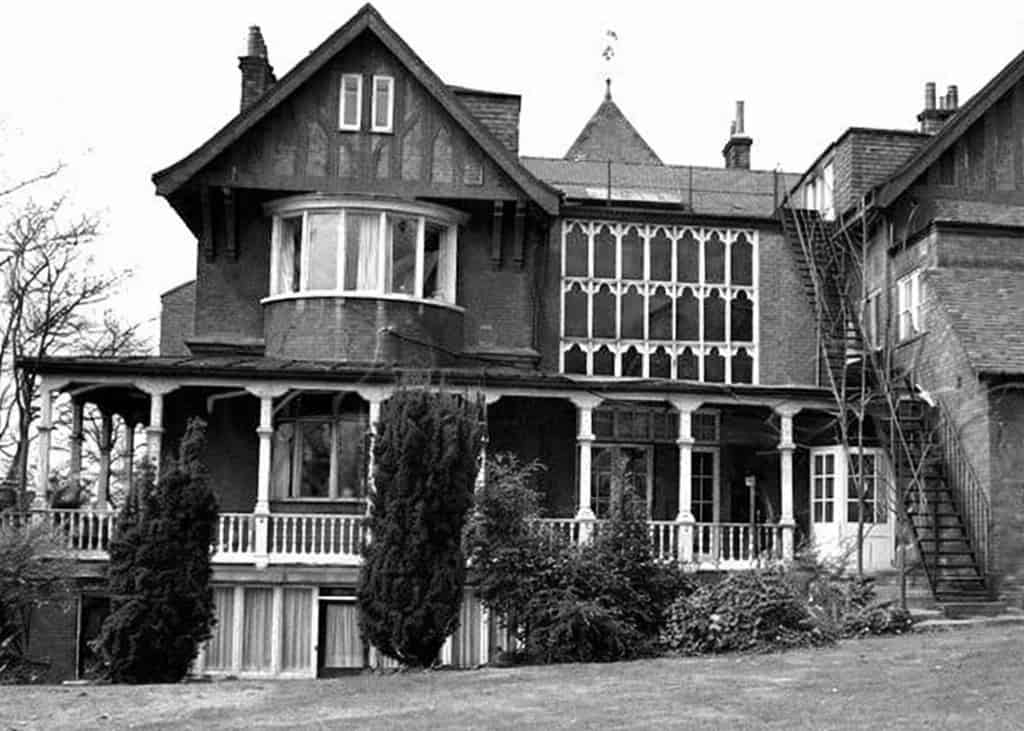
Haddon Hall (Beckenham) | Early Years & Space Oddity
Photo: Unknown photographer / Wikimedia Commons / CC BY-SA 4.0 (editorial use)
Haddon Hall in Beckenham was one of the most important locations in David Bowie’s early career, serving as both his home and creative headquarters between 1969 and 1970. At a crucial moment before his breakthrough, this large Victorian house became the place where ideas, collaborations and artistic direction began to take shape.
More than just a residence, Haddon Hall functioned as a communal creative space. Musicians, friends and collaborators gathered here, creating an atmosphere of constant experimentation that would directly influence Bowie’s development during the Space Oddity era.
- Location: Beckenham, London
- Period: 1969–1970
- Role: Creative residence & collaboration hub
- Bowie connection: Space Oddity development period
The move to Beckenham
By the end of the 1960s, David Bowie had already begun to establish himself within the Beckenham arts scene through his involvement with the Arts Lab and performances at local venues such as the Three Tuns Pub. Moving into Haddon Hall marked a significant step forward, providing him with both space and freedom to develop his ideas further.
The house, located on Southend Road, was large but somewhat run-down, which made it ideal for communal living. It quickly became a focal point for Bowie’s creative circle.
A shared creative environment
Haddon Hall was not a traditional home. Instead, it functioned as a shared living and working space where musicians and friends would come and go freely. Instruments were always present, rehearsals happened spontaneously, and ideas were constantly exchanged.
This environment encouraged experimentation without pressure, allowing Bowie to explore new musical and artistic directions.
The Space Oddity period
During his time at Haddon Hall, Bowie was developing the material that would lead to Space Oddity. While the recording itself took place in a professional studio, the conceptual groundwork and creative atmosphere that shaped the song were rooted in this period.
Themes of isolation, space and identity — which would become central to Bowie’s early success — were already forming during his time in Beckenham.
Connections to the Beckenham scene
The house remained closely connected to the wider Beckenham creative network. Friends and collaborators from the Arts Lab and local performances frequently gathered there, maintaining the sense of community that had begun at the Three Tuns Pub.
This network played an important role in supporting Bowie’s development, offering both inspiration and collaboration.
From local artist to emerging figure
Haddon Hall represents the transition between Bowie’s early experimental phase and the beginning of wider recognition. It was here that his confidence as a songwriter and performer began to solidify.
The move from local performances and small-scale events towards recorded success can be traced directly through this period.
Demolition and legacy
Although Haddon Hall itself no longer exists, its importance within Bowie’s history remains significant. It stands as a symbol of his formative years — a place where creativity, collaboration and ambition came together.
For fans and historians, it represents one of the key locations where David Bowie began to evolve into the artist who would soon achieve international success.
Video
Early Bowie period – Beckenham and Space Oddity era
Historical significance
Haddon Hall is one of the most important early locations in David Bowie’s career. It provided the environment in which his artistic identity began to take clearer shape, bridging the gap between experimentation and recognition.
Without this period of communal creativity and freedom, the transition to his breakthrough years might have been very different.
Place within Bowie’s development
Within the broader timeline of David Bowie’s career, Haddon Hall represents a turning point. It captures the moment where potential began to transform into direction, laying the groundwork for everything that followed.
From this shared house in Beckenham emerged the foundations of one of the most influential careers in modern music history.