
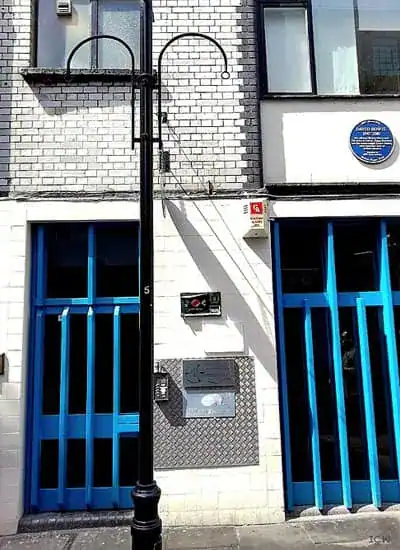
David Bowie – Trident Studios (London)
Photo: Unknown photographer / Wikimedia Commons / CC BY-SA 4.0 (editorial use)
Trident Studios in London played a decisive role in David Bowie’s early recording career, marking the point where his experimental ideas were transformed into fully realised music. It was here that Bowie recorded some of his most important early work, including Space Oddity and later sessions for Hunky Dory.
Unlike the informal environments of his earlier years, Trident Studios offered a professional recording setting, allowing Bowie to refine his sound with greater precision and ambition.
- Location: Soho, London
- Period: Late 1960s – early 1970s
- Type: Recording studio
- Bowie connection: Recording Space Oddity & Hunky Dory
From experimentation to production
By the late 1960s, David Bowie had begun to move beyond purely experimental performance spaces and into professional recording environments. Trident Studios provided the technical capabilities needed to realise his increasingly ambitious musical ideas.
This shift marked a crucial step in Bowie’s development, as his work began to take on a more polished and distinctive character.
Recording Space Oddity
One of the most significant moments at Trident Studios was the recording of Space Oddity (1969). The song combined storytelling, atmosphere and innovative production techniques, setting Bowie apart from his contemporaries.
Its success marked Bowie’s first major breakthrough, bringing him international attention.
Collaboration and musicians
At Trident, Bowie worked with talented musicians and producers who contributed to the development of his sound. Notably, pianist Rick Wakeman played a key role in shaping the musical texture of his recordings.
These collaborations helped elevate Bowie’s work from experimental concepts to fully realised compositions.
The Hunky Dory sessions
Trident Studios also hosted sessions for Hunky Dory (1971), an album that showcased Bowie’s growing confidence as a songwriter. The record combined introspective lyrics with sophisticated arrangements, further establishing his artistic identity.

Photo: Netherzone / Wikimedia Commons / CC BY-SA 4.0
Songs such as Life on Mars? demonstrated the depth and ambition of his work during this period.
Video
Important places in the early life of David Bowie
A professional breakthrough
Recording at Trident Studios marked Bowie’s transition into a fully professional artist. The quality of production and the collaborative environment allowed him to compete on an international level.
This period laid the groundwork for the creative explosion that would follow in the early 1970s.
Historical significance
Trident Studios is remembered as one of the key locations in David Bowie’s early career. It represents the moment when his ideas were translated into recordings that would reach a global audience.
Without this environment, Bowie’s breakthrough might have taken a very different form.
Place within Bowie’s development
Within Bowie’s early timeline, Trident Studios stands as the bridge between experimentation and success. It connects the creative exploration of the late 1960s with the confident artistry of the early 1970s.
From this point onward, Bowie’s trajectory would accelerate, leading to some of the most influential work in modern music history.
Breakthrough recording – 1969
🏛️ Trident Studios
🎸 Event: Recording session – “Space Oddity”
🗒️ Notes: Bowie records “Space Oddity” at Trident Studios, produced by Tony Visconti (with Gus Dudgeon overseeing the track). The song becomes his first major breakthrough and is released shortly after the Apollo 11 moon landing.
The Man Who Sold the World era – 1970
🏛️ Trident Studios
🎸 Event: Recording sessions – album development
🗒️ Notes: Bowie records material for The Man Who Sold the World with Tony Visconti and Mick Ronson. These sessions mark a decisive shift toward a heavier, more electric rock sound.
Hunky Dory sessions – 1971
🏛️ Trident Studios
🎸 Event: Recording session – “Changes” / “Oh! You Pretty Things”
🗒️ Notes: Bowie begins recording Hunky Dory at Trident Studios. The sessions introduce Rick Wakeman on piano and showcase a more refined songwriting approach.
🏛️ Trident Studios
🎸 Event: Album sessions continue
🗒️ Notes: Recording continues throughout June 1971, producing key tracks that would define Bowie’s early 1970s sound and artistic identity.
The Rise and Fall of Ziggy Stardust – 1971–1972
🏛️ Trident Studios
🎸 Event: Recording session – Ziggy Stardust album begins
🗒️ Notes: Bowie and the Spiders from Mars begin recording what will become The Rise and Fall of Ziggy Stardust and the Spiders from Mars, one of the most influential albums in rock history.
🏛️ Trident Studios
🎸 Event: Ziggy Stardust sessions continue
🗒️ Notes: Recording continues into early 1972, refining the sound and structure of the Ziggy concept before its release later that year.
Aladdin Sane sessions – 1972–1973
🏛️ Trident Studios
🎸 Event: Recording sessions – Aladdin Sane
🗒️ Notes: Bowie records parts of Aladdin Sane at Trident Studios between tour commitments. The album expands the Ziggy sound into a more experimental and avant-garde direction.
The importance of Trident Studios
🏛️ Trident Studios, Soho
🎸 Event: Primary recording location
🗒️ Notes: Trident Studios became Bowie’s main recording base during his breakthrough years. Equipped with advanced technology and a distinctive sound, it played a crucial role in shaping albums such as Space Oddity, Hunky Dory and Ziggy Stardust.