
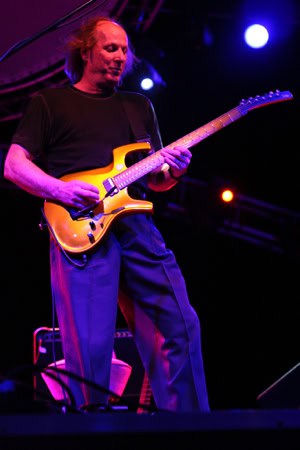
Adrian Belew – Innovative Guitarist on David Bowie’s 1978 World Tour
Photo: Unknown photographer / Wikimedia Commons / CC BY-SA 3.0 (editorial use)
Adrian Belew is an American guitarist, singer and composer whose brief but explosive collaboration with David Bowie in 1978 left a lasting impact on Bowie’s live sound. Belew’s radical use of guitar effects, textures and non-traditional techniques transformed the concerts into sonic experiments.
Although his time with Bowie was short-lived, it proved decisive for both artists, launching Belew into international recognition and reinforcing Bowie’s commitment to musical risk.
- Born: 1949, Covington, Kentucky, USA
- Instrument: Guitar
- With Bowie: 1978
- Tour: Isolar II World Tour
Early career
Adrian Belew emerged in the mid-1970s as a guitarist unlike any other, treating the guitar not merely as a melodic instrument but as a source of sound effects, textures and animal-like noises. His early work reflected influences from experimental rock, avant-garde music and electronic sound design.
Joining David Bowie
Belew came to David Bowie’s attention after performing with Frank Zappa. Bowie was immediately struck by Belew’s unorthodox approach and recruited him for the 1978 world tour supporting the Berlin Trilogy albums.
The 1978 Isolar II World Tour
During the Isolar II tour, Belew’s guitar work became a defining element of the live shows. He used pitch-shifting, feedback, delay and envelope filters to create sounds resembling sirens, animals and industrial noise, expanding the emotional and sonic range of Bowie’s music.
His playing injected volatility into otherwise structured material, ensuring that each performance felt unpredictable and alive.
Creative tension and departure
Despite the artistic success of the tour, tensions emerged. Belew’s growing recognition and strong musical personality eventually conflicted with Bowie’s vision of band balance. After the tour concluded, Bowie chose not to continue the collaboration.
After Bowie
Following his work with Bowie, Belew joined Talking Heads and later became a key member of King Crimson, where his experimental guitar language found a permanent home. His career continued to thrive as a solo artist and collaborator.
Legacy
Adrian Belew’s contribution to David Bowie’s live history represents a moment of pure experimentation. His fearless approach to sound aligned perfectly with Bowie’s late-1970s artistic ambition, leaving an enduring imprint on how Bowie’s music could be performed beyond the studio.