
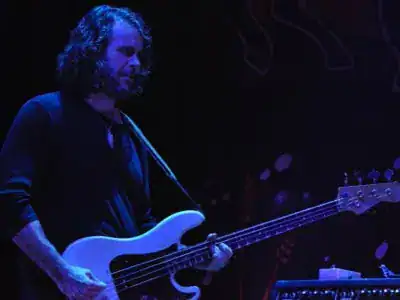
Tim Lefebvre – Bas Guitar Donny McCaslin Group
Photo: Unknown photographer / Wikimedia Commons / CC BY-SA 3.0 (editorial use)
Tim Lefebvre is an American bassist, composer and producer whose work became central to David Bowie’s final creative chapter. As part of the musicians assembled for Blackstar, Lefebvre helped shape one of the boldest and most innovative albums of Bowie’s career.
Drawing equally from jazz improvisation, electronic texture and rock power, his bass playing contributed to the restless, unstable and deeply modern sound Bowie pursued in his final years.
- Born: 1968, United States
- Role: Electric bass, effects bass
- Blackstar core band: Donny McCaslin, Tim Lefebvre, Mark Guiliana, Jason Lindner
- With Bowie: 2014–2015 (album released 2016)
- Key recordings: “Blackstar”, “Lazarus”, “Sue (Or In A Season Of Crime)”
- Era: Bowie’s final studio period
How Bowie found Tim Lefebvre
The Bowie connection began through the 2014 recording of Sue (Or In A Season Of Crime), arranged by Maria Schneider. Hearing saxophonist Donny McCaslin’s band led Bowie to the musicians who would become the core of Blackstar.
Rather than rely on familiar rock collaborators, Bowie deliberately sought contemporary musicians rooted in modern jazz and improvisation. Tim Lefebvre became a crucial part of that decision.
The Blackstar sessions


Recorded at New York’s Magic Shop, the Blackstar sessions were highly collaborative. Bowie encouraged the musicians to bring their own instincts into the material rather than imitate older Bowie styles.
That freedom allowed Lefebvre’s distinctive approach — fluid, aggressive and textural — to become part of the album’s identity.
Bass as a driving force
On several central Blackstar recordings, Lefebvre’s bass provides much of the music’s propulsion. His playing moves beyond conventional accompaniment, acting as pulse, melody and atmosphere simultaneously.
One of his most celebrated contributions is the title track Blackstar itself, where heavily processed electric bass, combined with octave effects, helps create the ominous elastic groove that drives the piece. That sound has become one of the album’s defining signatures.
The Blackstar core musicians
The musicians most associated with Bowie’s final sound were:
Donny McCaslin – tenor saxophone
Tim Lefebvre – bass
Mark Guiliana – drums
Jason Lindner – keyboards
Together they formed the core ensemble behind much of Blackstar, bringing a contemporary jazz vocabulary into Bowie’s songwriting.
Bowie’s collaborative method
Lefebvre has spoken about Bowie’s openness during the sessions. Ideas were often developed through experimentation, with Bowie responding to what the musicians generated in the room.
This method made the record feel less like a traditional rock album and more like a living ensemble project.
No tour, lasting legacy
Bowie did not tour in support of Blackstar, but after his death members of the McCaslin group performed the music in tribute concerts and repertory performances, demonstrating how deeply the material belonged to the musicians who helped create it.
Those performances reinforced that Blackstar was not simply Bowie using jazz musicians — it was a genuine collaborative fusion.
Why Tim Lefebvre matters in Bowie’s story
Lefebvre represents Bowie’s lifelong instinct to keep moving toward the new. Rather than ending his career with nostalgia, Bowie built his final masterpiece around players from a younger experimental scene.
In that sense, Tim Lefebvre stands among the final major new collaborators Bowie brought into his music.
Beyond Bowie
Outside the Bowie project, Lefebvre is also widely known for work with David Sylvian, Tedeschi Trucks Band, Wayne Krantz, Elvis Costello, and many other adventurous projects.
Yet for many listeners, his bass work on Blackstar remains his most iconic recorded contribution.