Susan SarandonThe Hunger and the David Bowie Collaboration

Susan Sarandon
Photo: David Shankbone / Wikimedia Commons / CC BY-SA 3.0 (editorial use)

Susan Sarandon is an American actress whose collaboration with David Bowie in The Hunger (1983) remains one of the most striking intersections between Bowie’s cinematic image and early-1980s gothic cinema.

Their screen partnership brought together Sarandon’s grounded emotional intensity and Bowie’s fragile, otherworldly presence, creating a film relationship filled with desire, mortality and unease.

Key facts
  • Born: October 4, 1946, New York City, United States
  • Role: Actress
  • Shared work with Bowie: The Hunger (1983)
  • Bowie connection: Co-star and former romantic partner

Early 1980s cinema context

By the early 1980s, David Bowie was expanding his artistic reach beyond music, increasingly drawn to film roles that allowed him to inhabit complex, stylised and psychologically charged characters.

Susan Sarandon was also moving through a period of bold artistic choices, taking on roles that resisted simple Hollywood formulas and placed her inside darker, more ambiguous stories.

The Hunger (1983)

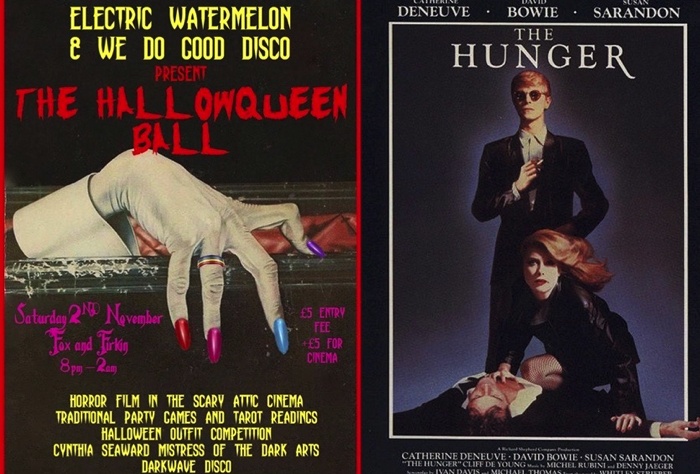
Directed by Tony Scott, The Hunger is a stylised erotic horror film centred on immortality, desire, aging and decay. Bowie plays John Blaylock, a centuries-old vampire whose promised eternal youth suddenly begins to collapse.

Sarandon portrays Dr. Sarah Roberts, a scientist studying sleep and aging, who becomes drawn into the dangerous world of John and Miriam Blaylock.

Shared performances

  • The Hunger (1983) — Susan Sarandon and David Bowie appear together in a film that places Bowie’s screen persona in one of its most haunting cinematic settings.

Contrasting screen presences

Sarandon’s performance is grounded, analytical and emotionally human, providing a stark contrast to Bowie’s fragile, decaying immortality.

That contrast gives the film much of its tension. Bowie appears both seductive and doomed, while Sarandon’s character becomes the emotional and moral centre of the story.

Bowie’s cinematic persona

The Hunger reinforced Bowie’s reputation as a performer uniquely suited to roles exploring alienation, beauty, transformation and impermanence.

His casting alongside Sarandon and Catherine Deneuve placed him within a serious dramatic context, rather than presenting him simply as a musician making a screen appearance.

Off-screen connection

During the period around The Hunger, Sarandon and Bowie also developed a private romantic relationship. Sarandon later confirmed that they had shared what she described as a “really interesting period,” speaking of Bowie with warmth and admiration.

What seems to have drawn them together was not simply attraction, but a meeting of minds. Both were intellectually curious, artistically adventurous and drawn to work that challenged conventional expectations.

Their relationship was brief and discreet, but it has remained one of the more intriguing and understated personal chapters connected to Bowie’s film career.

A landmark of gothic and queer cinema

Over time, The Hunger developed a cult reputation, especially within gothic and queer film culture. Its dreamlike imagery, erotic tension and stylised treatment of desire gave it a life far beyond its original critical reception.

The opening sequence, featuring Bauhaus performing Bela Lugosi’s Dead, became one of the defining images of gothic cinema in the 1980s.

Sarandon and Bowie remain central to that legacy, representing two very different kinds of screen presence drawn into the same hypnotic world.

Bowie’s extraordinary performance

One of the film’s most haunting elements is Bowie’s portrayal of accelerated aging and decay. His transformation from elegant immortal to abandoned, collapsing figure remains one of the most unsettling performances of his screen career.

The role connects closely to themes that had always surrounded Bowie’s art: beauty, artificiality, identity, time and the fear of disappearance.

Sarandon on Bowie

In later years, Sarandon spoke of Bowie with deep affection, often emphasising his intelligence, humour and creative seriousness rather than only his fame.

After Bowie’s death in 2016, she revealed that she had been able to reconnect with him before he passed away, a detail that suggested their bond had never entirely disappeared.

Cult legacy

Although initially divisive, The Hunger has endured as a cult film admired for its atmosphere, music, styling and visual language.

Sarandon and Bowie’s collaboration is now regarded as central to the film’s lasting appeal.

Place within Bowie’s universe

Within David Bowie’s extended creative universe, Susan Sarandon represents the cinematic counterpart to his musical collaborations — a meeting of two serious performers inside a carefully constructed aesthetic world.

Their shared work in The Hunger remains one of the clearest examples of Bowie’s ability to translate his artistic identity into film.

Why it still matters

The connection between Susan Sarandon and David Bowie endures because it sits at the intersection of art, cinema, desire and private history.

It was not a public spectacle, nor merely a footnote. It was a brief but meaningful meeting between two independent artists whose work in The Hunger continues to fascinate.

Like the film itself, their connection carries an atmosphere of mystery, elegance and emotional afterglow.

Leave a comment