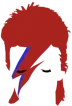
On March 19, 1970 yours truly was a 19-year-old junior reporter in the Bromley and Kentish Times newspaper office in south-east London. One day I answered a phone and a woman said: “I think you should know that David Bowie is getting married today at 11 o’clock at Bromley Register Office.”
Bowie lived at Haddon Hall in the neighbouring suburb of Beckenham and was a minor local celecbrity, having scored a hit single with “Space Oddity” in 1969, inspired by Stanley Kubrick’s 1968 film “2001: A Space Odyssey” and the first Moon landing on July 20, 1969. “Thanks. Who’s calling?” I asked the woman. “Well, it’s David’s mother,” she replied. “But don’t tell him I told you. He doesn’t want his fans to know.”
This was a little amusing because one-hit-wonder Bowie basically wasn’t overwhelmed with fans at the time. As the Swinging Sixties had exploded all around him, he went through a succession of unsuccessful groups – The Konrads, Manish Boys, The King Bees, The Buzz, The Lower Third, The Riot Squad – and his new solo single, “The Prettiest Star”, which was the follow-up to “Space Oddity”, and new album, “The World of David Bowie”, were both flopping on release in March 1970.
It was to be a whole year of struggle. He was uncertain of his artistic direction, was trying to put together a regular band and wanted to dump his manager, Ken Pitt. Bowie was open to influence, dabbling in mime, and he was thinking of ending his participation in the Beckenham Arts Lab, held each Sunday at the Three Tuns Pub, near his home. But to do what?
Following the secretive phone call from Mrs Jones, I summoned a Kentish Times photographer and we proceeded to the register office. I also alerted the Ferrari Press Agency in Sidcup, Kent, which serviced the Fleet Street national newspapers. If Ferrari’s owner, Geoff Garvey, could sell the story, I would get a cut. Despite Bowie’s middling profile, Garvey thought the wedding had potential and he sent his own reporter and photographer.
So when Bowie, his bride-to-be Mary Angela Barnett, Bowie’s Mum Margaret “Peggy” Jones and a handful of friends turned up, there were the four media men waiting outside, notebooks and cameras poised. Bowie was taken aback but polite, and he introduced Angie, an American, describing her as a model. The couple were vividly dressed, Bowie with rat-tail hair and an Afghan coat. Mum was dressed like the Queen, in matching jacket and skirt and hat, with clutch bag, and she stood between the couple as they obliged the two press cameramen.
After a few minutes’ chat with we two reporters, Bowie took his party inside, understandably leaving the journalists on the pavement. When the newlyweds emerged 20 minutes or so later, the press quartet was still hanging around. Bowie’s lot adjourned across the road for celebratory drinks in the Swan and Mitre pub, but when the reporters followed, Bowie’s face showed that he had clearly had enough of the uninvited quartet.
We took the hint and disappeared. Garvey sold the story with photo to one of the two London afternoon papers that day, and the Bromley and Kentish Times, a weekly containing strictly local news, had it on the front page. The photo was cropped, showing the top half of the happy couple and Mum in the middle. Nobody in the Bowie bunch seemed to have bothered to bring a camera, at least not outside, so otherwise the event would have gone unrecorded.
Soon after, though I can’t find the date, Bowie played for free in Bromley Library Gardens with a band billed as Harry the Butcher, which could have been The Hype under a pseudonym. When Bowie saw me in attendance, I got a glare from him as he recalled the fellow who had publicized his “secret” wedding.
My mate Ken was involved in the running of the Beckenham Arts Lab, and one day he said, “Bowie’s making a comeback in Eltham, do you want to go?”. This was Avery Hill College on February 25, 1972, and wham, bam, it turned out to be the nascent Spiders from Mars in full flow, with the costumes, the haircuts, the guitar fellatio, the lot. It was in a college hall and there was a reasonable standing crowd. It was so good that just a week or so later I went to Imperial College, London, to see them again. Bigger venue, bigger crowd… something was definitely building for Bowie, and fast. With the release of the “The Rise and Fall of Ziggy Stardust and the Spiders from Mars” album in June, 1972, he exploded. So finally I was at the Rainbow in Finsbury Park, London, on either August 19 and 20, 1972 and that was it… Bowie/Ziggy had hit the big time, as they say. Roxy Music was the support.
Well, almost finally. From 1980 to 1984 I was a journalist in Sydney, Australia, and used to walk the kilometre from home to the office via the Grace Bros. store on Broadway. I often stopped to look in the book section and one day there was a “David Bowie Black Book”. Thumbing through I was astonished, to say the least, to find a page filled with four photos of the wedding, two of the photos cropped as I’d seen before – Bowie, Mum and Angie – and two full-length shots – with yours truly standing in the background with notebook poised. Believe me, it is quite a shock to find yourself unexpectedly in a book.
And… I liked “Hunky Dory” so much that I pestered my mate at RCA about when there would be a new Bowie album. Then one day he sent me an unmarked white-label test pressing. It was “The Rise and Fall of Ziggy Stardust and the Spiders from Mars” and it was tremendous. I sold it, among other albums, for two pounds to a record shop in Bromley when I was saving to go on the hippie trail in 1973.
Submitted by Maddock Christopher
⭐️ Rating: 5/5
Great story