
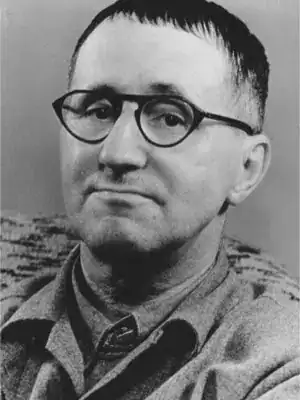
Bertolt Brecht – Theatrical Radical and a Deep Influence on David Bowie
Photo: Kolbe / Wikimedia Commons / CC BY-SA 3.0 (editorial use)
Bertolt Brecht (10 February 1898 – 14 August 1956) was one of the most influential playwrights and theatrical thinkers of the twentieth century. A poet, dramatist, and director, Brecht reshaped modern theatre through his concept of epic theatre and his insistence that audiences should think, not merely feel.
For David Bowie, Brecht represented a radical artistic stance: the outsider as truth-teller, the performer as commentator, and art as a deliberate construction rather than an emotional illusion.
- Name: Bertolt Brecht (born Eugen Berthold Friedrich Brecht)
- Born: 10 February 1898 (Augsburg, Germany)
- Died: 14 August 1956 (East Berlin, German Democratic Republic)
- Role: Playwright, poet, theatre director, cultural theorist
- Bowie link: BBC television adaptation of Baal (1982) + Baal EP + “Alabama Song”
- Core idea: Distance, performance, and art as critical awareness
Why Brecht mattered to Bowie
Bowie was drawn to artists who rejected naturalism and embraced artifice. Brecht’s insistence on showing the mechanics of performance — breaking illusion, exposing power structures, and foregrounding contradiction — aligned perfectly with Bowie’s lifelong exploration of identity as something constructed and fluid.
Rather than inviting empathy alone, Brecht wanted audiences to remain alert and critical. Bowie adopted a similar stance in music and performance, often placing emotional material inside stylised, distancing frameworks.
Early influence and pre-Ziggy context
Long before the Ziggy Stardust era, Bowie immersed himself in mime, theatre, and European modernism. Through figures such as Lindsay Kemp, Bowie encountered Brechtian ideas that treated the stage as a space for ideas, not illusion.
This intellectual theatre tradition offered Bowie a way to escape Anglo-American rock conventions and align himself with a broader, darker European cultural lineage.
“Alabama Song” – Brecht and Weill through Bowie
One of the clearest intersections between Brecht and Bowie is “Alabama Song”, originally written by Brecht with music by Kurt Weill for Rise and Fall of the City of Mahagonny. Bowie performed the song live in 1978 and released it as a studio single in 1980.
Bowie’s version strips away theatrical polish and replaces it with nervous urgency, irony, and alienation — qualities entirely in keeping with Brecht’s original intent.
Bowie as Brecht’s Baal
In 1982, Bowie took on the role of Baal in a BBC television adaptation of Brecht’s early play. The project coincided with the release of the Baal EP, featuring songs written for the production.
Bowie’s performance emphasised Baal’s cruelty, sensuality, and moral emptiness, presenting him as a destructive outsider figure — a role that resonated strongly with Bowie’s own fascination with anti-heroes.
Brechtian distance and Bowie’s personas
Brecht argued that performers should never fully “become” a character, but should instead demonstrate it. Bowie adopted this principle throughout his career, from Ziggy Stardust to the Thin White Duke and beyond.
In this sense, Bertolt Brecht stands not as a collaborator in the studio, but as a conceptual architect within Bowie’s creative universe — a guiding force behind Bowie’s theatrical intelligence and self-aware artistry.