
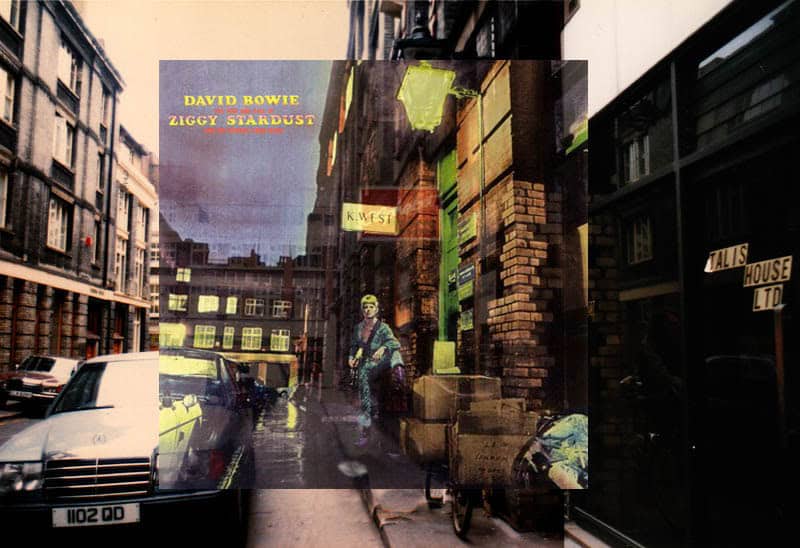
David Bowie – 23 Heddon Street (London)
Photo: Bob Egan / Pop Spots / CC BY-SA
23 Heddon Street in London is one of the most iconic locations in David Bowie’s career. It is the exact spot where the cover photograph for The Rise and Fall of Ziggy Stardust and the Spiders from Mars was taken in 1972.
This seemingly ordinary street became legendary overnight, capturing Bowie at the moment he fully transformed into Ziggy Stardust — the alter ego that would redefine his image and elevate him to international fame.
- Location: Mayfair, London
- Year: 1972
- Famous for: Ziggy Stardust album cover
- Photographer: Brian Ward
- Era: Rise of Ziggy Stardust
The Ziggy Stardust transformation
By 1972, David Bowie had fully embraced the concept of Ziggy Stardust — a fictional rock star from another world. The photo shoot at 23 Heddon Street visually introduced this persona to the world, marking a turning point in Bowie’s career.
The image, with Bowie standing under a glowing “K. West” sign, perfectly captured the atmosphere of early 1970s London while adding a sense of mystery and otherworldliness.
Why this location was chosen
The choice of Heddon Street was largely practical. Photographer Brian Ward selected the location near his studio, but the street’s narrow, urban character and lighting conditions created a striking visual composition.
What might have been a simple logistical decision became one of the most recognisable images in music history.
A street becomes iconic
Following the release of the Ziggy Stardust album, 23 Heddon Street gained international recognition. Fans began visiting the location, turning it into a pilgrimage site for Bowie admirers.
Over time, the street has changed, but its connection to Bowie remains firmly embedded in cultural history.
The “K. West” sign
One of the defining elements of the album cover is the “K. West” sign visible in the background. This detail added an extra layer of intrigue and has become inseparable from the imagery of Ziggy Stardust.
The sign still exists today, reinforcing the authenticity of the location.
From location to legend
Unlike many other places associated with Bowie’s career, 23 Heddon Street is not a performance venue or studio. Its importance lies entirely in its visual and symbolic impact.
It represents the moment where image, music and identity came together to create one of the most powerful artistic statements of the 20th century.
Video
The story behind the Ziggy Stardust cover and 23 Heddon Street
Historical significance
23 Heddon Street stands as one of the most important visual landmarks in David Bowie’s career. It marks the moment where his artistic vision became fully realised and globally recognised.
The location continues to attract fans and remains a permanent part of Bowie’s legacy.
Place within Bowie’s career
Within the broader timeline of Bowie’s career, this location represents the breakthrough into international stardom. It connects directly to the Ziggy Stardust era, one of the most influential periods in music history.
From this single street in London, Bowie’s image and identity would reach audiences around the world.