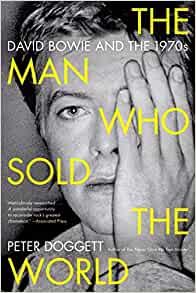
No artist offered a more incisive and accurate portrait of the troubled landscape of the 1970s than David Bowie. Through his multi-faceted and inventive work, he encapsulated many of the social, political and cultural themes that ran through this most fascinating of decades, from the elusive promise of scientific progress to the persistent fear of apocalypse that stalked the globe. *
In The Man Who Sold The World: David Bowie and the 1970s, cultural historian Peter Doggett explores the rich heritage of the artist’s most productive and inspired decade, and traces the way in which his music reflected and influenced the world around him. * The book follows his career from ‘Space Oddity’, his dark vision of mankind’s voyage into the unknown terrain of space, to the Scary Monsters album. It examines in detail his audacious creation of an ‘alien’ rock star, Ziggy Stardust, and his own increasingly perilous explorations of the nature of identity and the meaning of fame, against the backdrop of his family heritage of mental instability. * Among the book’s wider themes are the West’s growing sense of insecurity in the age of oil shortages and terrorism; the changing nature of sexual roles, as represented by Bowie’s pioneering adoption of a bisexual persona; the emergence of a new experimental form of rock music that would leave an indelible mark on the decades to come; and the changing nature of many of the world’s great cities, including London, New York, Los Angeles and Berlin, each of which played host to Bowie during particularly creative periods of his career. * Mixing brilliant musical critique with biographical insight and acute cultural analysis, The Man Who Sold The World is a unique study of a major artist and his times.
Editorial Reviews
Review
“Meticulously researched….A wonderful opportunity to reconsider rock’s greatest chameleon.” — Lisa Ko, author of The Leavers
“Packed with insight, a go-to text for anyone who wants to understanding what Doggett calls ‘the uncanny strangeness of the seventies Bowie,’ and the creative process that led to his artistic breakthroughs.” — San Francisco Chronicle
“Explores themes in Bowie’s most inventive period – from sexual identity to the nature of fame. Doggett’s song-by-song analysis will make obsessive fans of the ‘Ziggy Stardust’ days want to pull out their old vinyl.” — USA Today
“Details a decade of styles and influences of one of rock’s most enigmatic personalities….A complete treat.” — Library Journal
“Meticulous….A captivating look at an artist who defined an era.” — Publishers Weekly
“A thoughtful combination of critical observation and biographical digging….Doggett’s sparkling work of biocriticism is full of entertaining anecdotes and flashes of insight.” — Booklist (starred review)
“Astonishing and absorbing…Expertly unpicks this explosively creative time in Bowie’s life…. [Doggett intercuts] the individually tailored song biographies with essays on everything from glam rock, minimalism and punk, to radical left-wing politics, music video and a mass of other subjects that helped shape the ideas behind Bowie’s songs.” — Rob Fitzpatrick, Sunday Times (London)
“Doggett’s previous book, You Never Give Me Your Money: the Battle for the Soul of the Beatles, was the perfect preparation for writing about both the Seventies and Bowie.” — Toby Litt, New Statesman
“There aren’t many writers who have the combination of classic-rock knowledge, reverence for an artist and sheer patience to successfully pull off this sort of project.” — Kirkus Reviews
From the Back Cover
No artist offered a more compelling portrayal of the landscape of the 1970s than David Bowie. From his first hit, “Space Oddity,” in 1969 to the release of the LP Scary Monsters (and Super Creeps) in 1980, Bowie cultivated an innovative and shocking brand of performance, a mesmerizing blend of high-concept science fiction and old-fashioned rock ‘n’ roll, delivered in skintight spandex and operatic alien makeup. Through songs at once prescient and esoteric, beautiful and haunting, Bowie cut hard against the grain of ’60s and ’70s pop music, replacing it with something far more intriguing: a dark, fantastical vision that heralded the dawn of a new decade.
In The Man Who Sold the World, acclaimed journalist Peter Doggett explores the rich heritage of Bowie’s most productive and inspired decade. Viewing the artist through the lens of his music and his many guises, Doggett offers a detailed analysis—musical, lyrical, conceptual, social—of every song Bowie wrote and recorded during that period, as well as a brilliant exploration of the development of a performer who profoundly affected popular music and the idea of stardom itself.
About the Author
Peter Doggett’s books include Are You Ready for the Country: Elvis, Dylan, Parsons and the Roots of Country Rock,the award-winning There’s a Riot Going On: Revolutionaries, Rock Stars and the Rise and Fall of the ’60s, and You Never Give Me Your Money: The Beatles After the Breakup, which was chosen as one of the 10 Best Books of 2010 by the Los Angeles Times.