
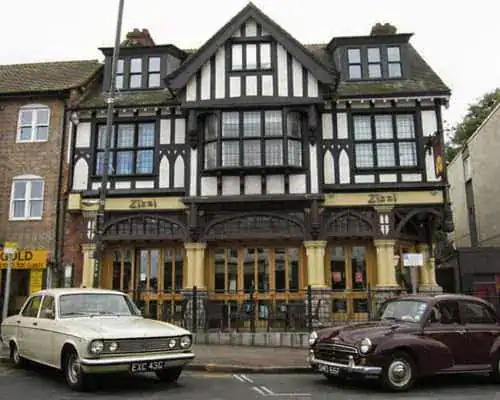
David Bowie – Three Tuns Pub (Beckenham)
Photo: Unknown photographer / Wikimedia Commons / CC BY-SA 4.0 (editorial use)
The Three Tuns Pub in Beckenham played a crucial role in David Bowie’s early career, serving as the central meeting place for the Beckenham Arts Lab between 1968 and 1969. At a time when Bowie was still searching for artistic direction, this modest suburban pub became the foundation of a creative community that helped shape his identity.
More than just a venue, the Three Tuns functioned as a laboratory of ideas — a place where music, mime, poetry and experimentation came together. It represents one of the earliest environments in which Bowie began to define himself not only as a musician, but as a multidimensional artist.
- Location: Beckenham, London
- Period: 1968–1969
- Role: Arts Lab headquarters
- Bowie connection: Early creative development & community building
The Beckenham period
By the late 1960s, David Bowie had yet to achieve commercial success and was still exploring different artistic paths. After moving to Beckenham, he became increasingly involved in the local arts scene, seeking new ways to express himself beyond conventional pop music.
This period marked a transition from uncertainty to experimentation. Rather than focusing solely on recording, Bowie immersed himself in performance, collaboration and artistic exploration.
The birth of the Arts Lab
The Beckenham Arts Lab was an informal collective that brought together musicians, poets, performers and creatives. Operating out of the Three Tuns Pub, it provided a space where unconventional ideas could be explored without commercial pressure.
Events organised by the Arts Lab included music performances, mime acts, poetry readings and experimental showcases. Bowie was at the centre of these activities, helping to shape both the vision and the atmosphere of the group.
A creative laboratory
The importance of the Three Tuns lies in its function as a testing ground. Here, Bowie could experiment freely, blending influences from theatre, visual art and music. His collaboration with mime artist Lindsay Kemp had already begun to influence his approach to performance, and this theatrical sensibility became increasingly visible during this period.
The environment encouraged risk-taking and reinvention — qualities that would later define Bowie’s entire career.
From pub to festival
The activities centred around the Three Tuns eventually led to the organisation of the Beckenham Free Festival in 1969. This outdoor event expanded the Arts Lab’s vision into a larger public setting, bringing together music and community in a way that reflected the countercultural spirit of the time.
The festival marked an important step forward, demonstrating Bowie’s ability not only to perform, but also to initiate and shape cultural events.
Early songs and identity
During this period, Bowie was developing material that would lead to his breakthrough with Space Oddity. While the Three Tuns itself was not a recording studio, it played a vital role in shaping the ideas and confidence behind his early work.
It was here that Bowie began to move away from imitation and towards a more personal artistic voice.
Community and collaboration
One of the defining aspects of the Three Tuns era was its collaborative nature. Bowie was surrounded by a network of creatives who contributed to an atmosphere of shared experimentation. This sense of community helped him refine his ideas and develop his stage presence.
Unlike later periods of his career, where Bowie often operated as a singular visionary, this phase was deeply collective.
Video
Important places in the early life of David Bowie
Historical significance
The Three Tuns Pub represents one of the earliest identifiable hubs in David Bowie’s career. It was here that the foundations of his artistic philosophy were laid — experimentation, reinvention and the blending of disciplines.
Although modest in scale, its impact was profound. Without the creative freedom and community found in Beckenham, Bowie’s later breakthroughs might have taken a very different path.
Place within Bowie’s development
Within the broader trajectory of David Bowie’s career, the Three Tuns period stands as the moment where possibility began to take shape. It bridges the gap between his early struggles and the emergence of a distinctive artistic identity.
From this small suburban pub would grow one of the most innovative and influential careers in modern music history.