
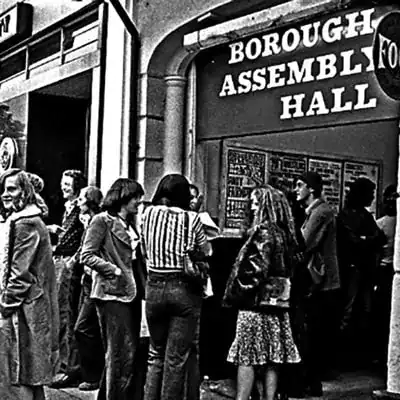
David Bowie – Friars Club (Aylesbury)
Photo: Unknown photographer / Wikimedia Commons / CC BY-SA 4.0 (editorial use)
The Friars Club in Aylesbury was one of the most important venues in David Bowie’s transition toward the Ziggy Stardust era. Between 1971 and 1972, Bowie used this club as a testing ground for new material, refining both his music and his stage identity.
Unlike earlier venues where experimentation dominated, Friars represented a turning point — a place where Bowie’s ideas began to solidify into a clear artistic direction that would soon redefine popular music.
- Location: Aylesbury, Buckinghamshire
- Period: 1971–1972
- Type: Live music club
- Bowie connection: Development of Ziggy Stardust material
A turning point in Bowie’s career
By the early 1970s, David Bowie had begun to move beyond the uncertainty of his earlier years. Albums such as Hunky Dory (1971) showed a growing confidence, but it was through live performance that Bowie truly refined his artistic vision.
Friars Club became a crucial environment for this transformation, offering a receptive audience and the freedom to experiment with new ideas on stage.
Testing the Ziggy concept
At Friars, Bowie introduced early versions of songs that would later appear on The Rise and Fall of Ziggy Stardust and the Spiders from Mars. These performances allowed him to explore the theatrical possibilities of his music.
The character of Ziggy Stardust began to take shape here, not fully formed, but clearly emerging through Bowie’s evolving stage presence.
The audience connection
The relatively intimate setting of Friars Club created a direct connection between Bowie and his audience. This interaction was essential in shaping the emotional and visual impact of his performances.
Bowie learned how to control the atmosphere of a room, a skill that would later define his arena shows.
Building a live identity
Unlike earlier venues where Bowie experimented with multiple styles, Friars marked a period of consolidation. His performances became more focused, combining music, theatre and visual identity into a cohesive whole.
This was the moment where Bowie began to fully understand the power of persona in performance.
Video Important places in the early life of David Bowie
Important places in the early life of David Bowie
Video Gallery
-

-
David Stopps promoter of the legendary Friars Club recalls Mr Bowie
-
Watch Video
-
-
-
David Bowie 18 07 1972 Borough Assembly Hall, Friars Club, Aylesbury
-
Watch Video
-
-
-
David Bowie Friars Club Aylesbury july 15th 1972
-
Watch Video
-
-
-
Bowie 1972 july 15 Friars Club Aylesbury silent footage
-
Watch Video
-
-
-
David Bowie - Friars - Aylesbury 1971
-
Watch Video
-


From club to global stage
The performances at Friars Club acted as a bridge between Bowie’s early experimentation and his global breakthrough. Shortly after this period, Ziggy Stardust would emerge as a defining cultural figure.
The lessons learned in Aylesbury directly influenced Bowie’s approach to performance, storytelling and visual presentation.
Historical significance
Friars Club holds a special place in Bowie’s history as one of the locations where his most iconic phase began to take shape. It represents the moment when potential became direction.
For fans and historians alike, it stands as a key chapter in the story of Bowie’s artistic evolution.
Place within Bowie’s development
Within the broader timeline of David Bowie’s career, Friars Club marks the transition from exploration to definition. It connects the experimental late 1960s with the revolutionary early 1970s.
From this point forward, Bowie would move with increasing clarity toward becoming one of the most influential artists in modern music.