
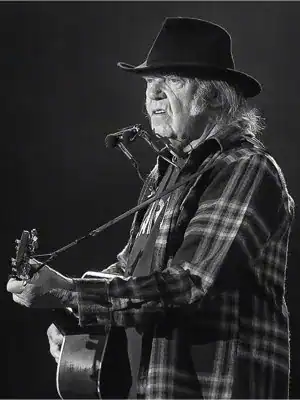
David Bowie & Neil Young – Bridge School Benefit (1996)
Photo: Odd Andersen / Wikimedia Commons / CC BY-SA 4.0 (editorial use)
In 1996, David Bowie appeared as a special guest at the legendary Bridge School Benefit, joining forces with Neil Young in one of the most spiritually charged and musically intimate charity environments in the history of live rock music. This was not spectacle — it was restraint, purpose, and acoustic truth.
Founded by Neil Young and Pegi Young, the Bridge School Benefit existed to serve children with severe speech and physical impairments, placing human necessity above performance ego.
- Year: 1996
- Event: Bridge School Benefit
- Main artists: David Bowie & Neil Young
- Format: Primarily acoustic performances
- Purpose: Charity for children with speech impairments
- Significance: One of Bowie’s most intimate live appearances of the 1990s
Neil Young – The spiritual counterweight of rock music
By 1996, Neil Young stood as one of the most uncompromising figures in modern music history. His career moved freely between folk introspection, distorted electric fury, political protest and raw personal confession.
Where others hardened into brands, Young remained a permanent shape-shifter — a quality that aligned him naturally with Bowie’s own resistance to creative safety.
The philosophy of the Bridge School Benefit
Unlike conventional charity concerts, the Bridge School Benefit imposed a strict rule: performances were primarily acoustic. Amplification as spectacle was removed, forcing songs to survive on intention, lyric and vulnerability.
This environment demanded authenticity — which is precisely why Bowie’s presence carried such symbolic weight.
Why Bowie’s appearance mattered
Bowie had just emerged from the industrial extremity of the Outside era. To then step into an acoustic charity setting represented a radical emotional shift.
At Bridge School, Bowie was not the architect of futurism — he was a human voice in a vulnerable room.
The Bowie–Neil Young intersection
Though born of different cultural geographies, Bowie and Young shared a core principle: art must remain dangerous. Their shared appearance symbolised the convergence of two philosophical rebels.
Prepared video section – acoustic charity performance
David Bowie – Bridge School Benefit 1996 (Acoustic Performance)
Neil Young, Patti Smith & David Bowie — “Helpless” (Bridge School Benefit)
Legacy of the collaboration
Though brief, the Bowie–Neil Young connection at the Bridge School Benefit remains one of the most humanly meaningful intersections in Bowie’s collaborative history.
It demonstrated that beneath experimentation and persona, Bowie’s work was always anchored in empathy.