David Bowie & Arnold Corns – The Prototype of Ziggy Stardust

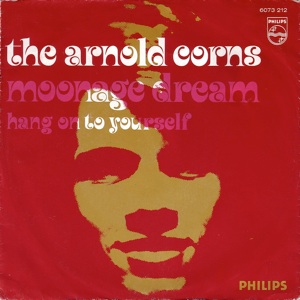
Arnold Corns — Moonage Daydream / Hang On to Yourself single sleeve
Arnold Corns occupies one of the most fascinating and misunderstood positions in David Bowie’s artistic evolution. Active briefly in the early 1970s, Arnold Corns was not a conventional band in the usual sense, but a pseudonymous and partly theatrical project through which Bowie tested songs, image strategies and identity games that would soon feed into The Rise and Fall of Ziggy Stardust and the Spiders from Mars.
The project is best understood as a prototype space: part recording alias, part glam experiment, part visual misdirection. Its importance lies not in commercial success, but in the way it reveals Bowie moving from singer-songwriter toward myth-maker.
- Active: 1971–1972
- Core figure: David Bowie
- Visual figure: Freddie Burretti / Rudi Valentino
- Key songs: Moonage Daydream, Hang On to Yourself
- Importance: Proto-Ziggy experiment and pseudonymous recording project
The origin of Arnold Corns
The project emerged in 1971, during a period when Bowie was experimenting with identity, image and presentation. The name Arnold Corns was deliberately artificial and strange, matching Bowie’s growing fascination with manufactured personas and fictional rock identities.
Rather than presenting new material directly under his own name, Bowie used Arnold Corns as a kind of mask. This allowed him to explore new ideas publicly while keeping a degree of separation between the songs, the image and the artist David Bowie.
Contractual disguise and pseudonym
Arnold Corns also served a practical purpose. Because Bowie was navigating record-company complications during this period, the project functioned partly as a pseudonymous vehicle through which new material could be issued outside his own name.
That mixture of necessity and invention is central to the project’s appeal. Arnold Corns was both a workaround and an artistic experiment — a sign of Bowie’s instinct for turning practical problems into mythology.
The musicians behind Arnold Corns
The earliest Arnold Corns recordings featured musicians associated with the group Rungk, including guitarist Mark Carr-Pritchard, bassist Polak de Somogyl and drummer Tim Broadbent. Their rougher, less polished sound gave the original recordings a rawer edge than the later Ziggy Stardust versions.
These recordings were not final statements. They were sketches, tests and transitional documents — valuable precisely because they show Bowie’s ideas before they became fully formed.
A vehicle for glam experimentation
Musically, Arnold Corns served as a testing ground for a heavier and more theatrical direction than Bowie’s earlier folk-leaning work. The project leaned toward raw rock energy, stylised aggression and exaggerated performance.
The early Arnold Corns versions of Moonage Daydream and Hang On to Yourself already contain the DNA of Ziggy Stardust, even though the later album versions would be sharper, more powerful and more fully realised.
Freddie Burretti and the Arnold Corns image

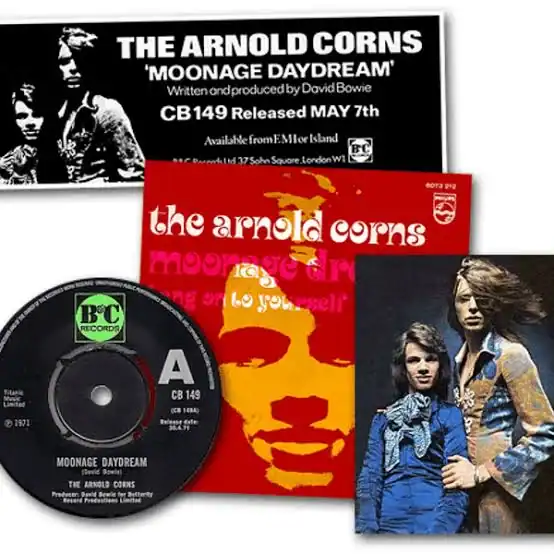
One of the most intriguing aspects of Arnold Corns was the use of Freddie Burretti, sometimes billed as Rudi Valentino, as a visual focal point for the project. Burretti — later important as a costume designer in Bowie’s Ziggy era — helped embody the emerging glam aesthetic.
However, despite long-standing mythology, the lead vocals on the original Arnold Corns recordings of Moonage Daydream and Hang On to Yourself were sung by David Bowie, not Burretti. In that sense Arnold Corns was less a band fronted by Freddie than a Bowie pseudonym wrapped in theatrical disguise.
Identity as performance
Arnold Corns was not simply a musical experiment. It was a demonstration of Bowie’s growing belief that identity itself could be staged, worn, discarded and redesigned.
The project challenged the assumption that a band had to be “real” in a traditional sense. Instead, it embraced artificiality as an aesthetic and philosophical tool.
The relationship to Ziggy Stardust
The connection between Arnold Corns and Ziggy Stardust is direct and historically important. The project introduced prototype versions of songs that would later become central to Bowie’s Ziggy mythology.
What Arnold Corns lacked in coherence, Ziggy Stardust gained in narrative focus. What Arnold Corns tested, Ziggy mythologised.
Further Arnold Corns recordings
The Arnold Corns story did not end with the first single. Later recordings including Man in the Middle and Looking for a Friend expanded the project, showing it as both prototype and parallel experiment.
The 1972 release of Hang On to Yourself as an Arnold Corns A-side came after Ziggy Stardust had begun to change Bowie’s public profile, giving the project a second life among collectors and fans.
Arnold Corns in performance and myth
Arnold Corns — early Bowie mythology before Ziggy Stardust
Rare Arnold Corns footage and recordings reveal Bowie’s transitional move from songwriter into myth-maker.
In embryo, many Ziggy elements are already present: alien glamour, aggressive rock textures, role-playing as art and the idea of a fictional rock identity.
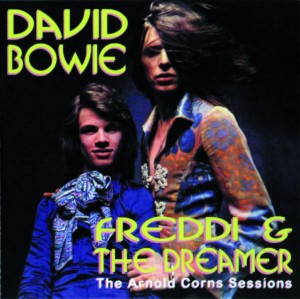
The Arnold Corns bootlegs
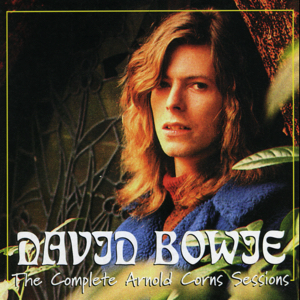
Because Arnold Corns sat at the edge of Bowie’s official discography, the project became especially attractive to collectors. Original singles, later reissues, bootlegs and archive appearances helped keep the material alive long after its initial commercial failure.
For Bowie historians, the appeal lies in hearing familiar Ziggy-era songs before they became canonical. The Arnold Corns versions are rougher and stranger, but that is exactly what makes them valuable.
Legacy
Though rarely discussed outside specialist circles, Arnold Corns holds enormous historical value. It represents the moment where Bowie consciously crossed from singer-songwriter into architect of myth.
The project’s commercial failure hardly matters. Its real achievement was conceptual: Arnold Corns gave Bowie a laboratory in which he could test songs, masks and strategies that would soon transform popular music through Ziggy Stardust.