
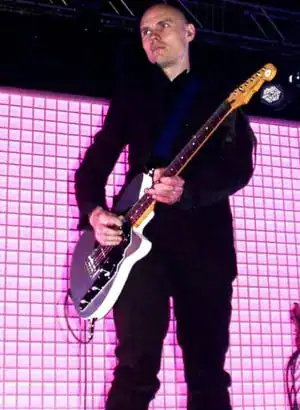
David Bowie – 50th Birthday Concert, Madison Square Garden (2002)
Photo: Unknown photographer / Wikimedia Commons / CC BY-SA 3.0 (editorial use)
On January 7, 2002, David Bowie celebrated his 50th birthday with one of the most monumental live events of his entire career: a star-studded anniversary concert at Madison Square Garden, New York City. What unfolded that night was not a nostalgic revue, but a living cross-section of five decades of musical mutation, collaboration, and creative survival.
The concert functioned simultaneously as a birthday celebration, an artistic summit, and a cultural mirror held up to Bowie’s unparalleled influence across genres, generations, and identities. The guest list itself formed a living genealogy of Bowie’s impact.
Madison Square Garden as Symbolic Arena
Madison Square Garden is not merely a venue — it is a symbolic arena of cultural legitimacy and historical magnitude. By staging his 50th birthday there, Bowie placed the milestone not in a private context, but in the full glare of global cultural memory.
This was not a farewell, but a declaration of endurance. Bowie was not retreating into legacy — he was standing at the center of it.
The Concept: Celebration Without Sentimentality
Unlike many anniversary concerts, the MSG event refused sentimentality. There was no soft-focus nostalgia, no emotional rewind button. Instead, Bowie curated the evening as a confrontation between past, present, and future.
Songs were not treated as museum artifacts. They were collision points — reshaped by the voices and identities of those who had inherited Bowie’s artistic DNA.
Lou Reed – The Velvet Underground Axis
One of the most symbolically loaded appearances of the night was that of Lou Reed. Reed and Bowie shared one of the deepest artistic kinships in modern music. Bowie’s early career was inseparably linked to his championing of The Velvet Underground.
Their shared presence on the MSG stage sealed a historical circuit: mentor and successor, underground and mainstream, art and abrasion unified in real time.
Dave Grohl – Post-Grunge Energy and Post-Modern Muscle
Dave Grohl, representing the post-Nirvana generation, brought a muscular, post-grunge vitality into Bowie’s musical bloodstream. His presence symbolized Bowie’s grip on contemporary rock momentum decades after his debut.
Grohl’s involvement reinforced Bowie’s refusal to become a static icon. Instead, he remained a participant in the evolving body of rock power.
Billy Corgan – Alternative Melancholy and Gothic Scale
Billy Corgan of The Smashing Pumpkins embodied a different Bowie inheritance: emotional maximalism, theatrical melancholy, and myth-scale songwriting.
His presence added a grand, aching emotional dimension to the evening — a reminder that Bowie’s influence extended as deeply into vulnerability as it did into power.
The Role of Gail Ann Dorsey
Once again, Gail Ann Dorsey stood at Bowie’s side as his primary live vocal anchor. Her voice acted as the emotional stabilizer across decades of material — bridging glam, soul, industrial fracture, and post-millennial reflection.
In the anniversary setting, Dorsey’s presence symbolized continuity: the human constant inside Bowie’s shifting identities.
A Living Timeline, Not a Greatest Hits Show
The 50th Birthday Concert did not unfold as a traditional “greatest hits” sequence. Instead, it functioned as a living timeline.
The audience did not merely witness Bowie’s history — they inhabited it.