
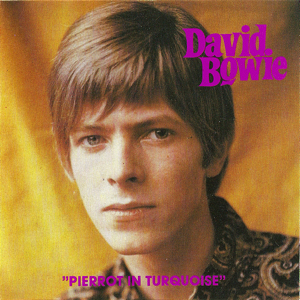
Turquoise
Photo: Unknown photographer Wikimedia file page
Turquoise was a short-lived and largely undocumented musical project connected to David Bowie in the late 1960s. Existing between his theatrical folk experiments and the creative leap that would produce Space Oddity, the project represents a crucial — if often overlooked — transitional moment in Bowie’s artistic evolution.
During this period, Bowie was redefining himself both musically and visually, moving away from mod-era pop toward a more introspective songwriting style that blended folk sensitivity with dramatic storytelling.
- Active: Circa 1968
- Type: Transitional Bowie project
- Era: Post-mime / pre-Space Oddity
- Historical importance: Reflects Bowie’s search for a defining sound
Members of Turquoise
Turquoise was structured as a trio featuring three musicians who each contributed vocals and guitar:
- David Bowie — vocals, guitar
- Tony Hill — vocals, guitar
- Hermione Farthingale — vocals, guitar
The group represented a continuation of Bowie’s late-1960s exploration of acoustic textures, harmony-driven arrangements and theatrical songwriting. Farthingale, Bowie’s partner at the time, had already collaborated closely with him artistically, while Tony Hill brought additional musical depth to the trio’s sound.
The Roundhouse debut – September 14, 1968
Turquoise made their documented live debut at London’s legendary Roundhouse on 14 September 1968. The concert placed Bowie among some of the era’s most forward-thinking performers and exposed the trio to one of the capital’s most culturally adventurous audiences.
The event was headlined by The Scaffold and Pete Brown & His Battered Ornaments, with a diverse lineup that included Ron Geesin, Terry Reid’s Fantasia, Junior’s Eyes and Principal Edwards Magic Theatre.
Only three performances by Turquoise are known to have taken place: 14 September, 16 September and 20 October 1968 — making the project one of the rarest live configurations of Bowie’s early career.
A period of reinvention
By the late 1960s, David Bowie had already passed through several bands, identities and musical directions. Unlike many emerging artists who quickly settled into a recognizable style, Bowie approached his early career as an ongoing experiment.
Turquoise belongs to this restless phase — a time when Bowie was absorbing influences from British folk, theatrical songwriting and the rapidly expanding creative energy of London’s underground culture.
Between mime, theatre and songwriting
The project coincided with Bowie’s deep immersion in performance art and mime, particularly through his work with choreographer Lindsay Kemp. These experiences reshaped Bowie’s understanding of stage presence, movement and narrative, elements that would later define his most famous personas.
Rather than separating music from visual expression, Bowie began thinking in terms of complete artistic presentation — an approach that would eventually revolutionize rock performance.
Known members and historical uncertainty
Unlike several of David Bowie’s earlier groups, Turquoise does not appear to have functioned as a stable, long-term band with a clearly documented line-up. Historical references to the project are scarce, and no fully verified list of members has survived.
Music historians generally regard Turquoise as a transitional collaboration rather than a formal group — likely involving musicians from Bowie’s evolving late-1960s circle, but without the permanence associated with bands such as The Konrads, The King Bees or The Buzz.
This absence of documentation reflects the experimental nature of Bowie’s early career, during which projects frequently formed and dissolved as he searched for new musical directions.
The sound of transition
Musically, Bowie was gravitating toward more melodic and introspective material. His songwriting became increasingly personal, mirroring a broader late-1960s shift toward poetic, psychologically nuanced pop music.
These creative developments would soon culminate in Space Oddity (1969), the recording that transformed Bowie from an ambitious young performer into a singular artistic voice.
Why Turquoise matters
Even Bowie’s briefest ventures help illuminate the discipline behind his later innovation. Turquoise represents persistence — a refusal to remain static and a willingness to pursue new directions regardless of commercial certainty.
Far from being a historical footnote, the project demonstrates that Bowie’s genius was built through continuous experimentation.
Legacy within Bowie’s evolution
Though rarely discussed, Turquoise occupies an important place in Bowie’s timeline. It stands as a creative bridge between youthful ambition and the visionary work that would soon reshape popular music.
In retrospect, these transitional chapters reveal the method behind Bowie’s reinventions — showing that every phase, no matter how fleeting, contributed to one of the most remarkable artistic journeys in modern culture.
🏛️ The Roundhouse
🎤 Artist: Turquoise
🗒️ Notes: Following the early experimental phase, the trio evolved into a stable line-up with David Bowie, Hermione Farthingale & John Hutchinson.
🏛️ Wigmore Hall
🎤 Artist: Turquoise
🗒️ Notes: Billed as ‘An Evening of Contemporary Music and Poetry’. David’s most ambitious attempt at high-art performance to date.
🏛️ Country Club, Haverstock Hill
🎤 Artist: Turquoise
🗒️ Notes: Final show under the name Turquoise. Following Tony Hill’s departure, the group would soon evolve into Feathers with John Hutchinson.