
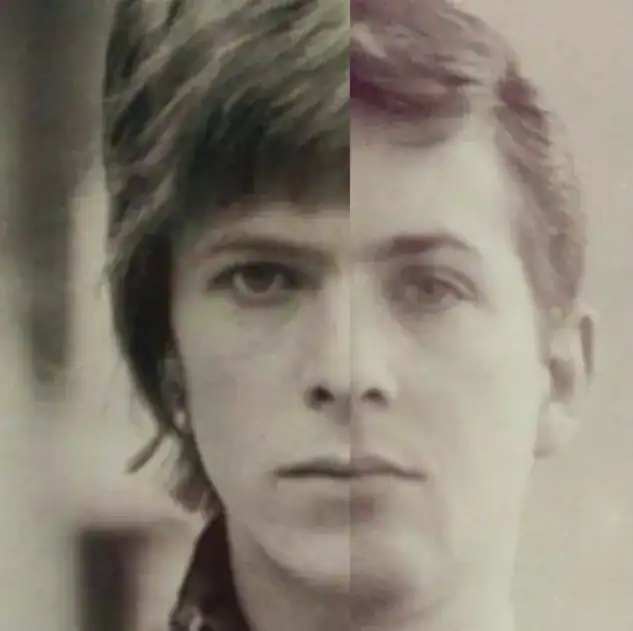
Terry Burns
Photo: Unknown photographer / Wikimedia Commons / >>” target=”_blank” rel=”noopener”> Wikimedia file page
Terry Burns was David Bowie’s half-brother and one of the most important — and tragic — figures in Bowie’s life. Though never a professional collaborator, Burns exerted a profound and lasting influence on Bowie’s musical tastes, artistic outlook, and emotional world.
His struggles with severe mental illness and his eventual death by suicide would echo through Bowie’s work for decades, shaping some of his most personal and haunting songs.
- Name: Terry Burns
- Relation: Half-brother of David Bowie
- Born: 1937
- Died: 16 January 1985
- Known for: Introducing Bowie to modern jazz
- Legacy: Inspiration for multiple Bowie songs
Terry Burns and Bowie’s formative years
Terry Burns entered Bowie’s life when Bowie was still a teenager growing up in post-war London. Burns, older and intellectually curious, became a mentor-like presence during Bowie’s formative years.
He introduced Bowie (then David Jones) to modern jazz, opening a door to a world far removed from skiffle and early rock ’n’ roll.
Jazz, the saxophone, and artistic awakening
Burns exposed Bowie to artists such as Charles Mingus and John Coltrane, whose intensity and emotional depth made a deep impression. This exposure directly inspired Bowie to take up the saxophone, an instrument that would remain central to his musical identity.
Bowie later acknowledged that without Terry’s influence, his musical path might have been entirely different.
Mental illness and institutionalisation
Terry Burns suffered from schizophrenia, a condition that increasingly shaped his life and ultimately led to long periods of institutionalisation. For many years, Bowie kept this aspect of his family history private.
The fear of inherited mental illness haunted Bowie, contributing to recurring themes of fractured identity, paranoia, and dual selves in his songwriting.
“The Bewlay Brothers”
One of the most enigmatic songs in Bowie’s catalogue, “The Bewlay Brothers” (from Hunky Dory, 1971), is widely understood to be inspired by Terry Burns.
Bowie later explained that the song reflects his sense of division and his feeling of being both himself and “Terry’s brother” — a meditation on identity, inheritance, and psychological fragility.
Tragic death and “Jump They Say”
On 16 January 1985, Terry Burns died by suicide after escaping from Cane Hill psychiatric hospital, stepping in front of a train. The event devastated Bowie and marked one of the darkest personal moments of his life.
Bowie confronted this loss directly in “Jump They Say” (1993), a song that addresses Burns’ death, the pressures of mental illness, and society’s discomfort with psychological suffering.
Mourning through music
Unlike the oblique symbolism of earlier songs, “Jump They Say” is unusually direct. Its accompanying video reinforces the themes of confinement, surveillance, and internal struggle.
Through this song, Bowie publicly mourned his brother and challenged the stigma surrounding mental health — something he had rarely done so openly before.
Why Terry Burns belongs in Bowie’s collaborative universe
Terry Burns was not a collaborator in the conventional sense, but he was one of Bowie’s most important creative catalysts. He shaped Bowie’s tastes, his instrument choice, and his emotional vocabulary.
In Bowie’s work, Burns exists as a shadow figure — a mirror, a warning, and a source of inspiration whose presence can be felt from Bowie’s earliest recordings to his most mature reflections on identity and loss.