
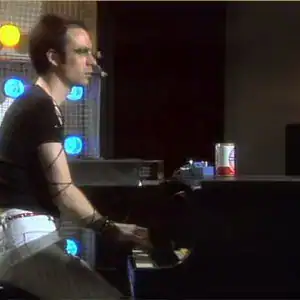
Sean Mayes
Sean Mayes was a British pianist and writer who became a key part of David Bowie’s touring band in the late 1970s, most notably on the Isolar II – The 1978 World Tour (often associated with the Low/“Heroes” era and the live album Stage).
Beyond his role on keyboards, Mayes is also remembered as a firsthand chronicler of life on the road: his tour-diary book offers a rare, ground-level view of Bowie’s 1978 touring machine—rehearsals, travel, backstage routines, and the reality behind the spectacle.
- Born: 1945
- Died: 1995
- Role: Pianist / keyboardist, writer
- Bowie connection: Isolar II touring band (1978); linked to Stage and the Lodger era
From Fumble to Bowie’s orbit
Sean Mayes first entered Bowie’s wider circle through the early-1970s live scene. He played keyboards in the band Fumble, who supported Bowie during the Ziggy Stardust period, creating an early professional link that later became significant.
Years later, Bowie recruited Mayes into his touring ensemble at a time when Bowie’s live presentation was evolving into a disciplined, high-concept production built around precision and atmosphere.
The Isolar II – The 1978 World Tour
In 1978, Mayes joined Bowie’s band for the Isolar II tour—also widely known as the Low / “Heroes” tour. The lineup featured a distinctive mix of rock rhythm section and electronic/ambient coloration, with Mayes on piano and related keyboard textures.
The tour ran from 29 March 1978 to 12 December 1978 and spanned North America, Europe, Oceania and Japan, establishing a new standard for Bowie’s late-70s live sound.
Shared songs and performances
- Isolar II – The 1978 World Tour (1978) — Sean Mayes performed as part of Bowie’s touring band on piano and string-ensemble textures.
- Stage (live album) — Mayes is credited among the tour personnel captured on the recordings associated with the 1978 tour.
- Lodger era — Mayes is commonly linked to Bowie’s late-70s studio world and is cited as playing in relation to Lodger (released 1979).
Stage and the late-70s band sound
The 1978 band combined tight, groove-based rock playing with an icy European modernism. Mayes’ piano work helped bridge these worlds: supporting rhythm and harmony while leaving space for the angular guitar and the colder synth textures.
Within that lineup, keyboards were not simply decorative— they were structural: shaping dynamics, reinforcing mood, and allowing Bowie’s voice to sit in a stark, cinematic frame.
Tour diary and the human story
Mayes’ memoir/tour diary is valued because it captures what official documentation rarely shows: the lived detail of touring—logistics, routines, personalities, and small moments that reveal how the “Bowie machine” functioned day-to-day.
For fans and historians, the book stands as an unusually intimate companion piece to the music of the period.
Place within Bowie’s universe
Within David Bowie’s extended creative universe, Sean Mayes represents the musician-insider: a touring band member who contributed to the sound of Bowie’s most disciplined late-70s live era and also left behind a rare written record of what it felt like inside that world.
His role connects performance and documentation—sound on stage, and story behind the curtain.