
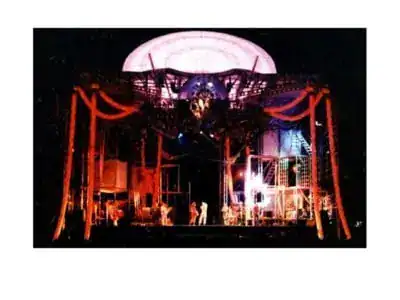
Photo: Unknown photographer / Glass Spider Tour stage
The Glass Spider Tour (1987–1988) was one of the most ambitious, theatrical, and technically complex tours of David Bowie’s career. Conceived as a rock concert with a narrative arc, it merged music, theatre, choreography, video, and monumental stage design.
Often described as Bowie’s most controversial tour, the Glass Spider Tour remains one of the largest and most visually daring productions ever attempted by a solo artist.
- Name: Glass Spider Tour
- Period: May 1987 – March 1988
- Role: Global concert tour
- Bowie link: Headline tour for Never Let Me Down
- Scale: Stadium tour with over 80 shows worldwide
- Core idea: Rock concert as theatrical narrative
Concept and ambition
Bowie conceived the Glass Spider Tour as more than a collection of songs. He described it as a form of “rock theatre,” complete with a loose storyline about temptation, innocence, and corruption.
This ambition placed the tour closer to large-scale stage productions than traditional rock shows, reflecting Bowie’s lifelong fascination with theatre and performance art.
The Glass Spider stage
The centrepiece of the tour was its enormous stage structure: a towering steel-and-fibreglass spider with Bowie performing beneath and within it. The set included cranes, video screens, trapdoors, and moving platforms.
At the time, it was one of the most expensive touring stages ever built, requiring dozens of trucks and a vast technical crew to transport and assemble.
Music and setlist
While the tour promoted the album Never Let Me Down, the setlist drew heavily on Bowie’s earlier catalogue, including songs from the 1970s that had not been performed live for years.
Songs such as “Heroes,” “Time Will Crawl,” “Fashion,” and “Ashes to Ashes” were recontextualised within the theatrical framework of the show.
Dancers, characters, and narrative
Professional dancers and actors played recurring roles throughout the performance, interacting with Bowie and embodying symbolic figures within the show’s loose narrative.
Bowie himself moved between performer, narrator, and character, blurring the boundary between concert and stage drama.
Critical reception
At the time, the Glass Spider Tour received mixed reactions. Some critics praised its scale and innovation, while others felt the theatrical elements overwhelmed the music.
Bowie later expressed ambivalence about the project, acknowledging both its ambition and its excess.
Legacy and reassessment
In retrospect, the Glass Spider Tour can be seen as the culmination of Bowie’s long-running attempt to merge rock, theatre, and spectacle on a truly monumental scale.
Its influence is visible in later large-scale pop and rock tours, many of which adopted narrative staging and immersive visuals as standard practice.
The Glass Spider in Bowie’s creative universe
The Glass Spider Tour stands as a bold, imperfect, and fearless experiment. It represents Bowie at his most uncompromising — willing to risk criticism in pursuit of an idea that had never been attempted at such scale.
Within Bowie’s extended creative universe, the tour remains a defining statement about ambition, risk, and the limits of spectacle.