
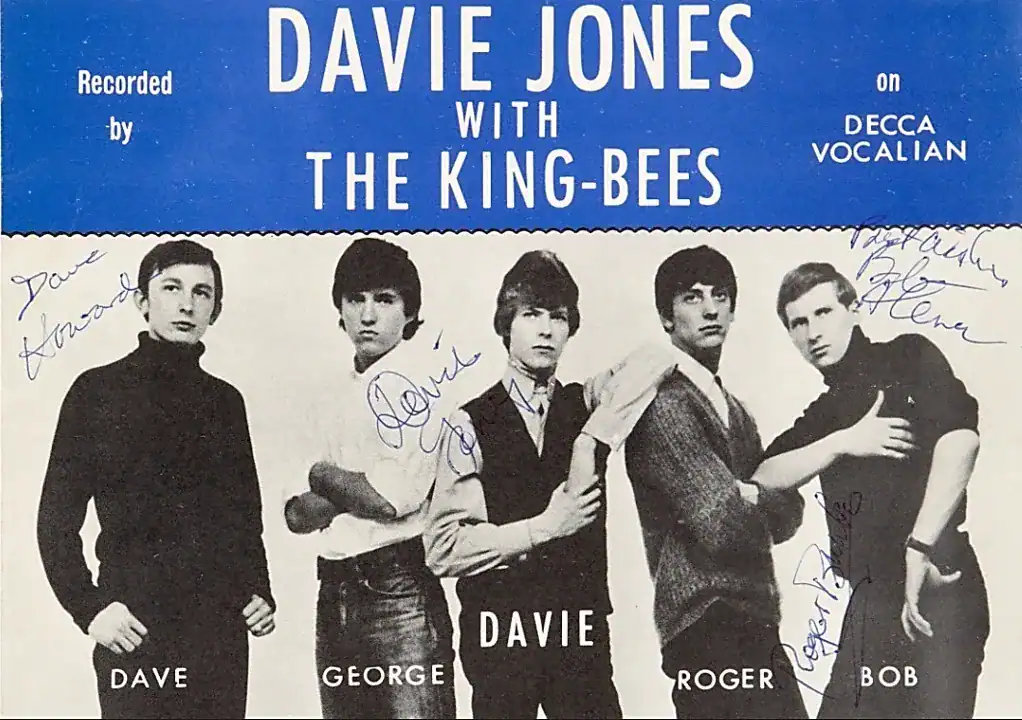
Francis (Dave) Howard (The King Bees)
Francis (Dave) Howard was the bassist for The King Bees, the London rhythm & blues band that featured David Bowie—then still performing under his birth name Davie Jones—in 1964.
His involvement places him at the very beginning of Bowie’s professional career, during the formative R&B club circuit years that preceded Bowie’s later stylistic reinventions.
- Name: Francis (Dave) Howard
- Band: The King Bees
- Role: Bass guitar
- With Bowie: 1964
- Era: British R&B apprenticeship
- Key release: “Liza Jane” (1964)
Where Dave Howard fits in Bowie’s timeline
Dave Howard belongs to the earliest, pre-mythological phase of David Bowie’s story. In 1964, Bowie was still learning the practical realities of being a working musician, performing American R&B covers in small London clubs.
The King Bees provided Bowie with his first sustained experience of professional gigs and recording sessions.
The King Bees and the R&B circuit
The King Bees were rooted firmly in the British R&B boom, drawing inspiration from American blues and soul artists. Their sound was direct, energetic, and designed for live performance rather than experimentation.
Howard’s bass playing formed part of the band’s solid rhythmic foundation, supporting Bowie’s early, forceful vocal style.
“Liza Jane” – Bowie’s recording debut
In 1964, The King Bees recorded “Liza Jane”, released as Davie Jones with The King Bees. Although the single failed to chart, it marked Bowie’s first official release.
Dave Howard’s bass performance is embedded in this historic recording, making him one of the musicians present at the true starting point of Bowie’s recorded legacy.
A short-lived lineup
Bowie’s time with The King Bees was brief. Almost immediately after the release of “Liza Jane”, Bowie moved on in search of greater artistic control and new musical opportunities.
This pattern of rapid change would define Bowie’s early career.
Historical importance
Francis (Dave) Howard may not appear in Bowie’s later mythology, but his role is foundational. He helped establish Bowie’s first steps into professional music-making.
Without musicians like Howard and The King Bees, Bowie’s later transformations would have lacked their essential apprenticeship.