
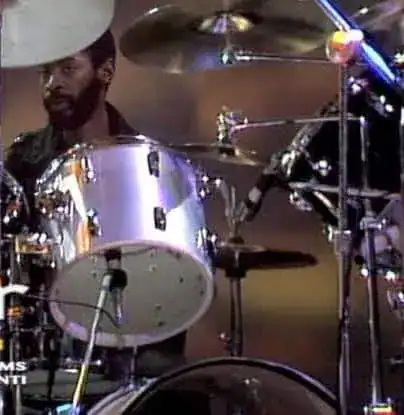
Dennis Davis
Dennis Davis was an American drummer whose collaboration with David Bowie defined one of the most radical and influential phases of Bowie’s career. As a core member of Bowie’s late-1970s band, Davis helped shape the rhythmic foundation of the so-called Berlin Trilogy.
His powerful, jazz-inflected drumming brought a muscular precision to Bowie’s increasingly experimental music, balancing abstraction with physical drive.
- Born: 1951, United States
- Died: 2016
- Role: Drummer
- Bowie connection: Berlin Trilogy, late-1970s touring band
Early career and musical background
Dennis Davis emerged from a background in jazz and fusion, developing a technical approach that combined precision, power and rhythmic complexity. His playing drew from funk, jazz and rock traditions, making him highly adaptable in experimental contexts.
Prior to working with Bowie, Davis had already established himself as a versatile drummer capable of supporting both structured compositions and open-ended musical exploration.
Joining David Bowie’s band
Davis joined Bowie’s core band in the mid-1970s, alongside bassist George Murray and guitarist Carlos Alomar. Together, they formed a rhythm section capable of handling Bowie’s increasingly complex artistic ambitions.
This lineup became central to Bowie’s move away from traditional rock structures toward darker, more fragmented musical forms.
The Berlin Trilogy
Dennis Davis played a crucial role on Low (1977), “Heroes” (1977) and Lodger (1979). His drumming anchored the abstract textures created by Bowie and Brian Eno, providing momentum and clarity amid sonic experimentation.
Tracks such as “Sound and Vision” and “Boys Keep Swinging” demonstrate Davis’s ability to combine restraint with explosive energy.
Live performance and tours
Davis’s impact extended beyond the studio. On stage, his drumming gave Bowie’s Berlin-era material a visceral physicality, translating experimental recordings into compelling live performances.
His tight, forceful style allowed Bowie’s music to retain emotional intensity even as it moved further from conventional rock frameworks.
Musical partnership and trust
Bowie trusted Davis implicitly, often relying on his rhythmic instincts rather than rigid instructions. This freedom allowed Davis to respond organically to Bowie’s shifting artistic direction.
The relationship was based on mutual respect, with Davis recognised as a key contributor rather than a background session musician.
Legacy
Dennis Davis’s legacy within David Bowie’s world is foundational. His drumming helped bridge the gap between experimental art music and physical rock performance, making Bowie’s Berlin-era work accessible without compromising its ambition.
Within Bowie’s broader career, Davis stands as one of the most important rhythmic collaborators — a musician whose contributions continue to resonate across generations of artists and listeners.