
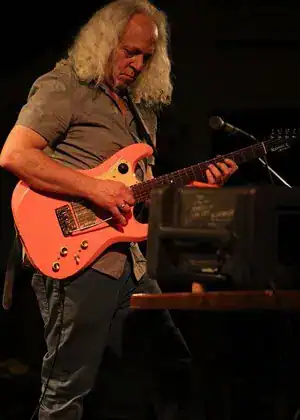
David Torn
Photo: Unknown photographer / Wikimedia Commons / CC BY-SA 4.0 — Wikimedia file page
David Torn is an American guitarist, composer, and experimental sound designer who collaborated with David Bowie during the late 1980s and early 1990s.
Known for his textural, non-traditional approach to the guitar, Torn contributed to Bowie’s work at a moment when Bowie was actively trying to escape rock orthodoxy and redefine his musical language.
- Name: David Torn
- Role: Guitarist, sound designer
- With Bowie: Late 1980s – early 1990s
- Live work: Glass Spider Tour (1987)
- Studio work: The Buddha of Suburbia (1993)
- Musical style: Experimental, ambient, textural guitar
Where David Torn fits in Bowie’s timeline
David Torn enters Bowie’s story during a transitional period. By the mid-to-late 1980s, Bowie was searching for ways to move beyond conventional pop-rock structures that had defined much of his earlier decade.
Torn’s experimental sensibility aligned with Bowie’s growing interest in atmosphere, abstraction, and sound design—interests that would later fully emerge during the Berlin-influenced revisits of the 1990s.
The Glass Spider Tour (1987)
Torn was part of Bowie’s band during the ambitious Glass Spider Tour, a large-scale theatrical production that blended rock concert, performance art, and narrative staging.
While the tour itself divided critics, Bowie’s choice of musicians was deliberate. Torn’s guitar work emphasized texture and space rather than flashy solos, subtly counterbalancing the spectacle with sonic depth.
Studio collaboration: The Buddha of Suburbia
Torn’s most significant studio association with Bowie appears on The Buddha of Suburbia (1993), Bowie’s soundtrack project for the BBC television adaptation of Hanif Kureishi’s novel.
The album is now widely regarded as a crucial bridge between Bowie’s 1980s work and the more adventurous sound worlds of Outside and beyond. Torn’s guitar textures contribute to the album’s moody, exploratory atmosphere.
Why Torn mattered to Bowie
Bowie consistently sought collaborators who challenged him rather than reinforced past habits. David Torn fit this pattern precisely: a musician less interested in genre and more focused on sound as an expressive medium.
Torn’s presence signals Bowie’s quiet pivot toward the experimental direction that would dominate his 1990s output, even if that shift was not yet fully visible to the public.
Beyond Bowie
Outside his work with Bowie, David Torn has built a highly respected career in experimental music, film scoring, and collaboration. He has worked extensively with artists such as David Sylvian, Tony Levin, and Jan Garbarek.
His influence is often felt more than heard—a quality that mirrors the role he played in Bowie’s own evolution during this period.