

David Bowie — Incidents, Controversies & Personal Turmoil
David Bowie’s career was defined by constant reinvention, artistic brilliance and cultural impact. Yet behind the public personas lay a series of David Bowie incidents and controversies, personal crises and periods of extreme addiction — particularly during the mid-1970s.
This page presents a complete and factual overview of the most significant David Bowie incidents and controversies, as well as the personal struggles that marked his life, spanning from his early years in the 1960s to his final onstage incident in 2004.
Important Incidents
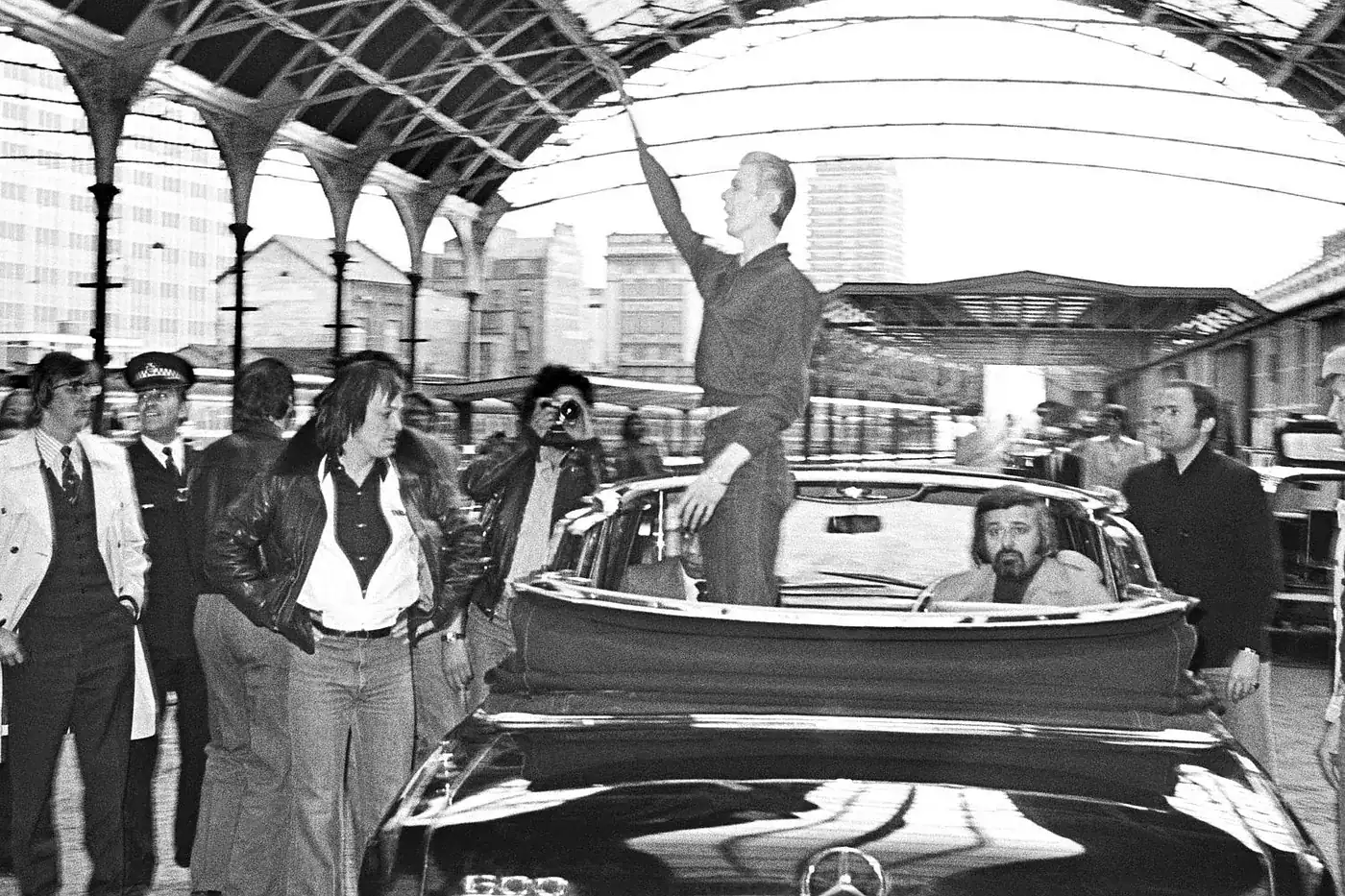
The “Victoria Station” Incident (1976): Upon his return to London in May 1976, David Bowie was photographed greeting fans from an open Mercedes outside Victoria Station. At the time, Bowie was emerging from one of the most chaotic periods of his life, marked by extreme cocaine addiction, psychological instability and the public confusion surrounding his Thin White Duke persona. One particular photograph appeared to show Bowie raising his arm in a manner that resembled a Nazi salute. The image was rapidly circulated by the British press and immediately sparked widespread outrage, with headlines accusing Bowie of fascist sympathies and extremist provocation. The controversy was intensified by his recent controversial interviews in which he had made ill-judged remarks about fascism, causing many critics to interpret the image as deliberate rather than accidental. Bowie firmly and consistently denied that the gesture was intended as a political statement. He explained that the photographer had captured him mid-wave as he was acknowledging the crowd, freezing a fraction of a second of movement into a misleading still image. Those close to Bowie later pointed out that the sequence of photographs from the same moment clearly showed a continuous waving motion rather than a fixed salute. Nevertheless, the single image became emblematic of the dangerous overlap between Bowie’s theatrical persona, his deteriorating mental state and the media’s willingness to frame ambiguity as ideology. In later years, Bowie distanced himself completely from the incident, describing the period as one of confusion, exhaustion and loss of control, and rejecting any association with fascist beliefs.

Controversial statements about fascism: During the same period, while adopting the Thin White Duke persona, David Bowie made a series of provocative and deeply ill-considered statements in interviews with the international press. In several high-profile conversations, he referred to Adolf Hitler as “one of the first rock stars,” framing the remark in terms of mass appeal, theatricality and charisma rather than ideology. He also suggested that Britain might benefit from a strong, authoritarian leader, comments that were widely interpreted as an endorsement of fascist ideas. These remarks caused immediate backlash and alarm, particularly given the broader cultural and political sensitivities of post-war Britain and Europe. Critics accused Bowie of trivialising totalitarianism and flirting irresponsibly with extremist symbolism. In later years, Bowie unequivocally distanced himself from these statements. He apologised publicly and repeatedly, explaining that they were made during a period of severe cocaine addiction, sleep deprivation and psychological instability, when the boundaries between his real self and the Thin White Duke role had become dangerously blurred. Bowie described this phase as one in which he had lost perspective and control, and he firmly rejected fascism and authoritarianism for the remainder of his life.

The “Lollipop” incident (2004): During a concert in Oslo in 2004, David Bowie was struck in the eye by a lollipop stick that had been thrown from the audience. The object lodged painfully between his eyeball and eyelid, immediately causing visible discomfort and concern among both the audience and the band. The concert was briefly halted while Bowie was escorted offstage to receive medical attention, and there was uncertainty as to whether the performance would be abandoned altogether. Despite the painful nature of the injury and the potential risk to his eyesight, Bowie chose to return to the stage after a short break. He calmly addressed the audience and went on to complete the concert, demonstrating a level of professionalism and composure that was widely remarked upon at the time. The incident later became one of the last notable onstage accidents of his career and is often cited as an example of Bowie’s commitment to his audience, even in the face of physical injury.
Fight over a Girl (1962)

The Incident:
One of the earliest and most consequential incidents in David Bowie’s life occurred when he was still a teenager,
long before fame or public controversy entered the picture.
When:
Spring 1962, when Bowie — then still known as David Jones — was 15 years old.
Who:
David Bowie and his best friend at the time, George Underwood.
Why:
The two boys became involved in a physical altercation over a girl they both liked, named Carol.
What Happened:
During the fight, Underwood punched Bowie in the left eye. The blow scratched the surface of the eye and damaged
the muscles controlling the iris, permanently paralyzing them. As a result, Bowie’s left pupil remained permanently
dilated — a condition known as anisocoria.
Aftermath – Injury:
Bowie required emergency surgery and spent several months recovering. Despite medical treatment, the damage could
not be fully repaired.
Appearance:
His left pupil remained fixed open, making it appear larger and darker than the right. This created the widespread
illusion that Bowie had two different colored eyes, although both of his eyes were, in fact, blue.
Friendship:
Despite the violence of the incident, Bowie and Underwood remained close friends. Underwood later became a frequent
creative collaborator, designing artwork for several Bowie releases, including
The Rise and Fall of Ziggy Stardust and the Spiders from Mars and Heroes.
Embrace:
Bowie ultimately incorporated the injury into his public image, turning it into one of his most distinctive visual
traits. The unusual appearance of his eyes enhanced his alien, mysterious and captivating stage persona.
Addiction and Paranoia

In the mid-1970s, David Bowie lived in Los Angeles under the influence of an extreme cocaine addiction, a period that would later be described by both Bowie himself and those around him as the most dangerous phase of his life. The combination of constant drug use, severe sleep deprivation and isolation led to a dramatic physical and psychological decline. Bowie’s daily routine became increasingly erratic, and his grip on reality weakened as paranoia and obsessive thoughts took hold. This environment of excess and instability directly contributed to a series of bizarre, unsettling and deeply disturbing incidents, many of which Bowie would later recount with a mixture of disbelief and alarm, acknowledging how close he had come to complete self-destruction during his time in Los Angeles.

David Bowie’s extreme diet during the mid-1970s — consisting almost entirely of milk and red peppers, combined with relentless cocaine use throughout his Thin White Duke era — has been widely documented by biographers, collaborators and Bowie himself. The severe lack of nutrition, coupled with prolonged stimulant abuse, led to dramatic physical deterioration and extreme weight loss, with Bowie reportedly losing around eighty pounds. His appearance during this period became alarmingly gaunt, skeletal and fragile, reinforcing public concern about his health. Bowie often went for days without proper sleep, remaining awake for extended periods as the effects of cocaine intensified both his physical exhaustion and psychological instability. In later interviews, Bowie referred to this phase as his “darkest days,” acknowledging that his addiction had brought him dangerously close to collapse. He would later reflect on this era with shock and disbelief, describing it as a time he barely survived and one he consciously sought to leave behind.

He suffered from severe paranoia and episodes of drug-induced psychosis, conditions that dramatically distorted his perception of reality during this period. Bowie became convinced that hostile forces were targeting him, including the belief that witches were attempting to steal his semen as part of occult rituals. Driven by these fears, he took extreme and irrational protective measures, including storing his urine in the refrigerator in an attempt to prevent it from being used against him. Friends and associates later described this behaviour as evidence of a profound mental breakdown caused by prolonged cocaine abuse, malnutrition and sleep deprivation. Bowie himself would later speak openly about these delusions, recognising them as symptoms of psychosis rather than reality, and citing them as a warning example of how far his addiction had pushed him beyond rational thought.

He later stated that he had no active memory of recording his album Station to Station, an admission that shocked both fans and critics given the album’s precision, intensity and lasting influence. Bowie explained that the sessions took place during the height of his cocaine addiction, when prolonged sleep deprivation, paranoia and physical exhaustion had effectively erased his sense of time and continuity. He described the period as one in which he was functioning on instinct alone, moving through recording sessions without clear awareness or reflection. In retrospect, Bowie regarded the absence of memory as one of the clearest indicators of how dangerously unwell he had become, later citing Station to Station as a paradoxical achievement created during a time when he was barely conscious of his own actions.
Allegations of Misconduct

Lori Mattix: There are long-standing and controversial accounts concerning a relationship Bowie allegedly had in the early 1970s with Lori Mattix, who was a well-known teenage groupie within the Los Angeles rock scene at the time. These stories have circulated primarily through interviews, memoirs and retrospective reporting rather than through any formal legal process. The claims have never been tested in court, nor have they resulted in charges or legal action, leaving the subject unresolved and heavily debated among biographers, journalists and fans. As with many accounts from that era, the stories exist within the broader context of 1970s rock culture, a period often characterised by blurred boundaries, excess and a lack of accountability. Bowie himself never publicly addressed the allegation in detail, and the issue remains one of the most disputed and sensitive aspects of his personal history.

Abuse: Bowie’s former wife, Angie Bowie, has accused him in the past of abusive behaviour during their marriage, claims that emerged primarily through interviews and later public statements rather than through legal proceedings. According to Angie Bowie, the relationship was marked by instability, emotional volatility and the effects of Bowie’s heavy drug use during the mid-1970s, a period widely acknowledged as one of severe personal dysfunction. These accusations were never examined in court and did not result in formal charges, leaving them unverified and subject to ongoing debate among biographers and commentators. Bowie himself did not publicly address these specific claims in detail, and the accounts remain part of a broader, contested narrative surrounding his personal life during a time of addiction, paranoia and emotional collapse.
Arrests and Legal Issues

Marijuana arrest in Rochester (1976): After a concert in Rochester, New York, in March 1976, David Bowie was arrested together with Iggy Pop and two others in their hotel room following a police search. Officers discovered approximately 225 grams (half a pound) of marijuana, leading to their detention and the filing of drug possession charges. The incident quickly attracted international media attention, not only because of Bowie’s celebrity status but also due to the striking police mugshots taken at the time, which later became some of the most widely circulated and iconic images in rock history. The arrest occurred during a period when Bowie’s erratic behaviour and substance abuse were already the subject of intense scrutiny, reinforcing public perceptions of a musician in crisis. Despite the initial seriousness of the charges, the case did not proceed to trial. A grand jury ultimately dismissed the indictment, and no conviction followed, allowing Bowie to continue his tour without further legal consequences from the incident.

Nazi memorabilia at the Russian border (1976): During a journey through Eastern Europe in 1976, while travelling on the Trans-Siberian Express, David Bowie was detained by customs officials at the Russian–Polish border after authorities discovered books and memorabilia related to Nazi Germany among his personal belongings. The incident occurred during a period when Bowie’s behaviour and interests were already attracting scrutiny, particularly in the context of his Thin White Duke persona and earlier controversial remarks. Bowie later explained that the materials were not connected to any political sympathy, but rather reflected an unhealthy and obsessive fascination with history, power structures and the occult. He attributed this fixation to the effects of severe cocaine addiction, paranoia and psychological instability, describing it as part of a broader pattern of compulsive and irrational behaviour during that time. In retrospect, Bowie acknowledged the incident as further evidence of how distorted his thinking had become, and he later distanced himself entirely from both the obsession and the circumstances that led to it.
Extreme Drug Experiences in Los Angeles
In 1975, Bowie’s cocaine addiction reached an absolute low, leading to increasingly bizarre, dangerous and self-destructive behaviour during his time in Los Angeles.

Physical deterioration: At the height of his addiction, David Bowie’s physical condition deteriorated to an alarming degree. At his thinnest, he reportedly weighed only around forty kilograms, giving him an emaciated and fragile appearance. Friends, collaborators and journalists described him at the time as looking like a “singing skeleton,” a phrase that came to symbolise the severity of his decline. His body was weakened by extreme malnutrition, prolonged stimulant abuse and a near-total lack of rest. Bowie sometimes remained awake for five to six consecutive days, pushing his body far beyond its limits. In later years, he would look back on this period with disbelief, recognising the visible physical collapse as one of the clearest signs of how dangerously close he had come to serious, irreversible harm.
Occult obsessions: During this period, Bowie developed intense and irrational occult obsessions that further reflected his deteriorating mental state. He became convinced that sinister forces were surrounding him and claimed to see bodies falling past the window of his Los Angeles residence, a belief that terrified him and reinforced his growing paranoia. He also believed that his swimming pool was possessed by hostile spirits, interpreting ordinary sounds and reflections as supernatural threats. In an effort to protect himself from what he perceived as “black magic,” Bowie engaged in compulsive and ritualistic behaviour, including storing his urine and nail clippings in the refrigerator. Friends and associates later described these actions as clear manifestations of drug-induced psychosis, brought on by prolonged cocaine abuse, severe malnutrition and extreme sleep deprivation. Bowie himself later acknowledged these beliefs as delusional, citing them as some of the most disturbing examples of how far his thinking had drifted from reality during that time.
Accusations and Conflicts

Relationship with his ex-wife: Angie Bowie claimed after David Bowie’s death that, during the late 1970s and at the height of his drug addiction, he once attempted to strangle her while under the influence of narcotics. According to Angie Bowie, the marriage was marked by instability, emotional volatility and the destructive impact of Bowie’s substance abuse during that period. These allegations emerged through retrospective interviews and personal accounts rather than through any formal legal process, and they were never examined in court or subjected to judicial review. Bowie himself did not publicly address this specific claim, and no charges were filed in relation to it. As with other accusations connected to this era, the account remains part of a contested and deeply sensitive narrative surrounding his personal life during a time widely acknowledged as one of severe psychological and emotional breakdown.

Feuds with other musicians: Throughout his career, David Bowie maintained complex and sometimes strained relationships with fellow musicians, shaped by differences in personality, artistic approach and public image. Some contemporaries perceived him as distant or aloof, including Elton John, who once described Bowie as “haughty” in interviews reflecting on their interactions. Bowie’s carefully constructed personas and intellectual approach to fame also led to criticism from figures associated with punk and anti-establishment movements. John Lydon, better known as Johnny Rotten of the Sex Pistols, openly refused to share a stage with Bowie, dismissing him as a “fake rebel” and accusing him of theatrical posturing rather than genuine confrontation. These tensions highlighted the polarising nature of Bowie’s artistry, admired by many for its innovation but viewed by others as calculated or artificial. Despite such criticisms, Bowie continued to command respect for his influence and originality, and many of these disputes remained rooted more in perception and ideology than in direct personal conflict.
1976–1978 — Berlin: Withdrawal and Recovery

Bowie relocated to Berlin in the late 1970s in a deliberate effort to escape both his addiction and the relentless media attention that had surrounded him in Los Angeles. Seeking anonymity and distance from the excesses of his previous lifestyle, he lived in relative isolation and adopted a far more disciplined daily routine. Berlin offered Bowie a sense of detachment and creative focus, allowing him to gradually regain physical health and psychological stability. This period is frequently described by biographers and historians as a crucial recovery phase, following the intense psychological chaos and near-total collapse he experienced in Los Angeles. While not free from struggle, his time in Berlin marked a clear turning point toward sobriety, reflection and renewed artistic control.
1983 — MTV Interview on Racism

In a live MTV interview in 1983, David Bowie openly challenged the channel’s executives about their lack of Black artists in regular rotation. Speaking directly to the interviewer on air, Bowie questioned why musicians who had played a foundational role in shaping popular music were largely excluded from the network’s programming. The exchange created visible discomfort in the studio, as such criticism was highly unusual for mainstream music television at the time. While the moment initially appeared awkward and confrontational, it has since been widely reassessed as principled and forward-thinking. Bowie’s remarks anticipated later debates about representation and diversity in the music industry, and the interview is now frequently cited as an example of his willingness to challenge institutional norms rather than remain silent for the sake of convenience or image.
Conclusion
The most severe incidents surrounding David Bowie are concentrated within a relatively short but intensely unstable period during the mid-1970s. Marked by addiction, psychological collapse and public controversy, this era produced some of the most troubling episodes of his life. In later years, Bowie openly distanced himself from this period, apologised for certain statements, and worked deliberately toward rebuilding his life with greater stability, self-awareness and control.