
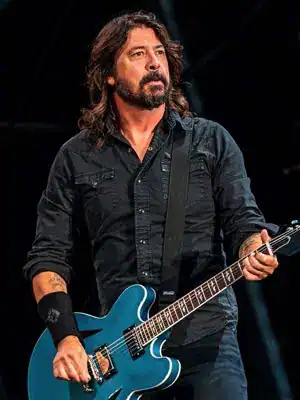
Dave Grohl
Photo: Raph_PH / Wikimedia Commons / CC BY 2.0 (editorial use)
Dave Grohl is an American musician whose career spans multiple eras of modern rock. His collaboration with David Bowie during the mid-1990s represents a rare intersection between alternative rock energy and Bowie’s experimental, post-industrial vision.
Although brief, their work together placed Grohl within Bowie’s evolving creative landscape at a moment when Bowie was once again challenging expectations and redefining his sound.
- Born: 1969, United States
- Career background: Drummer of Nirvana (1990–1994)
- Early recordings: Played drums on early Foo Fighters sessions
- Later role: Singer, guitarist and frontman (Foo Fighters)
- Bowie connection: Studio-era interaction (mid-1990s)
Emergence in alternative rock
Dave Grohl emerged in the early 1990s as a defining figure in alternative rock, known for his powerful, direct drumming style and instinctive sense of momentum.
His approach emphasised emotional drive and physical impact rather than technical complexity, aligning with the raw energy of the era.
David Bowie in the 1990s
By the mid-1990s, David Bowie was immersed in a period of artistic renewal. Drawing inspiration from industrial music, contemporary art and emerging alternative sounds, he actively sought collaboration outside his usual circles.
Grohl’s involvement reflected Bowie’s openness to younger musicians whose work embodied urgency and intensity.
The collaboration
Grohl contributed drums to sessions associated with Bowie’s Outside-era material, bringing a forceful rhythmic presence that contrasted with Bowie’s layered, fragmented compositions.
The collaboration was rooted in mutual respect, with Bowie valuing Grohl’s instinctive musicality and unfiltered performance style.
Shared artistic values
Despite differences in background, both artists shared a commitment to authenticity and reinvention. Neither remained confined to a single identity or genre.
Bowie’s willingness to collaborate across generations reinforced his relevance, while Grohl benefited from direct engagement with a pioneering artistic figure.