
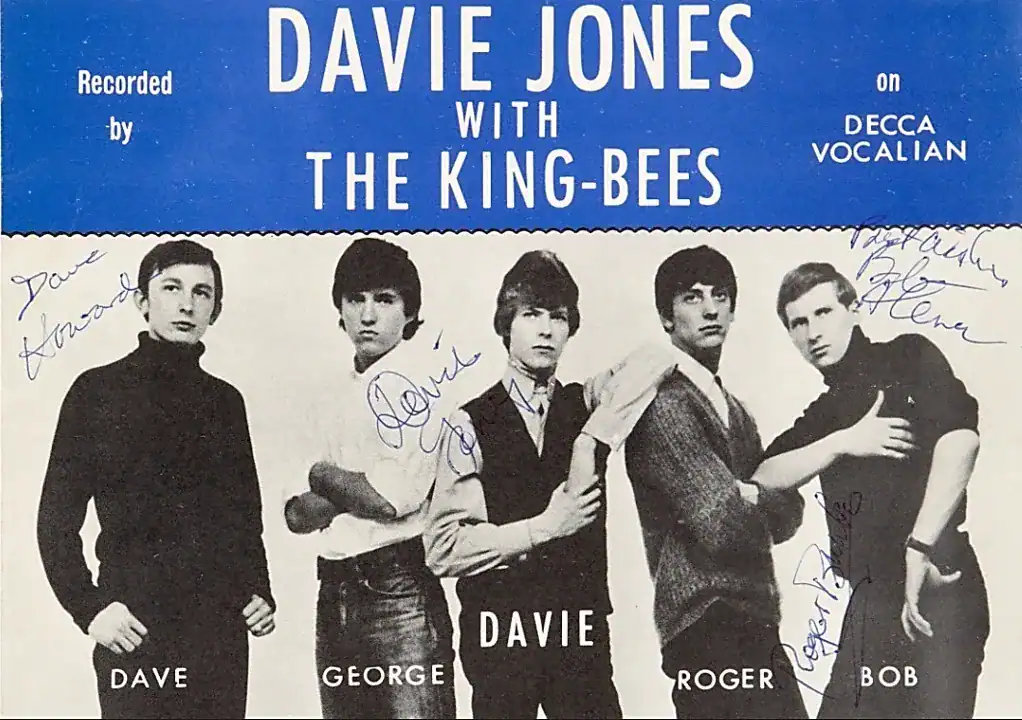
Brian Wilshaw (The King Bees)
Photo: Unknown photographer / Wikimedia Commons / Unknown —
Brian Wilshaw was a member of The King Bees, the London-based R&B group that backed a young David Bowie—then still performing under his birth name Davie Jones—in 1964.
Although the collaboration was brief, it occupies a crucial place in Bowie history: The King Bees recorded and released “Liza Jane”, Bowie’s first official single, marking the starting point of his documented recording career.
- Name: Brian Wilshaw
- Band: The King Bees
- Role: saxophone & flute (British R&B group)
- With Bowie: 1964
- Historical significance: Bowie’s first released collaboration
- Key release: “Liza Jane” (1964)
Where Brian Wilshaw fits in Bowie’s timeline
Brian Wilshaw’s place in Bowie’s story belongs firmly to the pre-Ziggy, pre-fame years—when Bowie was still searching for direction within the British rhythm & blues scene.
In early 1964, Bowie joined The King Bees as vocalist. The group was stylistically aligned with the London R&B circuit, drawing heavily on American blues and soul influences rather than pop or beat music.
The King Bees and the London R&B scene
The King Bees were part of a wave of young British R&B groups inspired by American blues artists. They played clubs and small venues, operating in the same underground ecosystem that fed bands like The Rolling Stones and The Yardbirds.
Brian Wilshaw, as a member of the band, contributed to this early incarnation of Bowie’s career—one that was grounded in traditional R&B rather than theatrical experimentation.
“Liza Jane” — Bowie’s first single
The collaboration between Bowie and The King Bees resulted in the single “Liza Jane”, released in 1964 and credited to Davie Jones with The King Bees.
While the record did not chart, its importance cannot be overstated: it represents Bowie’s first appearance on vinyl and his earliest documented studio collaboration. Brian Wilshaw’s involvement places him at the literal beginning of Bowie’s recorded legacy.
Why the collaboration was short-lived
Bowie’s tenure with The King Bees was brief. Almost immediately after the single’s release, he moved on in search of greater creative control and broader stylistic freedom.
This pattern—joining a group, learning quickly, and then moving on—would repeat several times throughout Bowie’s early career, as he passed through bands such as The Manish Boys and The Lower Third.
Historical importance
Brian Wilshaw does not appear in Bowie’s later mythology, but his role is foundational. Without The King Bees, there is no Liza Jane, and without that single, there is no official starting point for Bowie’s recording history.
In that sense, Wilshaw represents the ground floor of the Bowie story: a moment before reinvention became the rule, when everything was still forming.