
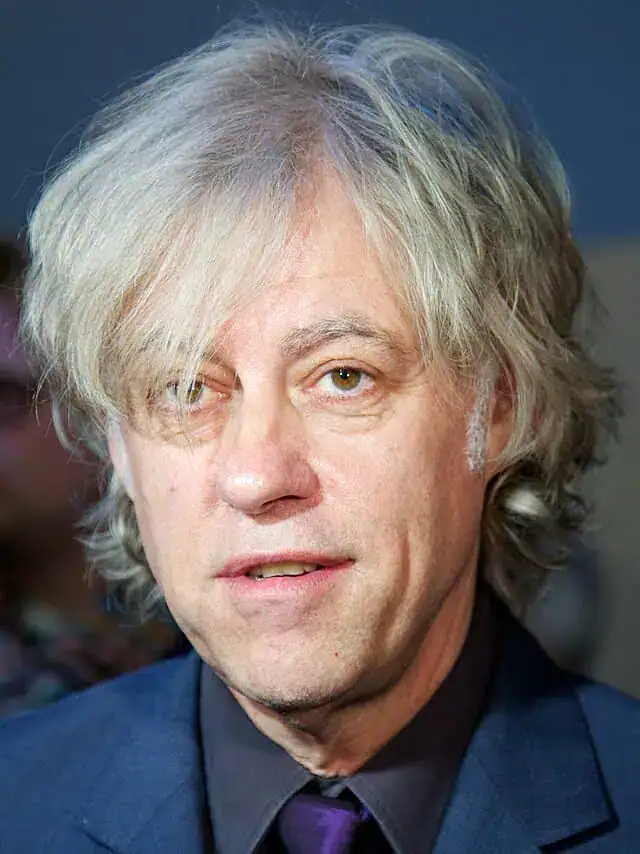
Bob Geldof
Photo: Barbara Mürdter / Wikimedia Commons / CC BY-SA 3.0 (editorial use)
Bob Geldof is an Irish musician, songwriter, political activist and organiser whose career uniquely bridges popular music and global humanitarian action. While best known as the driving force behind Live Aid, his cultural trajectory intersects directly with David Bowie at a moment when music became a vehicle for worldwide social change.
Geldof and Bowie represented different artistic temperaments, yet shared a belief that artists could — and should — engage with the world beyond the stage.
- Born: 1951, Dún Laoghaire, Ireland
- Band: The Boomtown Rats
- Known for: Live Aid, Band Aid
- Bowie connection: Live Aid 1985 cultural context
Early career and The Boomtown Rats
Bob Geldof rose to prominence in the late 1970s as the frontman of The Boomtown Rats, a band that combined punk urgency with sharp social commentary. Songs like I Don’t Like Mondays captured public attention through their unsettling narratives and confrontational tone.
Geldof’s songwriting was less concerned with glamour than with provocation, positioning him as a cultural agitator rather than a conventional rock star.
From musician to activist
In 1984, moved by television footage of famine in Ethiopia, Geldof initiated the Band Aid project, assembling leading musicians to record Do They Know It’s Christmas?. The record became a global phenomenon and laid the groundwork for an unprecedented experiment: Live Aid.
Live Aid and David Bowie
On 13 July 1985, Live Aid took place simultaneously in London and Philadelphia, broadcast worldwide. David Bowie performed at Wembley Stadium, delivering a tightly focused set that underscored his stature as a global artist.


Bowie’s performance and his on-screen appeal for donations played a crucial role in galvanising public response. Geldof later acknowledged Bowie’s contribution as pivotal in turning Live Aid into a truly global moment rather than a symbolic gesture.
Contrasting personalities
While Geldof operated through urgency and confrontation, Bowie maintained a measured distance, wary of moral absolutism. Yet both men shared a deep seriousness about responsibility and the power of mass communication.
After Live Aid
Following Live Aid, Geldof continued his humanitarian work through initiatives such as Live 8 and ongoing advocacy for debt relief and African development. His role shifted permanently from pop musician to global activist.
Legacy
Bob Geldof’s legacy lies not only in his music but in redefining what a musician could be in the public sphere. His intersection with David Bowie at Live Aid represents a moment when art, politics and media converged on an unprecedented scale.
Together — though in very different ways — Geldof and Bowie helped reshape the cultural expectations placed upon artists in the late twentieth century.