
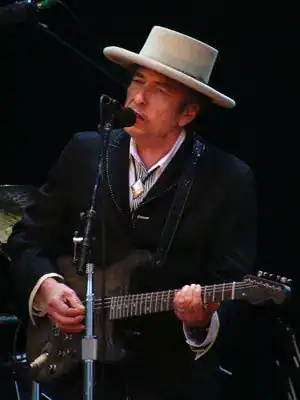
Bob Dylan
Photo: Alberto Cabello / Wikimedia Commons / CC BY 2.0 — Wikimedia file page
Bob Dylan (born Robert Allen Zimmerman, 24 May 1941) is an American singer, songwriter, musician, and author whose reinvention of popular song in the 1960s reshaped modern music and lyric writing.
For David Bowie, Dylan represented a model of artistic freedom: a songwriter who treated popular music as literature, embraced constant reinvention, and resisted confinement by genre or expectation.
- Name: Bob Dylan (Robert Allen Zimmerman)
- Born: 24 May 1941 (Duluth, Minnesota, USA)
- Role: Singer, songwriter, musician, author
- Bowie link: Major lyrical and artistic influence
- Core idea: Reinvention, poetic songwriting, independence
Dylan’s revolution in popular music
Bob Dylan transformed popular music by introducing complex, ambiguous, and literary lyrics into folk and rock traditions. His work challenged the idea that pop songs were limited to simple themes or straightforward narratives.
By the mid-1960s, Dylan had redefined what a songwriter could be, influencing generations of musicians across genres.
Early influence on David Bowie
David Bowie encountered Dylan’s work during his formative years in the early 1960s. Dylan’s phrasing, vocal delivery, and lyrical density left a clear imprint on Bowie’s earliest songwriting attempts.
Bowie’s 1966 song “Song for Bob Dylan” stands as an explicit acknowledgment of this influence, addressing Dylan directly as a guiding figure in contemporary music.
Parallel paths of reinvention
Although Bowie and Dylan belonged to different musical worlds, their careers followed strikingly similar trajectories. Both artists repeatedly abandoned established identities in favour of new artistic directions.
Dylan’s shift from acoustic folk to electric rock, and Bowie’s continual reinvention of persona and sound, reflect a shared resistance to stagnation.
Mutual respect
Bowie spoke frequently of his admiration for Dylan, citing him as proof that popular music could sustain intellectual depth and artistic seriousness.
While they met on several occasions and moved within overlapping cultural circles, their connection remained one of influence rather than direct collaboration.
Dylan’s shadow in Bowie’s work
Dylan’s influence can be traced throughout Bowie’s catalogue: in his approach to lyrics, his embrace of ambiguity, and his refusal to explain or resolve meaning for the listener.
Even as Bowie moved far beyond Dylan stylistically, the underlying philosophy — that songs could function as art rather than entertainment alone — remained intact.
Bob Dylan in Bowie’s creative universe
In Bowie’s creative universe, Bob Dylan stands as a foundational figure: not a collaborator in the studio, but a catalyst who expanded Bowie’s understanding of what music could achieve.
Dylan’s legacy within Bowie’s work is one of permission — permission to change, to challenge, and to ignore expectations.