
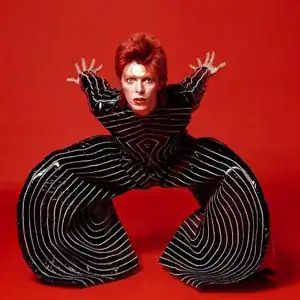
Kabuki – Japanese Theatre Influence on David Bowie’s Visual and Performance Style
Photo: Unknown photographer
Kabuki is a classical Japanese theatre tradition that emerged in the early seventeenth century, known for its highly stylised movement, elaborate costumes, bold makeup, and symbolic gesture.
For David Bowie, Kabuki offered a powerful alternative model of performance — one in which identity is constructed, exaggerated, and consciously displayed rather than hidden.
- Name: Kabuki (Japanese classical theatre)
- Origin: Early 17th century, Japan
- Role: Theatrical tradition (dance, drama, music)
- Bowie link: Visual and performance influence from the early 1970s onward
- Core idea: Stylisation, transformation, and visible artifice
Kabuki as a language of transformation
Kabuki theatre rejects naturalism in favour of deliberate artifice. Movement is codified, emotion is externalised, and gesture carries symbolic meaning. Characters are not meant to feel “real” in a psychological sense, but to exist as heightened figures.
This approach resonated deeply with Bowie, who consistently treated performance as a space for transformation rather than confession.
Bowie’s early exposure to Japanese theatre aesthetics
In the late 1960s and early 1970s, Bowie explored non-Western performance traditions, particularly Japanese theatre forms. Through mime, dance, and visual art, he absorbed Kabuki’s emphasis on posture, silhouette, and controlled movement.
These ideas entered Bowie’s work alongside influences from mime and German Expressionism, forming a hybrid stage language that was neither rock nor traditional theatre.
Kabuki, makeup, and persona
One of Kabuki’s most recognisable elements is kumadori makeup, which uses bold lines and colours to externalise inner traits such as anger, nobility, or corruption.
Bowie adopted a similar principle in his use of makeup and costume: faces became masks, identities became visual symbols, and the performer remained visibly constructed.
Ziggy Stardust and theatrical distance
The Ziggy Stardust persona reflects Kabuki’s core principle of distance. Bowie did not attempt to disappear into the character; instead, he demonstrated Ziggy as a figure — a role being played.
This visible separation between performer and persona mirrors Kabuki’s tradition, where the audience is always aware of the theatrical frame.
Gesture, stillness, and control
Kabuki places enormous importance on controlled stillness and deliberate gesture. A single pose can carry as much meaning as extended dialogue.
Bowie translated this into rock performance by slowing movement, emphasising posture, and using silence and restraint as expressive tools — particularly in his early-1970s stage work.
Kabuki in Bowie’s creative universe
Kabuki stands as one of the most important non-Western influences on Bowie’s art. It reinforced his belief that performance is not about authenticity, but about clarity of form.
Within Bowie’s extended creative universe, Kabuki represents the idea that identity can be worn, reshaped, and discarded — a principle that defined Bowie’s work from Ziggy Stardust to his final performances.