
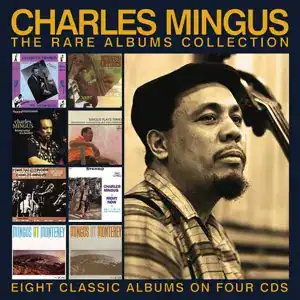
Charles Mingus (22 April 1922 – 5 January 1979) was one of the most powerful, confrontational, and original voices in twentieth-century music. A virtuoso bassist, composer, and bandleader, Mingus reshaped jazz by merging composition, improvisation, political anger, and emotional intensity.
For David Bowie, Mingus represented the ultimate example of artistic freedom: a musician who rejected compromise and treated music as a living, dangerous force.
- Name: Charles Mingus Jr.
- Born: 22 April 1922 (Nogales, Arizona, USA)
- Died: 5 January 1979 (Cuernavaca, Mexico)
- Role: Jazz bassist, composer, bandleader
- Bowie link: Lifelong musical influence; Bowie attended Mingus live in 1973
- Core idea: Artistic freedom, emotional truth, refusal to conform
Why Mingus mattered to Bowie
David Bowie repeatedly named Charles Mingus as one of the most important musicians in his life. Mingus embodied originality without compromise — music that was intellectually complex, emotionally raw, and politically charged.
Rather than smoothing jazz into refinement, Mingus allowed contradiction, volatility, and tension to remain audible. This approach strongly resonated with Bowie’s own belief that art should never feel safe.
Pre-Ziggy influence: discipline and rebellion
Long before the Ziggy Stardust era, Bowie immersed himself in modern jazz. Mingus demonstrated that strict composition and explosive improvisation could coexist — a lesson Bowie would later apply across his career.
This balance between control and collapse can be felt in Bowie’s work from Aladdin Sane through the Berlin period and ultimately in the jazz-infused textures of Blackstar.
David Bowie sees Charles Mingus live (1973)
On 4 February 1973, David Bowie attended a performance by Charles Mingus at the Village Gate nightclub in New York City — one of the world’s most famous jazz venues.
Bowie invited a small group to join him for the evening, heading out after dinner to hear Mingus perform live. For those present, the experience felt extraordinary — not only because of Mingus’s reputation, but because of the intensity and brilliance of the performance itself.
The Mingus group was, unsurprisingly, superb. During the set, Mingus surprised the audience by playing a solo on a large, flexible steel saw — an old music hall trick in which the blade is bent and bowed, producing an eerie, unearthly sound.
Known for his seriousness and volatile temperament, Mingus was rarely associated with overt humour. The musical saw felt like a rare joke, or perhaps a provocation — a moment of theatrical defiance aimed at an audience hungry for spectacle.
Those present felt privileged to witness the great man perform. Mingus would die only three years later, making the evening at the Village Gate an especially poignant memory — a moment when Bowie saw one of his musical heroes still fully alive, unpredictable, and uncompromising.
Mingus as a model of the outsider artist
Mingus’s volatility, anger, and refusal to accommodate expectations made him a natural model for Bowie’s own vision of the outsider artist. He demonstrated that complexity and discomfort could be creative strengths.
Bowie did not imitate Mingus stylistically; instead, he absorbed the principle that music must remain restless, challenging, and emotionally honest.
Key works that shaped Bowie’s thinking
- Mingus Ah Um (1959)
- The Black Saint and the Sinner Lady (1963)
- Pithecanthropus Erectus (1956)
- Let My Children Hear Music (1972)
These recordings exemplify Mingus’s belief that music could be intellectual, political, violent, tender, and deeply human — often all at once.