
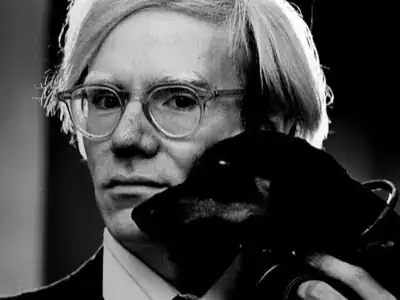
Andy Warhol – Pop Art Icon in David Bowie’s Early-1970s Creative Universe
Photo: Jack Mitchell / Wikimedia Commons / CC BY-SA 4.0 (editorial use)
Andy Warhol (6 August 1928 – 22 February 1987) was the defining Pop Art figure of the 1960s and 1970s — an artist who turned celebrity, repetition, advertising, and mass media into the language of modern art.
For David Bowie, Warhol was more than a famous name. Warhol represented a complete cultural model: the artist as brand, the studio as factory, and the public persona as a deliberately constructed artwork.
- Name: Andy Warhol (born Andrew Warhola)
- Born: 6 August 1928 (Pittsburgh, Pennsylvania, USA)
- Died: 22 February 1987 (New York City, USA)
- Role: Artist, filmmaker, publisher, cultural icon
- Bowie link: Song tribute “Andy Warhol” (Hunky Dory, 1971) + Factory meeting
- Core idea: Art, media, and fame as one system
Why Warhol mattered to Bowie
Bowie was drawn to artists who understood identity as something you could design and perform. Warhol’s world made that idea concrete: the cool surface, the controlled public image, and the blur between “real life” and “show”.
In Bowie’s early-1970s development, Warhol functioned as a kind of cultural North Star — proof that modern art could live in the same space as pop stardom.
Meeting at The Factory (1971)
In 1971, Bowie visited Warhol at The Factory in New York. The meeting has become part of Bowie lore: Bowie arrived as a fascinated admirer, and Warhol responded in his famously minimal, enigmatic manner.
Whether Warhol liked what he heard or not, Bowie walked away with something valuable: a first-hand encounter with the most influential “artist-as-myth” of the era.
The song “Andy Warhol” on Hunky Dory
Bowie’s tribute appeared on Hunky Dory (released in 1971). The track is not a simple fan letter — it is a portrait of Warhol as a modern figure: distant, iconic, and strangely human in his remoteness.
Musically, the song sits in the album’s gallery of cultural references (Dylan, Warhol, the idea of America), reflecting Bowie’s habit of building pop music from art history, literature, and media imagery.
Warhol’s influence on Bowie’s aesthetics
Warhol’s impact on Bowie is felt less in direct “collaboration” and more in method: how images are manufactured, how fame changes meaning, and how an artist can treat the public self as a medium.
Bowie’s later eras — from Ziggy’s constructed stardom to the self-aware media play of the 1980s and beyond — make more sense when seen through a Warhol lens.
Pop Art, celebrity, and Bowie’s universe
Warhol turned celebrity into a canvas; Bowie turned the stage persona into a living artwork. Both understood that modern culture runs on images — and that controlling those images is itself a form of power.
In Bowie’s extended creative universe, Andy Warhol stands as a symbolic collaborator: not a studio musician, but a conceptual force who helped define what “modern” could look like.