
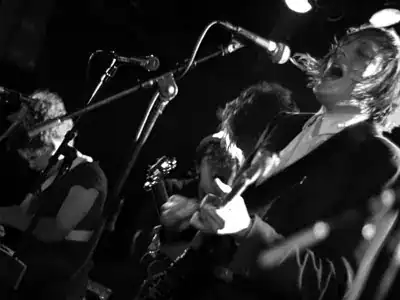
Arcade Fire – Indie Rock Collective and Late-Career David Bowie Collaborators
Photo: Unknown photographer / Wikimedia Commons / CC BY-SA 2.0 (editorial use)
Arcade Fire are a Canadian indie rock collective whose emotionally expansive sound and communal stage presence earned the admiration of David Bowie during the later years of his career. Their connection was rooted in mutual artistic respect and culminated in shared live performances, public endorsement and lasting artistic dialogue.
Bowie reportedly regarded Arcade Fire as one of the most vital bands of their era, recognising in their work a continuation of art-rock ideals he had long championed.
- Formed: 2001, Montreal, Canada
- Genres: Indie rock, art rock, baroque pop
- Key members: Win Butler, Régine Chassagne
- Bowie connection: Live performances, public endorsement, “Reflektor” era link
Rise of Arcade Fire
Arcade Fire emerged in the early 2000s with a sound combining indie rock, orchestral arrangements and emotionally expansive songwriting. Albums such as Funeral, Neon Bible and The Suburbs established them among the defining bands of their generation.
Their mix of intimacy, scale and communal performance resonated strongly with Bowie’s own long-standing interest in art-driven popular music.
David Bowie’s admiration
David Bowie publicly praised Arcade Fire on several occasions, citing their ambition, emotional force and refusal to conform to genre limitations. His endorsement carried unusual weight and placed the band within a lineage of adventurous art-rock.
Bowie was an early champion of Funeral, and his admiration was visible long before they shared a stage.
Fashion Rocks 2005 – Live with David Bowie
David Bowie & Arcade Fire — “Wake Up” at Fashion Rocks, 2005
On 8 September 2005, David Bowie made a surprise appearance alongside Arcade Fire at Fashion Rocks in Radio City Music Hall, New York, joining the band for a powerful performance of Wake Up.
The appearance was widely seen as a symbolic passing of artistic recognition from one generation to another. Bowie’s public endorsement of Arcade Fire carried unusual significance, especially given how selective he had become about live appearances.
It remains one of the most memorable guest performances of Bowie’s late career.
Further connections
Bowie also appeared with Arcade Fire at other notable events, including the 2005 CMJ Music Marathon and the 2007 Keep A Child Alive Black Ball, reinforcing that their relationship extended beyond a single celebrated moment.
Bowie and Reflektor
The connection continued into the Reflektor era. Bowie is widely associated with backing vocal contributions on the title track, deepening the relationship between the band and one of their most vocal champions.
Whether on stage or in the studio orbit, the mutual admiration remained evident.
Mutual artistic values
Both Bowie and Arcade Fire shared an interest in theatrical presentation, collective identity and performance as emotional narrative. That common ground explains the natural affinity between Bowie and the band despite belonging to different eras.
Both also treated rock music as something capable of myth, ritual and social commentary.
Legacy within Bowie’s story
Arcade Fire occupy a unique place in David Bowie’s later-career story. Rather than traditional collaborators, they were artists Bowie actively championed — seeing in their work part of the future of ambitious rock music.
Their connection stands as one of Bowie’s most meaningful late-career artistic endorsements.